
Crypto: MoonPay and Ledger Want to Solve the Private Key Problem in Automated Trading

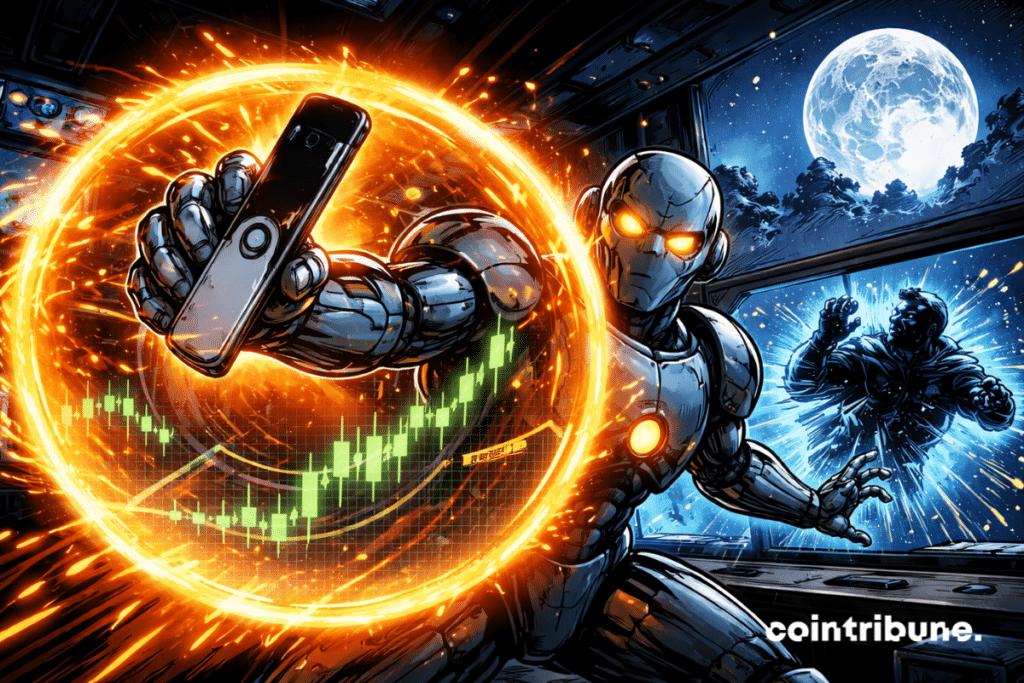
Automated trading by artificial intelligence is booming. However, it carries a well-known Achilles’ heel: the security of private keys. Two giants in the crypto sector have partnered to address this, and their solution could redefine industry standards.
In brief
- MoonPay integrates Ledger’s Secure Element technology into its AI-powered crypto agents.
- Private keys remain stored in an offline hardware environment, inaccessible to the Internet.
- Programmable safeguards strictly limit the transactions the agent can execute.
A critical flaw in crypto trading finally fixed at the hardware level
MoonPay officially announced its integration this week with the hardware security modules of Ledger. The goal is clear: to protect AI agents that autonomously execute on-chain transactions, a vulnerability never before resolved at the hardware level.
The problem is called the “hot wallet dilemma.” To function, an AI agent needs continuous access to private keys.
Storing them in an environment connected to the Internet is to offer a gateway to hackers, malware, or even faulty AI models.
With this integration, the architecture changes completely. The AI analyzes and prepares transactions. However, the private keys remain in Ledger’s secure element, an offline hardware environment. They never touch the Internet. The signature is made inside the chip and does not leave it.
Two features further strengthen this protection:
- Programmable safeguards: the user defines strict rules upfront, for example, only exchange USDC for SOL, or cap each transaction at $500. The agent can only sign what respects these parameters. Even a compromised AI model cannot empty a crypto wallet.
- Intent-based execution: the user gives a simple goal (“buy $100 of this token on Base”), and the agent handles cross-chain bridging alone in a secure step.
A threat context that makes this partnership urgent
The announcement comes at a particularly sensitive moment. Ledger’s Donjon research team revealed this week a critical flaw on Android, allowing malicious apps to steal recovery phrases in seconds. A real-time demonstration of why software security alone no longer suffices.
Circle’s figures highlight the stakes: 98.6% of financial transactions between AI agents recorded at the start of 2026 were settled in USDC, totaling over 140 million operations. Autonomous trading is not a future scenario; it is already massive.
To complete this infrastructure, Worldcoin launched its Face Auth feature on March 11, allowing verification of a transaction initiator’s humanity via facial recognition, without storing any biometric data. An authentication layer added above the execution layer.
Three pillars thus emerge for secure autonomous trading: protected keys in hardware, transactions governed by programmable rules, and human identity verified at authorization. The $63 million lost this week in poorly structured transactions illustrates what happens in their absence.
In short, the MoonPay-Ledger partnership represents one of the first concrete implementations of this secure stack. In a sector where AI already manages hundreds of millions of transactions, it is no longer an option; it is a necessity.
Maximize your Cointribune experience with our "Read to Earn" program! For every article you read, earn points and access exclusive rewards. Sign up now and start earning benefits.
Disclaimer: The content of this article solely reflects the author's opinion and does not represent the platform in any capacity. This article is not intended to serve as a reference for making investment decisions.
You may also like
US stock retail funds are flowing back into tech stocks; JPMorgan: Nvidia (NVDA.US) attracted $834 million last week, storage chip stocks are in favor
The latest research report released by JP Morgan shows that as the US stock market enters October, retail investors' trading sentiment has begun to improve, and funds are flowing back into the technology sector.
Top 3 Crypto Coins to Buy in October — ETH, SOL, SUI
Cathie Wood Just Declared That “The Turnaround for Bitcoin Has Occurred”

US Midterm Elections Enter Final Stretch: AI Regulation, Medical Subsidies, and Defense Budget Become Wall Street's Three Main Trading Themes—Which Sectors Are Most at Risk?
As the US midterm election campaigns enter the final month of intense competition, AI regulation and government spending in the medical and defense sectors are becoming the primary focus for stock investors.
Crypto prices
More


