Bitget App
Trade smarter
Buy cryptoMarketsTradeFuturesStocksEarnInstitutionAI & More
XRP ETF Posts $6M Outflow While Bitcoin ETFs Attract Inflows

XRP ETF Posts $6M Outflow While Bitcoin ETFs Attract Inflows

BitcoininfonewsBitcoininfonews2026/03/13 02:15
By:Bitcoininfonews
Crypto News · Uncategorized

XRP ETF Posts $6M Outflow While Bitcoin ETFs Attract Inflows

U.S. spot XRP exchange-traded funds posted a net outflow of $6.0806 million in a single day, extending a withdrawal streak that has drained over $44 million from the funds since early March. The selling contrasts sharply with Bitcoin ETFs, which absorbed $115 million in a single session this week as institutional capital gravitates back toward the original cryptocurrency.

WHAT TO KNOW

  • XRP spot ETFs have shed roughly $44.76 million since March 5, though cumulative inflows since launch remain at $1.24 billion across seven funds.
  • Bitcoin ETFs reversed five months of outflows in March, pulling in nearly $700 million and widening the institutional preference gap over altcoin products.

March Outflows Hit $44.76 Million Across Seven XRP Funds

The $6.08 million withdrawal adds to a pattern of persistent redemptions that began March 5. shows seven U.S. XRP spot ETFs now manage approximately $1 billion in assets, with 784.6 million XRP tokens locked.

The heaviest single-day outflow this month hit $18.11 million on March 9, marking the third consecutive day of net withdrawals. On March 6, 21Shares Core XRP Trust led outflows with $10.60 million, followed by Bitwise XRP ETF at $3.65 million and Grayscale XRP Trust at $2.37 million.

Despite the March selling, cumulative net inflows since the funds launched remain at $1.24 billion. The $44.76 million withdrawn represents roughly 3.6% of total inflows, a modest pullback relative to the asset base.

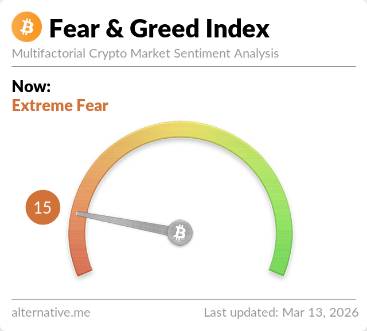
The broader crypto Fear & Greed Index sat at 15 on March 13, deep in “Extreme Fear” territory. That reading has held below 20 for the past month, reflecting sustained risk aversion across digital asset markets.
window.sevioads = window.sevioads || []; var sevioads_preferences = []; sevioads_preferences[0] = {}; sevioads_preferences[0].zone = "69ae91bf-aacd-4f88-a90c-1f61a5594da5"; sevioads_preferences[0].adType = "banner"; sevioads_preferences[0].inventoryId = "d91d4808-9159-4fa7-8f5e-bc80894381cd"; sevioads_preferences[0].accountId = "ad82357c-af89-4cb2-ad76-470425cadd81"; sevioads.push(sevioads_preferences);
XRP ETF Posts $6M Outflow While Bitcoin ETFs Attract Inflows image 0 Crypto Fear & Greed Index at 15 (Extreme Fear). Source: Alternative.me

Bitcoin ETFs Absorb $700M in March While Altcoin Products Bleed

The divergence between Bitcoin and XRP ETF flows underscores where institutional conviction lies during periods of stress. U.S. spot Bitcoin ETFs attracted roughly $700 million in March, ending a five-month streak of withdrawals that had drained $3.8 billion from the products since October 2025.

On a single day this week, Bitcoin ETFs logged $115 million in net inflows, with BlackRock’s IBIT leading allocations. The return of institutional capital to Bitcoin, rather than altcoin products, reinforces a pattern seen across multiple ETF volatility cycles. When fear rises, money flows toward the asset with the deepest liquidity and longest track record.

XRP traded at $1.41 at press time, up 2.54% over 24 hours but still 62% below its all-time high of $3.65 reached in July 2025. Roughly 60% of XRP holders remain underwater at current prices, creating persistent break-even selling pressure near the $1.44 level.

$738 Million in Exchange Outflows Contradicts ETF Selling

While ETF investors pulled capital, on-chain data tells a different story. On March 10, $738 million worth of XRP was withdrawn from major exchanges, a move typically associated with long-term holders transferring tokens to cold storage.

The divergence between ETF outflows and exchange withdrawals suggests two distinct groups acting in opposite directions. Institutional investors trimming regulated ETF exposure appear to be selling into accumulation by larger holders who prefer direct custody, a dynamic that previously supported XRP sentiment during earlier capital rotations.

Bitcoin Network Fundamentals Hold at 944 EH/s

Bitcoin’s network health provides context for the institutional preference shift. Hashrate stands at approximately 944.5 EH/s, near all-time highs, with network difficulty at 145 trillion. Miners continue committing hardware despite compressed revenue margins.

Transaction fees on Bitcoin’s base layer sit at 3 sat/vB for priority confirmation, reflecting low mempool congestion. Record-high hashrate paired with minimal fee pressure signals a healthy, uncongested network, the kind of stability institutional allocators weigh when choosing between Bitcoin and altcoin exposure.

Bitcoin itself traded at $71,967, supported by the ETF inflow reversal and steady corporate treasury accumulation including MicroStrategy’s recent 1,360 BTC purchase disclosed in an SEC filing.

Outlook: Redemption Pace Slows, but Macro Headwinds Persist

The $6.08 million outflow is notably smaller than the $18.11 million and $16.62 million withdrawals recorded earlier in March, suggesting the pace of XRP ETF redemptions may be decelerating. Cumulative inflows of $1.24 billion across seven funds indicate the XRP ETF complex retains a substantial capital base.

Macro headwinds persist. Crude oil prices above $100 per barrel have driven broad risk-off positioning across speculative assets. With the Fear & Greed Index stuck in “Extreme Fear” below 20 for an entire month, a sustained reversal in ETF flows likely requires a catalyst beyond price stabilization alone.

For Bitcoin, the network tells a clearer story. Hashrate at 944 EH/s, fees near historic lows, and the return of ETF inflows suggest the protocol’s core value proposition continues to attract capital that altcoin products struggle to retain. Scarcity, decentralization, and growing institutional adoption remain Bitcoin’s distinguishing fundamentals.


0
0

Disclaimer: The content of this article solely reflects the author's opinion and does not represent the platform in any capacity. This article is not intended to serve as a reference for making investment decisions.

Understand the market, then trade.
Bitget offers one-stop trading for cryptocurrencies, stocks, and gold.
Trade now!

You may also like

Nasdaq Hits New High, Igniting Earnings Season Expectations! Citi Predicts Nearly 90% of Tech Stocks Will Deliver “Earnings Surprises”, with Nvidia and AMD Leading the Outperformance List

The latest quantitative research on earnings season released by Citigroup provides concrete evidence for this profit trend: the model predicts that 66.2% of Russell 1000 constituents will deliver positive earnings surprises (i.e., earnings exceeding market consensus expectations) and corresponding positive stock price return trajectories (i.e., Citigroup's model also predicts positive stock price return directions), significantly higher than last quarter's already strong 60.9%, reaching the highest level since Q4 2021.

智通财经•2026/10/08 10:58
Nasdaq Hits New High, Igniting Earnings Season Expectations! Citi Predicts Nearly 90% of Tech Stocks Will Deliver “Earnings Surprises”, with Nvidia and AMD Leading the Outperformance List

Analysis - European Dilemma Provides New Reason for Dollar Bulls to Remain Optimistic

The US dollar has risen 5% against the euro, with some investors expecting further strengthening. The options market has become strongly bearish on the euro, as concerns over France’s fiscal situation and political uncertainty are creating pressure points for the eurozone. Laura Matthews/Saqib Iqbal Ahmed, Reuters New York, October 8 – This fall, the dollar surged to an 18-month high, with the latest rally fueled by uncertainty across the Atlantic, prompting some investors to bet the dollar will appreciate further. Analysts say the dollar continues to receive support from high—and possibly rising—US interest rates, robust economic growth, and persistent inflation risks. However, broader pressure centered on France’s massive fiscal deficit, potentially spreading to Italy and the wider eurozone, is emerging as a primary driver for the dollar in the coming months. So far this year, the dollar has appreciated about 5% against the euro, boosting the dollar index .DXY, which measures the dollar’s strength against six major currencies, including the euro (its largest component). “The euro remains under pressure, limiting one of the main alternatives to the dollar,” said Yuuto Shinohara, Senior Investment Strategist at Mesirow Currency Management. Last week, the yield spread between French and German 10-year government bonds recorded its largest weekly increase in decades, while the Italy-Germany yield spread saw its biggest weekly surge since the pandemic. The euro EUR= was last at 1.1183, down 0.67% against the dollar. “The market is focused on countries that, due to political dysfunction, cannot restore sustainable fiscal trajectories,” said Karl Schamotta, Chief Market Strategist at Toronto’s Corpay. One concern is that the euro no longer receives much support from the European Central Bank’s hawkish signals. The ECB raised rates by 25 basis points in September—its second hike this year to counter energy-driven inflation—but the euro fell after the decision, as markets worried about the impact of future hikes on the economy. Typically, rising European bond yields support the euro, but the euro's muted response suggests investors are increasingly concerned about growth and fiscal risks. Rising energy prices could add further pressure. “Structurally, Europe is a major energy importer and is more manufacturing-dependent than the US. The impact is obvious: high energy prices will drag down the region,” said Benjamin Ford, a researcher at Macro Hive. Ford expects the euro to fall to $1.10 within the next month, nearly 2% lower than current levels. “The US medium-term outlook seems stronger, while Europe is more susceptible to shocks,” Ford said. Policy Missteps Investors are also weighing whether the ECB can continue fighting inflation without causing greater harm to already weakening economies. The eurozone inflation rate (link) exceeded expectations in September, and with energy costs surging, it may rise further in coming months, keeping pressure on the ECB to hike rates. “There’s clear asymmetric downside risk for the euro at present,” said Dan Tobon, Citi’s Head of G10 FX Strategy in New York. “One of the likeliest triggers is policy error—if the ECB overtightens at a time when markets can’t bear it.” Euro risk reversal for one-month options, which measures whether traders are paying more to hedge against euro losses than gains, hit its most bearish level since March last Friday, while the three-month indicator touched its lowest point since June 2024. Federal Reserve policymakers have signaled that inflation risks remain high, which has helped keep US Treasury yields at multi-year highs. “Yields continue to rise, and US rates have an absolute advantage over most developed markets,” Shinohara said. Federal funds futures show about an 84% chance of at least one more 25-basis-point hike by December. Although few strategists expect the dollar to surge dramatically from current levels, they note that US economic resilience, sustained high yields, and Europe’s unique risks continue to tilt the balance toward the dollar. “For now, this imbalance looks very unfavorable for Europe,” Citi’s Tobon said. (For the convenience of non-native English speakers, Reuters automates translation of its reports into several other languages. As automated translation may be flawed or lack necessary context, Reuters does not guarantee the accuracy of such translations. They are provided solely for the readers’ convenience, and Reuters accepts no liability for any damage or loss arising from use of automated translation.)

路透社•2026/10/08 10:11
Analysis - European Dilemma Provides New Reason for Dollar Bulls to Remain Optimistic