
Is Bitcoin price at risk if private credit breaks?

There is a growing risk that a looming crisis in the private credit market, fueled by rising redemptions and defaults, could spill over into Bitcoin (BTC) and crypto markets, according to analysts.
Key takeaways:
The $2 trillion private credit sector faces a crisis from defaults, redemptions, and limited oversight.
A liquidity crunch may force investors to sell readily accessible assets, like Bitcoin, first.
Historical crises show Fed interventions often lead to strong Bitcoin price rallies as a hedge against money supply expansion.
The private credit ticking time bomb?
The private credit sector, the non-bank lending sector that has grown to over $2 trillion from $500 billion in the past five years, is flashing warning signs of an impending crisis.
Fueled by low rates and investor hunger for high yields, it now rivals traditional banks but lacks the same oversight.
Related: Will Bitcoin crash if oil prices hit $100 per barrel?
In 2024, the International Monetary Fund (IMF) warned that the private credit sector “warranted closer watch,” adding:
“Rapid growth of this opaque and highly interconnected segment of the financial system could heighten financial vulnerabilities given its limited oversight.”
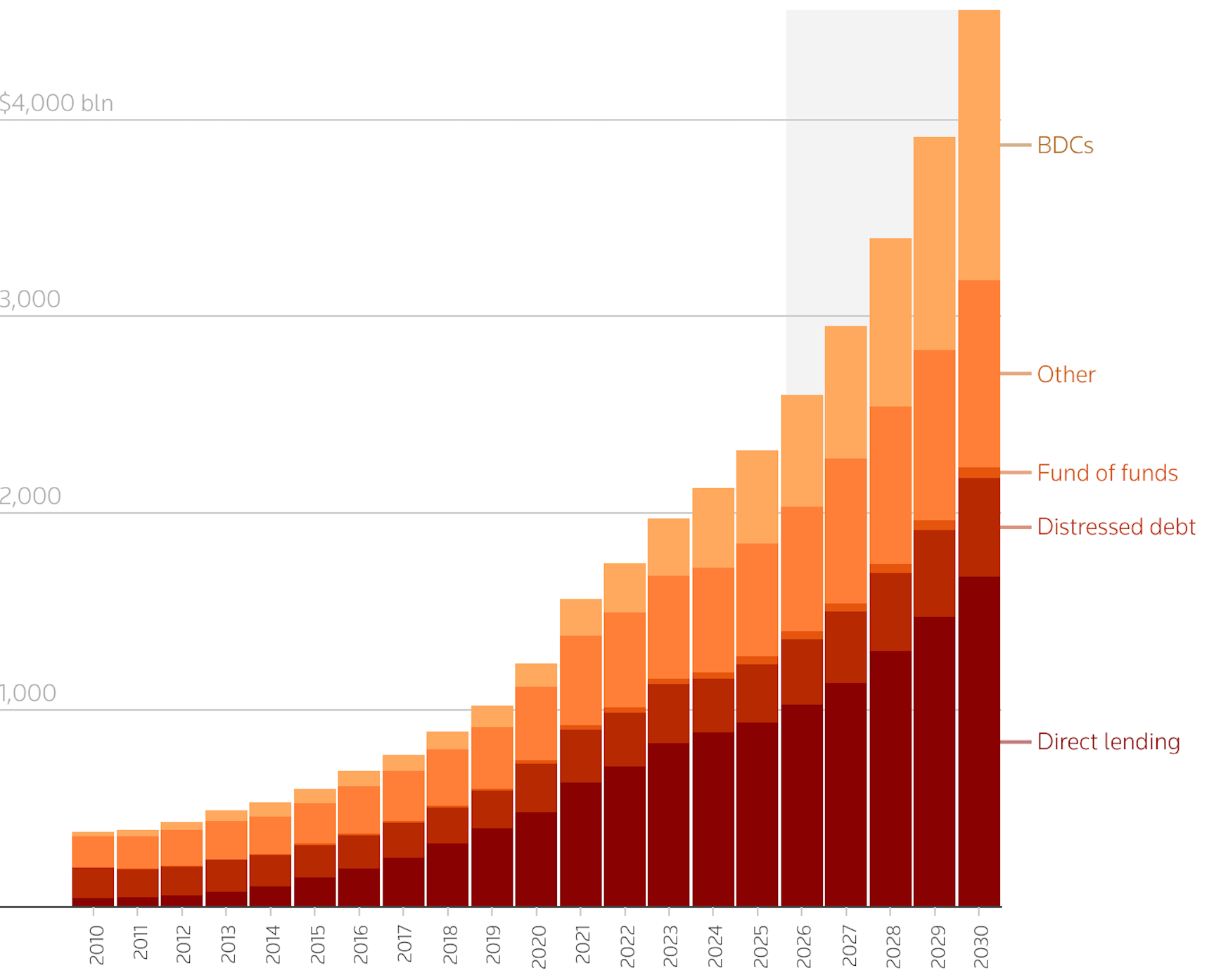 Private credit assets under management to double by 2030. Source: Preqin
Now, the private credit market shows cracks that threaten triggering a financial crisis.
BlackRock, the world's largest asset manager, with over $10 trillion under management, limited withdrawals from its $26 billion flagship credit funds, reported Bloomberg.
Blue Owl Capital halted redemptions amid software sector woes from AI disruptions, while UBS warns of default rates hitting 15% in worst-case scenarios.
On Wednesday, Reuters reported that JPMorgan restricted lending to its private credit funds while Morgan Stanley and Cliffwater Private Credit Fund joined the growing list of asset managers under distress.
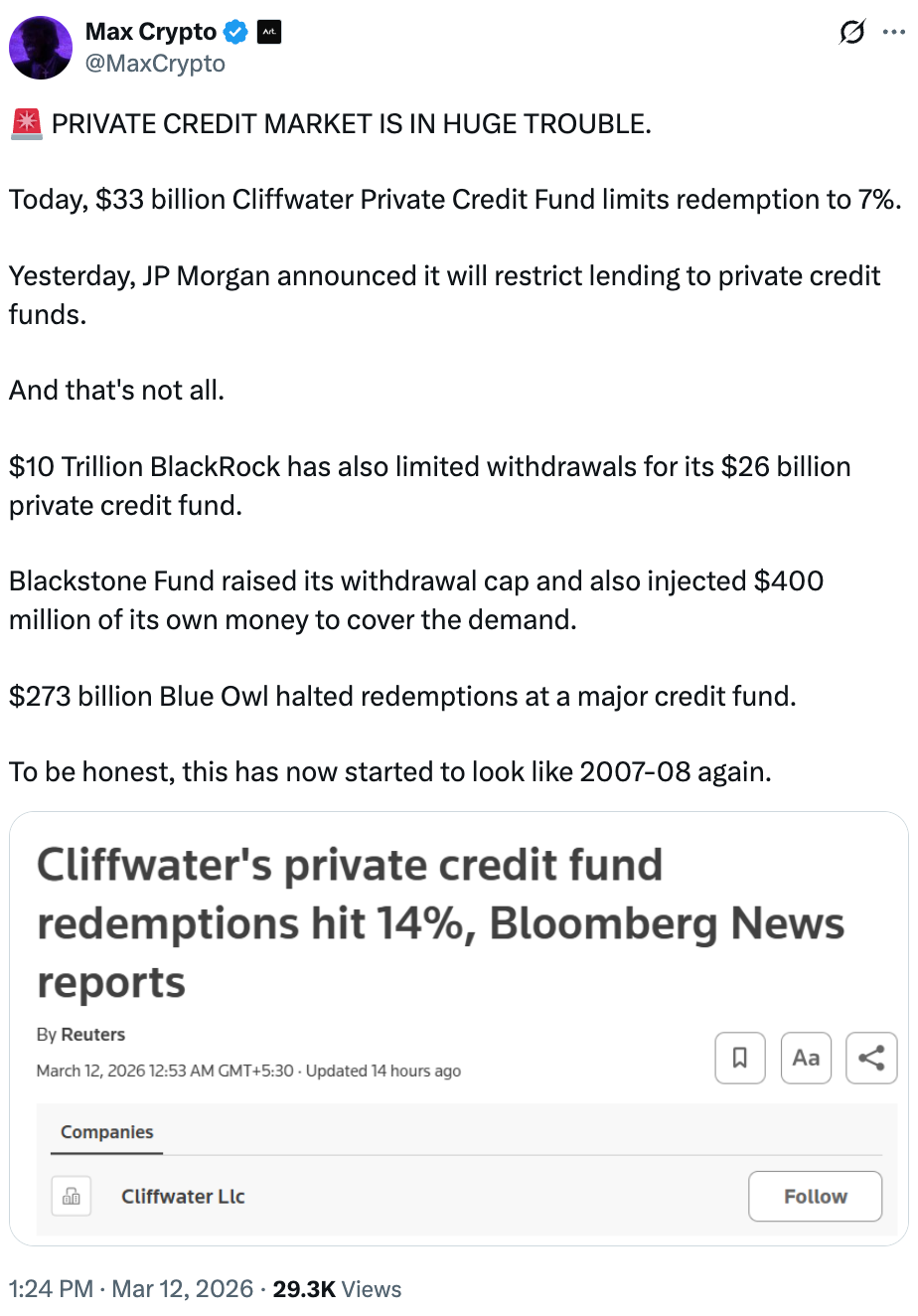 Source: X/Max Crypto
”Bond King” Jeffrey Gundlach, founder at Double Line said that the private credit fund of funds in 2026 closely mirrors CDO-squared in early 2007, before the 2008 global financial crisis.
“Financial repression is incoming,” market analyst MartyParty said in an X post on Thursday, attributing the problems to the sector’s rapid growth in the face of ‘increasing scrutiny’ over liquidity during periods of investor outflows.
“Either the Fed injects liquidity, or we go into crisis.”
Global conflict and macroeconomic uncertainties exacerbate this, potentially delaying Fed easing while putting pressure on equities and the Bitcoin price.
As Cointelegraph reported, futures markets are pricing less than a 1% chance of Fed rate cuts at the March 18 FOMC meeting.
Liquidity crunch could crash Bitcoin price, at first
While the withdrawal limitations directly affect the private credit market, the implications extend far beyond traditional finance.
Withdrawal limits are a “big deal for crypto,” crypto investor Paul Barron said in a recent post on X, adding:
“When giants like Blackrock lock the gates on private funds, it signals a ‘liquidity crunch.’ Investors stuck in private credit might sell their ‘liquid’ assets (Bitcoin/ETH) to raise cash elsewhere.”
This means that if investors cannot access funds from illiquid private credit portfolios, they may turn to assets that can be sold instantly in public markets.
Bitcoin, which trades 24/7, often serves as the first pressure valve. Its price dropped sharply by 50% in March 2020 as the market priced in the COVID-19 crisis.
But this usually forces government interventions: emergency liquidity injections and rate cuts, aimed at averting systemic collapse.
In 2020, Fed actions post-crash fueled Bitcoin’s surge to its previous all-time high of $69,000 by year-end from $4,400, a 1,400% rally.
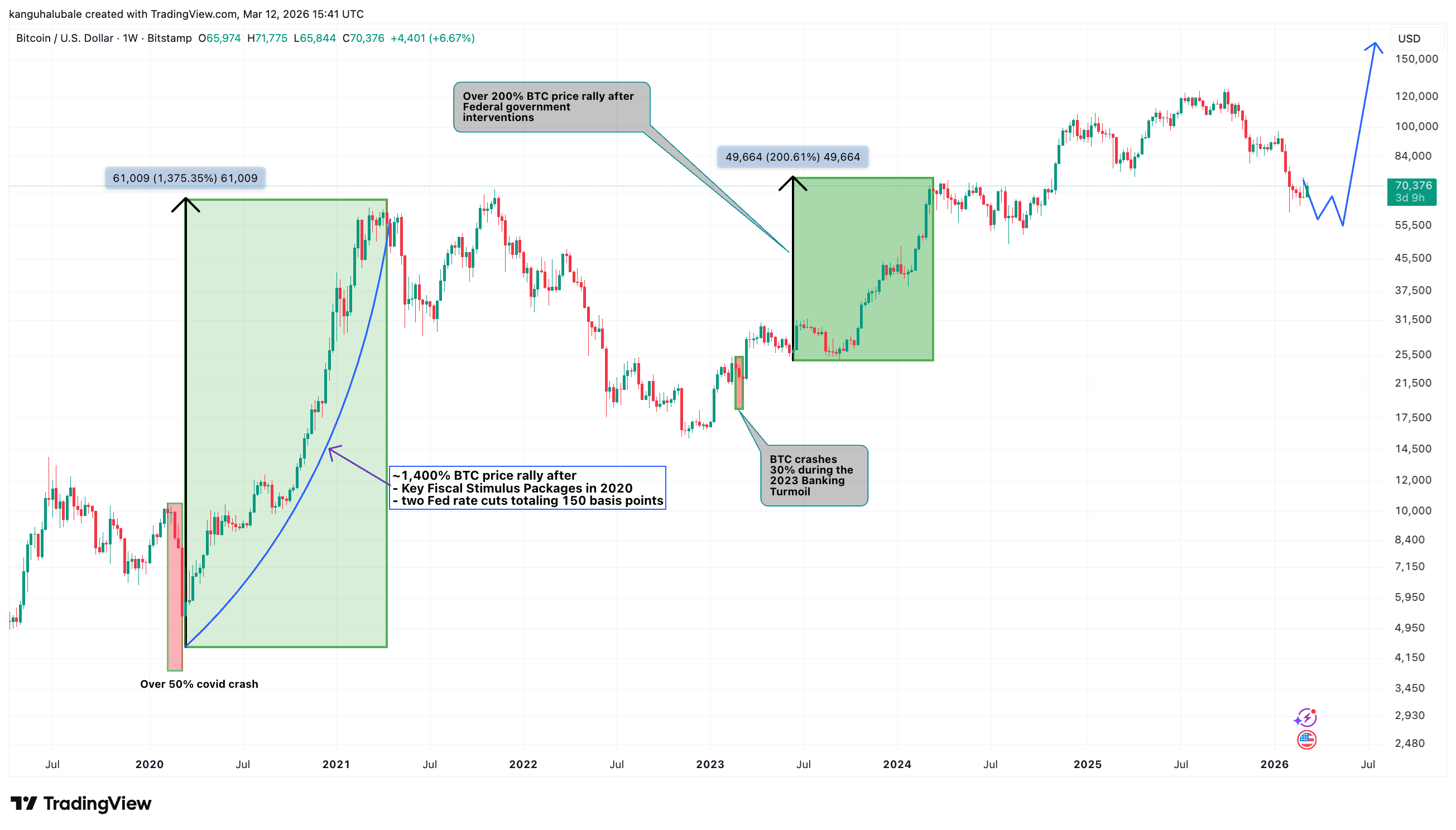 BTC/USD weekly chart. Source: Cointelegraph/
TradingView
BTC/USD weekly chart. Source: Cointelegraph/
TradingView
Similarly, during the March 2023 banking turmoil, Bitcoin initially sold off on contagion fears, then rallied more than 200% as markets priced in a Fed pause on rate hikes.
This suggests that a private credit breakdown might ultimately result in the further expansion of the money supply, sending BTC price to new highs.
As Cointelegraph reported, BitMEX co-founder Arthur Hayeshe will wait untill until the Fed loosens its monetary policy before buying any more Bitcoin. BTC price will then rise to $250,000, he predicted.
Disclaimer: The content of this article solely reflects the author's opinion and does not represent the platform in any capacity. This article is not intended to serve as a reference for making investment decisions.
You may also like
Analysis - European Dilemma Provides New Reason for Dollar Bulls to Remain Optimistic
The US dollar has risen 5% against the euro, with some investors expecting further strengthening. The options market has become strongly bearish on the euro, as concerns over France’s fiscal situation and political uncertainty are creating pressure points for the eurozone. Laura Matthews/Saqib Iqbal Ahmed, Reuters New York, October 8 – This fall, the dollar surged to an 18-month high, with the latest rally fueled by uncertainty across the Atlantic, prompting some investors to bet the dollar will appreciate further. Analysts say the dollar continues to receive support from high—and possibly rising—US interest rates, robust economic growth, and persistent inflation risks. However, broader pressure centered on France’s massive fiscal deficit, potentially spreading to Italy and the wider eurozone, is emerging as a primary driver for the dollar in the coming months. So far this year, the dollar has appreciated about 5% against the euro, boosting the dollar index .DXY, which measures the dollar’s strength against six major currencies, including the euro (its largest component). “The euro remains under pressure, limiting one of the main alternatives to the dollar,” said Yuuto Shinohara, Senior Investment Strategist at Mesirow Currency Management. Last week, the yield spread between French and German 10-year government bonds recorded its largest weekly increase in decades, while the Italy-Germany yield spread saw its biggest weekly surge since the pandemic. The euro EUR= was last at 1.1183, down 0.67% against the dollar. “The market is focused on countries that, due to political dysfunction, cannot restore sustainable fiscal trajectories,” said Karl Schamotta, Chief Market Strategist at Toronto’s Corpay. One concern is that the euro no longer receives much support from the European Central Bank’s hawkish signals. The ECB raised rates by 25 basis points in September—its second hike this year to counter energy-driven inflation—but the euro fell after the decision, as markets worried about the impact of future hikes on the economy. Typically, rising European bond yields support the euro, but the euro's muted response suggests investors are increasingly concerned about growth and fiscal risks. Rising energy prices could add further pressure. “Structurally, Europe is a major energy importer and is more manufacturing-dependent than the US. The impact is obvious: high energy prices will drag down the region,” said Benjamin Ford, a researcher at Macro Hive. Ford expects the euro to fall to $1.10 within the next month, nearly 2% lower than current levels. “The US medium-term outlook seems stronger, while Europe is more susceptible to shocks,” Ford said. Policy Missteps Investors are also weighing whether the ECB can continue fighting inflation without causing greater harm to already weakening economies. The eurozone inflation rate (link) exceeded expectations in September, and with energy costs surging, it may rise further in coming months, keeping pressure on the ECB to hike rates. “There’s clear asymmetric downside risk for the euro at present,” said Dan Tobon, Citi’s Head of G10 FX Strategy in New York. “One of the likeliest triggers is policy error—if the ECB overtightens at a time when markets can’t bear it.” Euro risk reversal for one-month options, which measures whether traders are paying more to hedge against euro losses than gains, hit its most bearish level since March last Friday, while the three-month indicator touched its lowest point since June 2024. Federal Reserve policymakers have signaled that inflation risks remain high, which has helped keep US Treasury yields at multi-year highs. “Yields continue to rise, and US rates have an absolute advantage over most developed markets,” Shinohara said. Federal funds futures show about an 84% chance of at least one more 25-basis-point hike by December. Although few strategists expect the dollar to surge dramatically from current levels, they note that US economic resilience, sustained high yields, and Europe’s unique risks continue to tilt the balance toward the dollar. “For now, this imbalance looks very unfavorable for Europe,” Citi’s Tobon said. (For the convenience of non-native English speakers, Reuters automates translation of its reports into several other languages. As automated translation may be flawed or lack necessary context, Reuters does not guarantee the accuracy of such translations. They are provided solely for the readers’ convenience, and Reuters accepts no liability for any damage or loss arising from use of automated translation.)

Privacy coins: the missing layer between crypto and institutions
Altcoin NEAR Pumps by Over 6% as the Rest of the Crypto Market Bleeds, Next Bull Target for NEAR Soon?
Crypto prices
More


