
Crypto : American Justice Opposes a New Trial for Sam Bankman-Fried

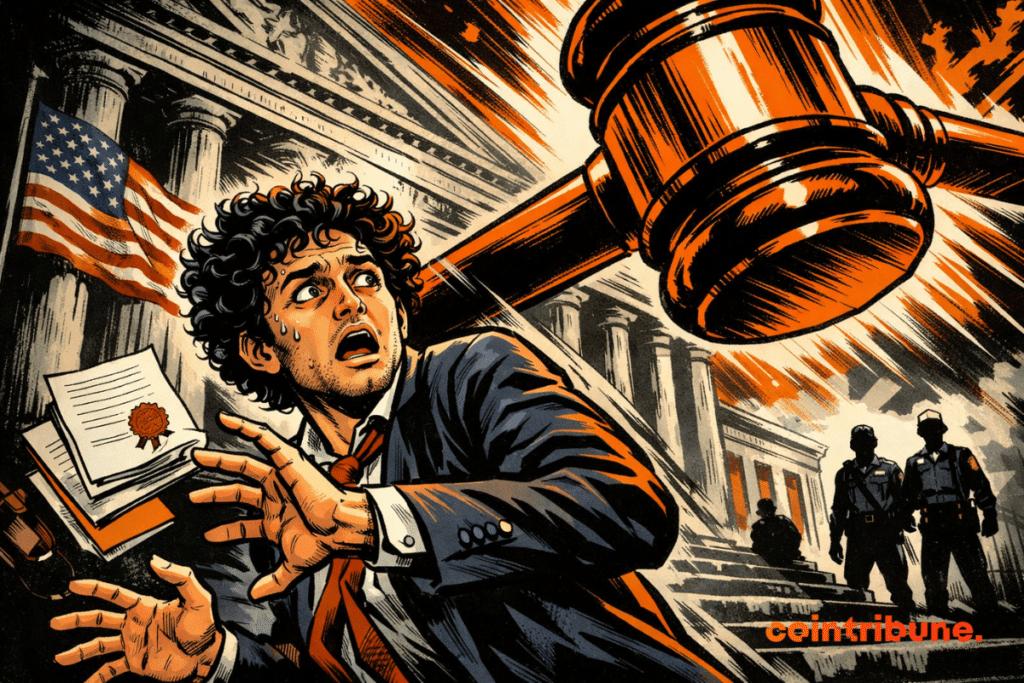
Sam Bankman-Fried faces another setback in the United States. Federal prosecutors ask the judge to reject his new trial request, arguing that the elements presented by the former FTX boss do not meet the required legal criteria. This new stage confirms one simple thing: despite appeals, the criminal case of one of the biggest fallen figures in crypto remains tightly locked.
In brief
- American prosecutors want to have Sam Bankman-Fried’s new trial request dismissed.
- They believe the witnesses cited by the defense do not provide truly new evidence.
- The FTX case remains a harsh reminder of governance risks in crypto.
A New Trial Request Already Weakened
The core of the debate is quite clear. Sam Bankman-Fried argues that new testimonies could weaken the prosecution’s thesis on the real state of the FTX crypto platform before its collapse. His defense notably cites Ryan Salame and Daniel Chapsky, two former executives linked to the FTX ecosystem. This step comes as his parents reportedly conducted a support campaign among the Republican camp.
But the prosecution responds that these witnesses are not “new” in the sense of American law. According to the prosecutors, the defense already knew of their existence before the 2023 trial. In other words, Bankman-Fried attempts to repackage already identified elements as “newly discovered evidence,” which greatly complicates his case.
From a judicial standpoint, this detail matters a lot. A new trial is not granted because a defense believes, in hindsight, that it could have better used certain witnesses. It is necessary to show that these elements were actually unavailable before and that they could have changed the verdict outcome. It is precisely here that SBF’s request seems to lose credibility.
The Unchanged Weight of the FTX Conviction
This setback occurs in an already very unfavorable context for the former FTX boss. In November 2023, a jury found him guilty of seven charges related to fraud and conspiracy. In March 2024, he was sentenced to 25 years in prison for embezzling billions of dollars of client funds within FTX and Alameda Research.
The important point for the crypto sector lies elsewhere. The Bankman-Fried case is no longer just about a platform that fell too quickly. It has become a judicial symbol. American authorities want to show that a star crypto leader receives no special treatment when internal management turns to fraud. This logic also explains the current firmness of the prosecution. It is a continuity, not a surprise.
Even his appeal procedure follows this tension line. Bankman-Fried continues to contest his conviction before the federal appellate court of the second circuit. But between the appeal and the attempt for a new trial, his strategy mainly looks like a battle on multiple fronts, with little political or judicial space for a quick reversal.
An Even More Damaged Public Image
The other dimension of the case is political. For several months, speculations have circulated around a possible presidential pardon. They have resumed after public statements perceived as favorable to Donald Trump and his line on crypto. However, nothing concrete has emerged publicly, and the path remains highly speculative.
This context weighs on his image. In the crypto world, Sam Bankman-Fried once embodied rapid success, aggressive lobbying, and the promise of a more sophisticated digital finance. Today, he mostly represents the opposite excess: opaque governance, confusion between client assets and internal bets, followed by a legal defense under permanent pressure.
There is a broader lesson here for the market. Major crypto scandals do not die with a company’s bankruptcy. They survive in courts, in regulation, and in investors’ memory. Each new judicial setback of SBF reminds that rebuilding trust takes far longer than a bullish cycle.
Maximize your Cointribune experience with our "Read to Earn" program! For every article you read, earn points and access exclusive rewards. Sign up now and start earning benefits.
Disclaimer: The content of this article solely reflects the author's opinion and does not represent the platform in any capacity. This article is not intended to serve as a reference for making investment decisions.
You may also like
Analysis - European Dilemma Provides New Reason for Dollar Bulls to Remain Optimistic
The US dollar has risen 5% against the euro, with some investors expecting further strengthening. The options market has become strongly bearish on the euro, as concerns over France’s fiscal situation and political uncertainty are creating pressure points for the eurozone. Laura Matthews/Saqib Iqbal Ahmed, Reuters New York, October 8 – This fall, the dollar surged to an 18-month high, with the latest rally fueled by uncertainty across the Atlantic, prompting some investors to bet the dollar will appreciate further. Analysts say the dollar continues to receive support from high—and possibly rising—US interest rates, robust economic growth, and persistent inflation risks. However, broader pressure centered on France’s massive fiscal deficit, potentially spreading to Italy and the wider eurozone, is emerging as a primary driver for the dollar in the coming months. So far this year, the dollar has appreciated about 5% against the euro, boosting the dollar index .DXY, which measures the dollar’s strength against six major currencies, including the euro (its largest component). “The euro remains under pressure, limiting one of the main alternatives to the dollar,” said Yuuto Shinohara, Senior Investment Strategist at Mesirow Currency Management. Last week, the yield spread between French and German 10-year government bonds recorded its largest weekly increase in decades, while the Italy-Germany yield spread saw its biggest weekly surge since the pandemic. The euro EUR= was last at 1.1183, down 0.67% against the dollar. “The market is focused on countries that, due to political dysfunction, cannot restore sustainable fiscal trajectories,” said Karl Schamotta, Chief Market Strategist at Toronto’s Corpay. One concern is that the euro no longer receives much support from the European Central Bank’s hawkish signals. The ECB raised rates by 25 basis points in September—its second hike this year to counter energy-driven inflation—but the euro fell after the decision, as markets worried about the impact of future hikes on the economy. Typically, rising European bond yields support the euro, but the euro's muted response suggests investors are increasingly concerned about growth and fiscal risks. Rising energy prices could add further pressure. “Structurally, Europe is a major energy importer and is more manufacturing-dependent than the US. The impact is obvious: high energy prices will drag down the region,” said Benjamin Ford, a researcher at Macro Hive. Ford expects the euro to fall to $1.10 within the next month, nearly 2% lower than current levels. “The US medium-term outlook seems stronger, while Europe is more susceptible to shocks,” Ford said. Policy Missteps Investors are also weighing whether the ECB can continue fighting inflation without causing greater harm to already weakening economies. The eurozone inflation rate (link) exceeded expectations in September, and with energy costs surging, it may rise further in coming months, keeping pressure on the ECB to hike rates. “There’s clear asymmetric downside risk for the euro at present,” said Dan Tobon, Citi’s Head of G10 FX Strategy in New York. “One of the likeliest triggers is policy error—if the ECB overtightens at a time when markets can’t bear it.” Euro risk reversal for one-month options, which measures whether traders are paying more to hedge against euro losses than gains, hit its most bearish level since March last Friday, while the three-month indicator touched its lowest point since June 2024. Federal Reserve policymakers have signaled that inflation risks remain high, which has helped keep US Treasury yields at multi-year highs. “Yields continue to rise, and US rates have an absolute advantage over most developed markets,” Shinohara said. Federal funds futures show about an 84% chance of at least one more 25-basis-point hike by December. Although few strategists expect the dollar to surge dramatically from current levels, they note that US economic resilience, sustained high yields, and Europe’s unique risks continue to tilt the balance toward the dollar. “For now, this imbalance looks very unfavorable for Europe,” Citi’s Tobon said. (For the convenience of non-native English speakers, Reuters automates translation of its reports into several other languages. As automated translation may be flawed or lack necessary context, Reuters does not guarantee the accuracy of such translations. They are provided solely for the readers’ convenience, and Reuters accepts no liability for any damage or loss arising from use of automated translation.)

Privacy coins: the missing layer between crypto and institutions
Altcoin NEAR Pumps by Over 6% as the Rest of the Crypto Market Bleeds, Next Bull Target for NEAR Soon?
Crypto prices
More


