
BoE open to scrapping stablecoin limit idea after backlash

Bank of England Deputy Governor Sarah Breeden told UK lawmakers that the central bank is open to alternative ways to manage stablecoin risks other than imposing holding limits.
Speaking before the House of Lords Financial Services Regulation Committee on Wednesday, Breeden said the proposed holding limits are designed to prevent a mass migration of deposits from banks into stablecoins, arguing it could curtail lending and reduce credit availability for businesses and households.
“We are genuinely open to other ways of achieving the objective. I think you've heard from other people as part of your inquiry that this risk to the provision of credit is real.”
“We proposed holding limits as a way of managing that risk. We are open to feedback on other ways of achieving it. But I think you would expect us as the financial stability authority to ensure that there isn't a precipitous drop in credit to the businesses and households in the UK,” Breeden added.
Industry groups have criticized the proposed limits, floated at between 10,000 and 20,000 British pounds ($13,368 to $26,733), arguing it would signal that the UK is hostile to crypto and drive businesses offshore, while stifling innovation and undermining economic growth.
Self-custody wallets holding stablecoins not “permissible”
Last November, the Bank of England released a consultation paper outlining its proposed regulatory framework for sterling-denominated systemic stablecoins, inviting public feedback through Feb. 10.
The central bank flagged that it would continue monitoring the risks associated with unhosted wallets, such as reduced oversight of transactions.
However, Breeden ruled out self-custody wallets holding stablecoins, telling lawmakers that users holding stablecoins in self-custody wallets outside regulated entities such as exchanges won’t be covered by the UK’s regulatory regime.
“There is this concept of an unhosted wallet, you haven't got a wallet provider who is a regulated entity who is ensuring that AML [anti-money laundering] KYC [know your customer] criteria are complied with. Unhosted wallets will not be permissible in the UK; they are permissible in the US regime,” Breeden said.
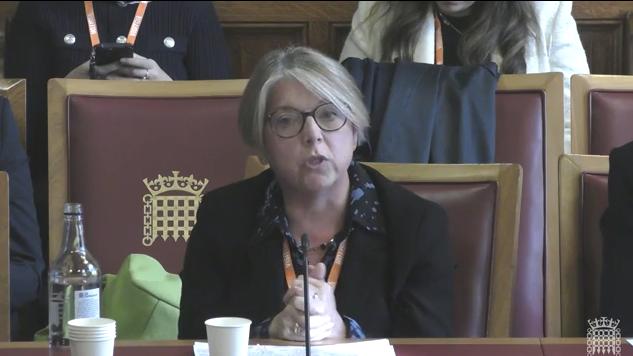 Bank of England Deputy Governor Sarah Breeden spoke to the House of Lords Financial Services Regulation Committee on Wednesday. Source:
UK Parliament
Bank of England Deputy Governor Sarah Breeden spoke to the House of Lords Financial Services Regulation Committee on Wednesday. Source:
UK Parliament
Sterling stablecoin applications will open before end of 2026
The Financial Conduct Authority, which regulates the UK financial services industry, has established a regulatory sandbox that will allow several firms to test stablecoin products and services in Q1 2026.
Even though the Bank of England is still consulting and finalizing rules for sterling stablecoins, companies can start applying to launch their coins before the end of 2026.
“I hear some say that the UK is behind. I simply don't recognize that. We'll be welcoming applications from stablecoin issuers by the end of this year,” Breeden said.
“On the substance of our regime, the guiding principle is that a stable coin used as money in the economy should be as robust as the money we use today issued by banks.”
Disclaimer: The content of this article solely reflects the author's opinion and does not represent the platform in any capacity. This article is not intended to serve as a reference for making investment decisions.
You may also like
CDS Soar Collectively, "SpaceX and Others" Still Borrowing Furiously! How Long Can the AI Debt Frenzy Last?
The wave of AI infrastructure debt is reshaping the global credit landscape at an unprecedented pace, with the technology industry's debt reaching $500 billion in the first nine months of this year. However, frequent alarms have been raised in the CDS market, US Treasury yields have climbed to 5.3%, the highest in over twenty years, and Dalio pointed out that this is a "classic bubble that will be burst by interest rates."
Is a major reversal in stock-bond allocation approaching? Bank of America issues rare signal: Bonds compete with stocks for capital for the first time in decades, S&P 500's return over the next ten years may be less than 5%
Savita Subramanian, Head of US Equity and Quantitative Strategy at Bank of America, said in an interview on Wednesday that the bond market is becoming attractive again and has, for the first time in decades, become a real competitor to the stock market.

Stop Using the Consumer Cycle to Analyze Micron (MU.US)! AI is Redefining NAND Logic, Enterprise SSDs Have Taken Over Pricing Power
Eudaemon Research previously assessed that within Micron's business structure, DRAM is more resilient than NAND, and that NAND prices and demand would return to normal faster. However, Micron's latest Q4 financial data has led them to revise this view: NAND is no longer a homogeneous market, and the supply-demand and pricing dynamics of consumer-grade NAND and enterprise-level data center SSDs are clearly diverging.
Micron's target price is significantly raised by investment banks, with a maximum of 3,000 USD
DA Davidson has raised Micron's target price to $3,000, implying a 176% upside from the current share price. The core logic is that the AI-driven memory supercycle will continue until 2028, with the supply-demand gap widening further. The key variable lies in the shift of demand—buyers are transitioning from smaller, high-default-risk clients to tech giants such as Amazon, Microsoft, and Google. Micron has already secured $150 billion in remaining contractual obligations.
Crypto prices
More


