
Due to profit-taking pressure from traders, gold and silver prices decline

FX Huitong Network, March 12—— On Wednesday (March 11) during the US trading session, gold and silver prices fell due to selling pressure from short-term futures traders taking profits. The stronger US Dollar Index during the day also acted as a bearish external market factor weighing on metal prices. Currently, spot gold prices have pulled back to around $5,161/ounce (a roughly 0.6% drop during the day, with intraday lows seen at $5,149), while spot silver prices are fluctuating in the range of about $85-$88/ounce (a larger intraday decline of about 3%-4%, with lows down to around $85).
On Wednesday (March 11) in the US trading session, gold and silver prices fell due to short-term futures traders taking profits, while the strong US Dollar Index was also a bearish external market factor weighing on metal prices. Currently, spot gold prices have pulled back to around $5,161/ounce (a roughly 0.6% drop during the day, with intraday lows seen at $5,149), while spot silver prices are oscillating in the range of about $85-$88/ounce (a larger intraday drop of about 3%-4%, touching lows near $85).
The US February Consumer Price Index (CPI) report released today basically met market expectations and did not have a significant impact on the metals market. In February, US CPI rose 0.3% month-on-month and 2.4% year-on-year; the core CPI excluding food and energy rose 0.2% month-on-month and 2.5% year-on-year. Market analysis: Inflation data is overall moderate, but the potential upside risk in energy prices (affected by geopolitical tensions) may gradually emerge over the coming months. The short-term direct impact on precious metals is limited.
From the perspective of key external markets, the US Dollar Index (DXY) moved higher during the day, currently trading near 99.00-99.30 (up about 0.3%-0.4% intraday); NYMEX crude oil futures prices are rising, with WTI crude currently trading around $86-$88 per barrel (intraday gains of about 3%-5%, with highs near $89), while Brent crude once approached $91-$92 per barrel. Benchmark 10-year US Treasury yields are currently around 4.15%-4.22% (slight increase, reflecting market adjustments to long-term inflation expectations).
Due to another attack on ships in the Strait of Hormuz (at least 3-5 merchant vessels attacked, with some reports of intensified Iranian mining operations), concerns about disruptions to oil supplies have intensified. Oil prices have risen by nearly 4%-5% (with even larger gains on some trading days, briefly approaching above $90). Analysts commented that the International Energy Agency’s (IEA) plan to release oil reserves (with what would be a record 400 million-barrel scale) is not enough to fully alleviate these concerns, as Iran’s continued blockade of the strait and threats to prevent "a single drop of oil" from passing through could result in actual supply interruptions of more than 15 million barrels/day—far more than the short-term cushioning of reserve releases. Iran has fired at Israeli and other Middle Eastern targets, stating that the world should prepare for oil prices reaching $200 per barrel. An Iranian military spokesperson warned that since regional security has deteriorated, oil prices will depend on this, stating, "Prepare for $200/barrel oil prices."
Analysts at Standard Chartered pointed out that in the context of strong cash demand, it is not uncommon for gold prices to come under pressure for several weeks. We maintain a bullish long-term outlook for gold and expect that, after short-term profit-taking, gold will continue its upward trend.
Zaner Metals Vice President and Senior Metals Strategist Peter Grant said: "The gold market seems to be caught in a tug-of-war between safe havens triggered by war and concerns over prolonged high interest rates."
Institutions such as Goldman Sachs and J.P. Morgan have recently reiterated that geopolitical risk premiums have already significantly lifted the bottom support for gold. If the Strait of Hormuz crisis drags on for more than 30 days, gold could retest the $5,400-$5,600 high range; conversely, if tensions ease in the short term, the short-term pullback target would focus on the psychological level of $5,000.
Technical Analysis
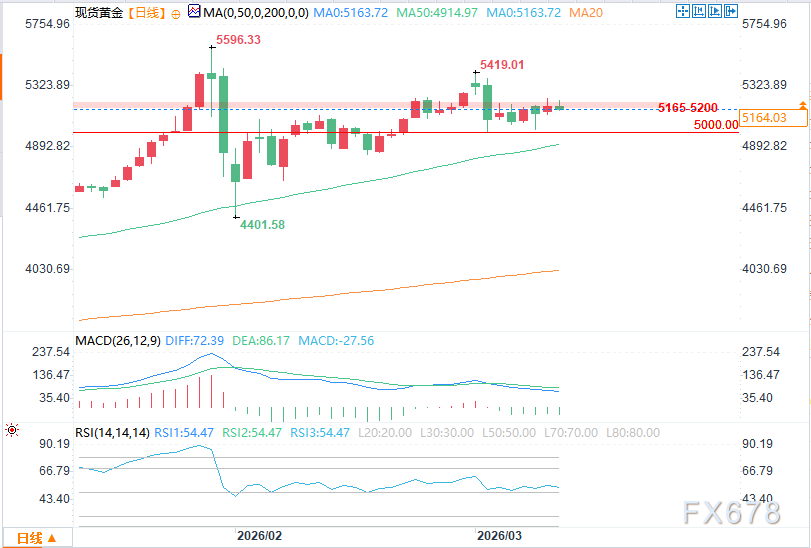
(Spot Gold Daily Chart Source: Yihuitong)
The daily chart of gold shows a short-term pattern of high-level consolidation and pullback, with $5,150-$5,100 as the key support zone (near the 50-day moving average) and $5,250-$5,300 as the initial resistance above. Silver appears even weaker, with the gold/silver ratio rising to about 60:1, indicating that industrial demand for silver is more obviously squeezed in the short term by high oil prices.
The market is currently highly focused on the March FOMC meeting (expected to keep rates unchanged) and US energy inventory data. Any sudden developments in the Middle East could trigger sharp volatility. In the long run, continued central bank gold buying (annual average expected to exceed 800 tons in 2025-2026) and expectations of renewed inflation acceleration remain solid supports for the structural bull market in gold.
Disclaimer: The content of this article solely reflects the author's opinion and does not represent the platform in any capacity. This article is not intended to serve as a reference for making investment decisions.
You may also like
Stop Using the Consumer Cycle to Analyze Micron (MU.US)! AI is Redefining NAND Logic, Enterprise SSDs Have Taken Over Pricing Power
Eudaemon Research previously assessed that within Micron's business structure, DRAM is more resilient than NAND, and that NAND prices and demand would return to normal faster. However, Micron's latest Q4 financial data has led them to revise this view: NAND is no longer a homogeneous market, and the supply-demand and pricing dynamics of consumer-grade NAND and enterprise-level data center SSDs are clearly diverging.
Micron's target price is significantly raised by investment banks, with a maximum of 3,000 USD
DA Davidson has raised Micron's target price to $3,000, implying a 176% upside from the current share price. The core logic is that the AI-driven memory supercycle will continue until 2028, with the supply-demand gap widening further. The key variable lies in the shift of demand—buyers are transitioning from smaller, high-default-risk clients to tech giants such as Amazon, Microsoft, and Google. Micron has already secured $150 billion in remaining contractual obligations.
Oil prices continue to surge, triggering inflation concerns; global stock markets under pressure, Korean stocks close down 2.6%, US Treasury yields rise
Brent crude oil rose about 2.5% on Thursday, surpassing the $102 per barrel mark. Driven by this surge, the U.S. 10-year Treasury yield climbed 3 basis points to 5.31%, approaching its highest level since 2002. Asian stock markets followed the downward trend of U.S. stocks on Wednesday, with an overall decline of 1.2%. Japan's Nikkei 225 closed down 1.4%, and South Korea's Seoul Composite Index plunged 2.6%.
Samsung Partners With Solana to Launch Crypto Stablecoin Payments for 82 Million Americans via Samsung Wallet
Crypto prices
More


