
Is Altseason Officially Dead? What the Data Is Telling Us Now

Crypto fans often rave about altseasons, a period when smaller cryptocurrencies () outperform Bitcoin. Many believed that once Bitcoin’s price rose, money would flow out of Bitcoin and into altcoins, but recently, it has felt different. Prices of many altcoins have lagged behind, and Bitcoin seems to be dominating headlines and capital inflows.

In this article, we’ll explore whether altcoin season is over or just delayed. We’ll look at the altcoin season index, Bitcoin dominance, market rotation, capital concentration, liquidity fragmentation, and crypto correlation trends. The data points to a changing market structure, which may explain why recent altseasons have seemed weaker than before.
What Is Altseason?
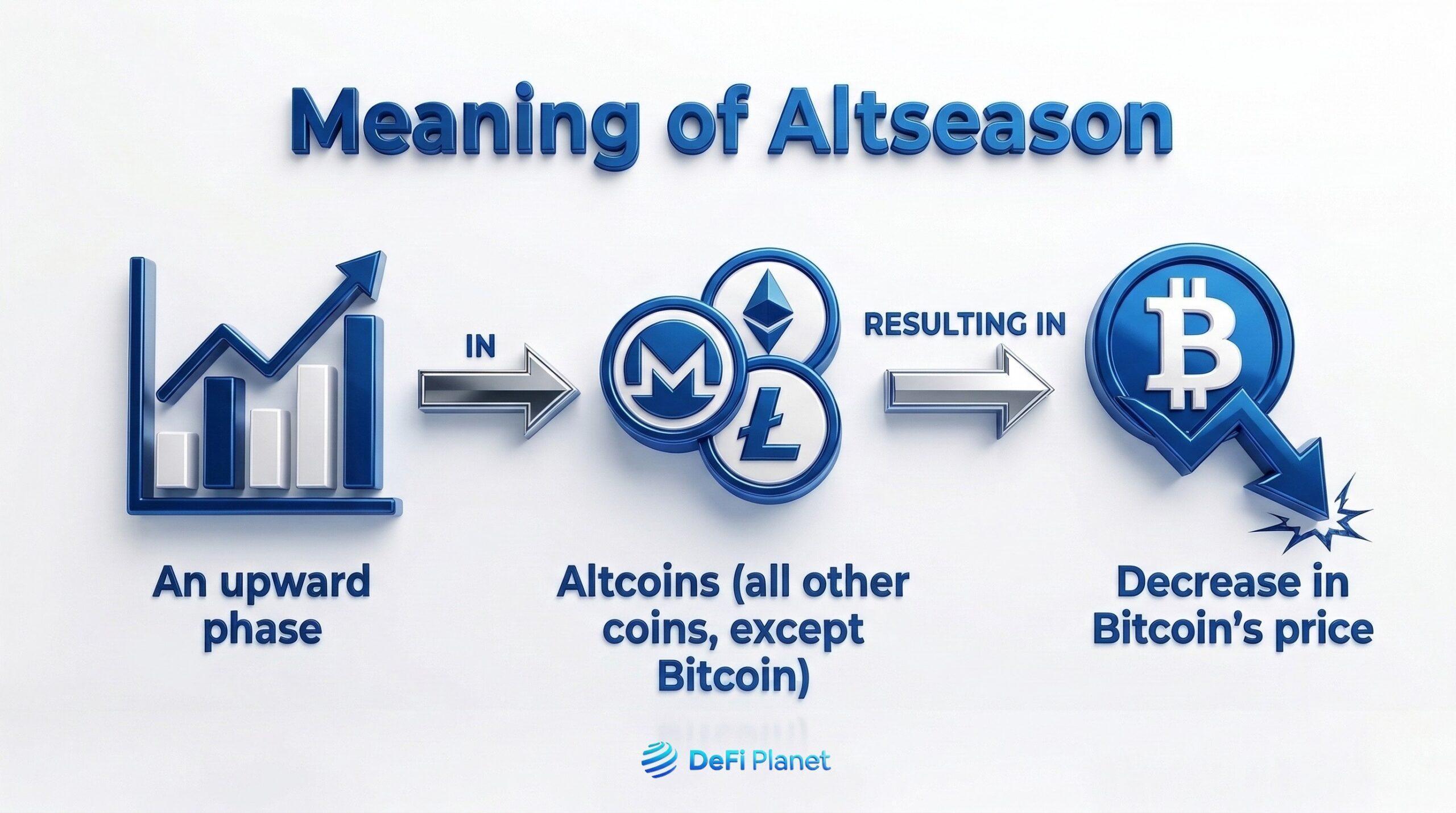 “Altseason” is a term traders use when altcoins outperform Bitcoin, and this means that the altcoin season index, which is a metric that compares the number of altcoins beating Bitcoin over a set period, rises above a certain level.
In past cycles, rising interest in DeFi, NFTs, or new blockchain ecosystems triggered that rotation, but this cycle has seen a very different pattern.
Bitcoin Dominance is Central to the Story
One of the clearest ways to measure market structure is Bitcoin dominance, which tracks Bitcoin’s share of the total crypto market value. If Bitcoin dominance rises, it means Bitcoin is capturing more capital relative to the rest of the market.
At several points in 2025 and early 2026, Bitcoin dominance climbed sharply even as altcoins were expected to rally, suggesting that capital is concentrated in Bitcoin rather than spreading across smaller assets.
This trend contrasts with previous cycles, in which Bitcoin peaked, and capital began rotating into altcoins. Analysts now point to Bitcoin’s dominance as a sign that institutions, wallets, and big investors prefer Bitcoin’s relative safety over more speculative altcoins. Strong inflows into Bitcoin exchange‑traded products compared with slower inflows into altcoin products support this observation.
Data shows that Bitcoin exchange‑traded funds (ETFs) have drawn significant capital since their launch, while products linked to altcoins like Ethereum or Solana receive comparatively smaller inflows. This contributes to Bitcoin dominance and reduces the relative upside for altcoins.
Market Rotation Crypto Patterns Have Changed
Traditionally, crypto markets go through a predictable market rotation crypto cycle: first Bitcoin rises, then large altcoins, then smaller-cap tokens. This happened in 2017 and again during parts of 2021.
However, this cycle has not played out the same way in recent years, and even when Bitcoin’s price paused or consolidated, altcoins failed to break out strongly. Instead, much of the trading volume remained concentrated in Bitcoin, and capital flowed into stable, well‑known assets, with Bitcoin tending towards another rotation.
There are many reasons for this shift, and one of them is the increasing participation of institutional investors who prefer assets that are perceived as safer. Another is the rise of products like Bitcoin and Ethereum ETFs that make it easier for traditional money to enter digital assets without touching smaller tokens.
Correlation Trends Undermine Traditional Cycles
Market analysts often look at crypto correlation trends to understand how assets move relative to each other, and in past cycles, altcoins sometimes decoupled from Bitcoin before a breakout. More recent data show that altcoins remain highly correlated with Bitcoin, meaning that when Bitcoin moves up, altcoins also move up, but usually less, and when Bitcoin moves down, altcoins often drop more.
When altcoins are highly correlated with Bitcoin, it’s harder for them to outperform. In a real altseason, this correlation usually drops as smaller tokens rally on their own, but that hasn’t happened much lately.
This stronger correlation suggests that the market is treating altcoins more like extensions of Bitcoin’s price action rather than independent assets with their own drivers.
Investor Behaviour Has Shifted
Investor behaviour has also changed this cycle, with new retail investors who entered crypto during earlier rallies now more cautious. They see Bitcoin as a longer‑term store of value or hedge against inflation, even though it is still volatile.
Institutions, pension funds, and family offices are increasingly comfortable with Bitcoin and, to some extent, Ethereum. They have, however, shown less appetite for smaller tokens unless there is a clear use case and strong fundamentals behind them. This behaviour further concentrates capital and slows rotation.
When wealth managers place capital into well‑known, regulated products linked to Bitcoin and Ethereum, that tends to reinforce Bitcoin dominance and reduce the capital available to push altcoins higher.
Could Altseason Come Back?
The simple answer is yes, but with conditions. For altseason to return in the classic sense, a few things would likely need to happen:
- Prices of major tokens like Bitcoin would need to stabilize
- Liquidity would need to spread back into smaller markets.
- Investor confidence in emerging tokens would have to improve
- Correlation trends would need to weaken so that smaller tokens move more independently.
These are not impossible, but they do not appear to be happening yet in the way that fueled earlier altseasons.
Conclusion: Not Dead, But Different
The evidence suggests not dead, but transformed, the crypto ecosystem has matured in ways that make traditional altseason conditions less likely without new catalysts. Capital is more concentrated, liquidity is fragmented, and correlation trends keep smaller tokens tied to Bitcoin’s performance.
If history teaches us anything, markets evolve, and this cycle may be less explosive in its altcoin action, but it may also lay the groundwork for smarter, more sustainable growth.
Understanding these dynamics helps set expectations, guide investment, and avoid disappointment. Altseason may come again, but it may not look like it did before.
Disclaimer: The content of this article solely reflects the author's opinion and does not represent the platform in any capacity. This article is not intended to serve as a reference for making investment decisions.
You may also like
Stop Using the Consumer Cycle to Analyze Micron (MU.US)! AI is Redefining NAND Logic, Enterprise SSDs Have Taken Over Pricing Power
Eudaemon Research previously assessed that within Micron's business structure, DRAM is more resilient than NAND, and that NAND prices and demand would return to normal faster. However, Micron's latest Q4 financial data has led them to revise this view: NAND is no longer a homogeneous market, and the supply-demand and pricing dynamics of consumer-grade NAND and enterprise-level data center SSDs are clearly diverging.
Micron's target price is significantly raised by investment banks, with a maximum of 3,000 USD
DA Davidson has raised Micron's target price to $3,000, implying a 176% upside from the current share price. The core logic is that the AI-driven memory supercycle will continue until 2028, with the supply-demand gap widening further. The key variable lies in the shift of demand—buyers are transitioning from smaller, high-default-risk clients to tech giants such as Amazon, Microsoft, and Google. Micron has already secured $150 billion in remaining contractual obligations.
Oil prices continue to surge, triggering inflation concerns; global stock markets under pressure, Korean stocks close down 2.6%, US Treasury yields rise
Brent crude oil rose about 2.5% on Thursday, surpassing the $102 per barrel mark. Driven by this surge, the U.S. 10-year Treasury yield climbed 3 basis points to 5.31%, approaching its highest level since 2002. Asian stock markets followed the downward trend of U.S. stocks on Wednesday, with an overall decline of 1.2%. Japan's Nikkei 225 closed down 1.4%, and South Korea's Seoul Composite Index plunged 2.6%.
Samsung Partners With Solana to Launch Crypto Stablecoin Payments for 82 Million Americans via Samsung Wallet
Crypto prices
More


