
Bitcoin ETFs add $251M as Goldman Sachs tops XRP ETF holders

US spot Bitcoin exchange-traded funds (ETFs) saw increased inflows on Tuesday, even as BTC dipped below $70,000.
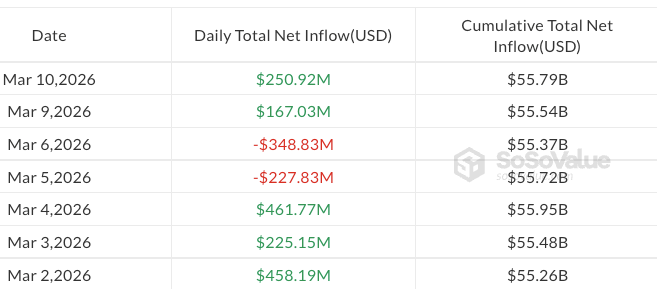
Spot Bitcoin (BTC) ETFs recorded $251 million in inflows, building on Monday’s $167 million in gains, according to SoSoValue data.
The inflows continue a positive trend in March, with cumulative monthly gains now at $1.56 billion versus $576.6 million in outflows.
The inflows came despite Bitcoin briefly falling to $69,400 on Tuesday. It traded at $69,810 at the time of writing, down 0.7% over the past 24 hours.
XRP selling eases as Goldman Sachs tops ETF holdings
Following a three-day outflow streak, some altcoins, including Ether (ETH), flipped into the positive territory, seeing minor inflows at $12.6 million. Solana (SOL) funds posted no inflows.
XRP (XRP) funds, by contrast, posted about $3.9 million in outflows, extending their selling streak to a fourth straight session, though the pace of redemptions eased from Monday’s larger withdrawals.

Bloomberg ETF analyst James Seyffart noted in a post on X that XRP ETFs have held up well despite the asset’s volatility. According to CoinGecko, XRP dropped around 5% over the past 30 days, trading at $1.38 at the time of writing.
Related: Spot Bitcoin ETFs post second straight weekly inflows for first time in 5 months
“They’ve taken in a cumulative $1.4 billion since launch,” Seyffart said, adding that Goldman Sachs emerged as the largest XRP ETF holder. As of Dec. 31, the investment bank held around $154 million in XRP ETFs, compared with $23 million and $5.3 million held by Millennium Management and Logan Stone Capital.

In another post on X, Seyffart provided a breakdown of four groups of ETFs, highlighting that XRP ETFs are largely driven by retail demand.

Only 15.9% of XRP ETF assets under management are reported in 13F filings, compared with 48.8% for SOL ETFs, which are more institutionally held. Bitcoin and Ether ETFs fall in between, with 24% and 27% of assets disclosed in filings, respectively.
Magazine: The debate over Bitcoin’s four-year cycle is over: Benjamin Cowen
Disclaimer: The content of this article solely reflects the author's opinion and does not represent the platform in any capacity. This article is not intended to serve as a reference for making investment decisions.
You may also like
How to view the current AI bubble? Industry leaders are fiercely debating
Novogratz said, "The bubble is not spectacular enough"; Dalio warned, "It's very close to bursting"; Taleb pointed out that the real risk lies in the bond market. Goldman Sachs data shows that AI stocks now account for 42% of the S&P 500's market capitalization, surpassing the peak of the 1999 tech bubble. The focus of the debate has evolved into "how to make money before it bursts."
24 Hour Crypto Recap: Here’s What Happened in the Market
Peter Brandt Favors Monero Over XRP Despite Bullish Price Targets
What does Meta Muse mean for GPU and CPU?
Unlike chatbots with a high idle rate, the “always online” nature of intelligent agents like Meta Muse leads to a dramatic increase in computing power consumption. Citi predicts that this trend will shift the CPU-GPU ratio from 1:8 during the training phase to 1:1, driving the CPU market to reach $300 billion by 2030. Meanwhile, just 100 million daily active Muse users could generate up to $19 billion in GPU revenue for Nvidia.

Crypto prices
More


