
"OpenAI Shadow Stocks" Crash! SoftBank's Share Price Halved Since Last November's Peak

SoftBank is paying the price for its big bet on OpenAI. As the most direct leveraged tool for ordinary investors to access OpenAI, the Japanese tech investment giant, led by Masayoshi Son, has seen its share price nearly halved in four months due to growing market concerns over the scale of SoftBank’s investment in OpenAI.
On Monday, SoftBank's share price plunged 9.8% in a single day, more than double the decline of the Japanese main index on the same day. The trigger was reports that OpenAI and Oracle have abandoned plans to expand the Stargate joint data center project in Texas, in which SoftBank is a key participant.
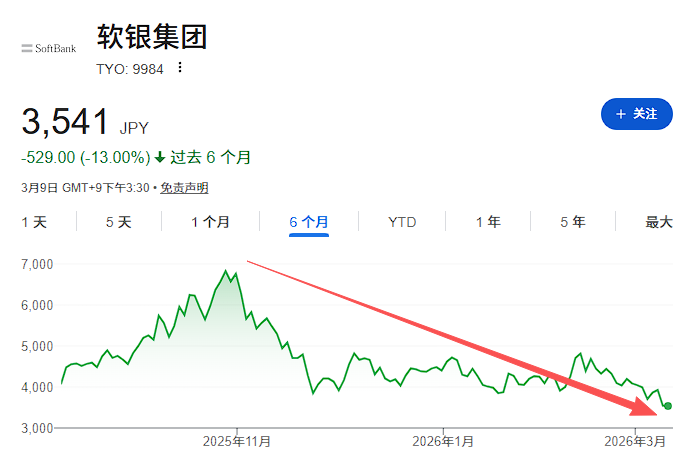
Just last month, SoftBank announced it would invest $30 billion in the latest $11 billion financing round of OpenAI, bringing its total investment in the ChatGPT developer to $64.6 billion and a stake of about 13%.
This steep share price drop has sparked widespread concerns about SoftBank’s liquidity position. This month, S&P has revised SoftBank’s already junk-rated credit rating outlook to negative, citing concerns over its liquidity and OpenAI’s credit quality.
At the same time, SoftBank is seeking bridge loans to cover the above investment until it can liquidate other holdings.
The Stargate Project Faces Uncertainty, Triggering Market Sell-off
The immediate reason for the latest share price fall is the news that the Stargate data center expansion plan has been stalled.
According to reports, OpenAI and Oracle have given up expanding the Texas-based, jointly backed data center project, and SoftBank is an important participant in Stargate.
This news has raised doubts about the strategic logic of SoftBank’s deep engagement with OpenAI. Just last month, SoftBank completed a $30 billion commitment in OpenAI’s latest financing round, bringing total investment to $64.6 billion and holding about 13% equity.
As uncertainties cloud the prospects of the Stargate project, expectations for returns on this colossal bet have wavered.
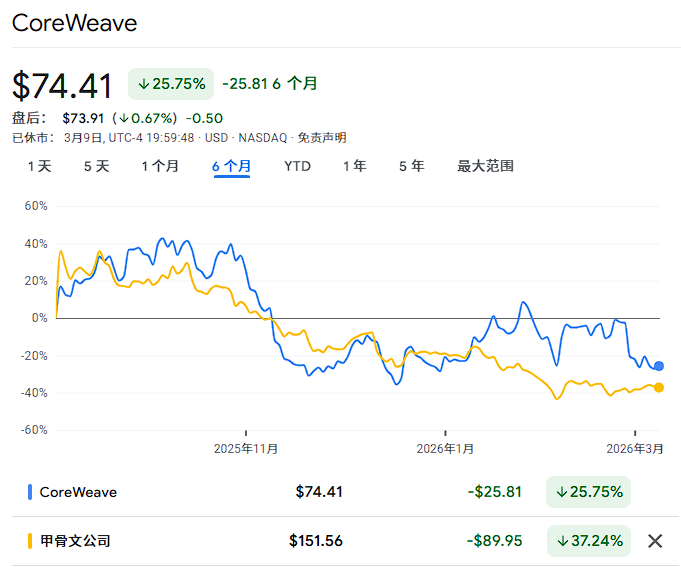
Other companies deeply involved in the OpenAI ecosystem have not been spared either. Since SoftBank’s share price peaked at the end of October last year, both Oracle and CoreWeave have seen their share prices drop by more than 40%.
Liquidity Pressure and Rating Downgrade
SoftBank’s asset structure makes it particularly vulnerable in the current market environment. According to S&P data, more than half of SoftBank’s $320 billion investment portfolio is made up of unlisted, illiquid assets. This structure becomes a significant constraint when the company needs to rapidly liquidate assets to meet massive investment commitments.
This month, S&P revised SoftBank’s rating outlook to negative for two main reasons: the overall liquidity situation of the company, and OpenAI’s own weak credit quality. Such comments only intensify SoftBank’s financing challenges and costs at a time when it is aggressively seeking bridge financing.
SoftBank’s current liquid assets include shares in chip designer Arm, worth about $80 billion.
Previously, SoftBank sold its Nvidia holdings to fund its early investments in OpenAI. Last week, despite turmoil in the Middle East, SoftBank pushed forward with the $1 billion IPO of its Japanese digital payment platform PayPay in New York.
Masayoshi Son's "Excitement Cycles" and Leverage Logic
From a broader perspective, SoftBank's development history is essentially a succession of "excitement cycles": Masayoshi Son identifies a new investment theme, the scale of investment expands, leverage rises, until shareholders or creditors—often both—begin to apply pressure.
Son is not without foresight. He earned rich rewards from an early bet on China's Alibaba, and in 2017 redefined the boundaries of venture capital with the $100 billion Vision Fund. However, this model has also led to notable failures, with WeWork being the most well-known example, and the Vision Fund as a whole experiencing ups and downs.
Today, thanks to its scale, renown, and characteristic use of leverage, SoftBank has become a rare liquidity tool for ordinary investors seeking exposure to big tech themes.
Analysts point out that this means whenever confidence in the “megatrends” bet by Masayoshi Son wavers, SoftBank is often among the first to be reduced in investor portfolios. At present, SoftBank is the most direct channel for ordinary investors to take a leveraged position on OpenAI—regardless of direction.
Notably, the last time SoftBank’s stock price fell sharply was in 2021, and at that time, the decline preceded a broader bear market by about eight months.
Disclaimer: The content of this article solely reflects the author's opinion and does not represent the platform in any capacity. This article is not intended to serve as a reference for making investment decisions.
You may also like
Has the "only buyer" of Korean stocks left early?
Over the past two months, Samsung and SK Hynix have alone absorbed over $25 billion in sell pressure. Now, Samsung Electronics has completed its buybacks ahead of schedule, and SK Hynix is left with only about $500 million to finish up. On their "exit" day, the KOSPI instantly dropped by 2%. More dangerously, Samsung's Q3 results missed expectations for both revenue and profit. Coupled with ETF rebalancing and options expiry, a "liquidity vacuum" has become a reality, leaving the question of who will step in as the biggest mystery.
Strong Demand for AI Memory Drives Growth Outlook! DA Davidson Raises Micron Technology (MU.US) Target Price to $3,000
DA Davidson reiterated its "Buy" rating on Micron Technology and significantly raised its target price from $2,100 to $3,000. This target price represents nearly 176% upside compared to the stock's closing price of $1,088.00 on Wednesday.
Trump Says Military Actions Against Iran “Must End,” Media Reveals US Military Has Prepared “Pre-Election Strike Plan,” Oil Prices Surge
Although Trump has stated that "the action must be wrapped up," whether the approach will be "soft or tough" remains undecided. More importantly, in order to boost the election campaign, the White House is planning a "limited strike" against Iran before the election, which is in stark contrast to the previous mainstream market expectation of "pre-election restraint." Coupled with the storm in the Gulf of Mexico shutting down over 25% of crude oil production, frequent attacks on oil tankers in the Strait of Hormuz, and record highs in transnational shipping costs, Brent crude oil has risen above $101.
Dollar rises, Euro in peril
Crypto prices
More


