

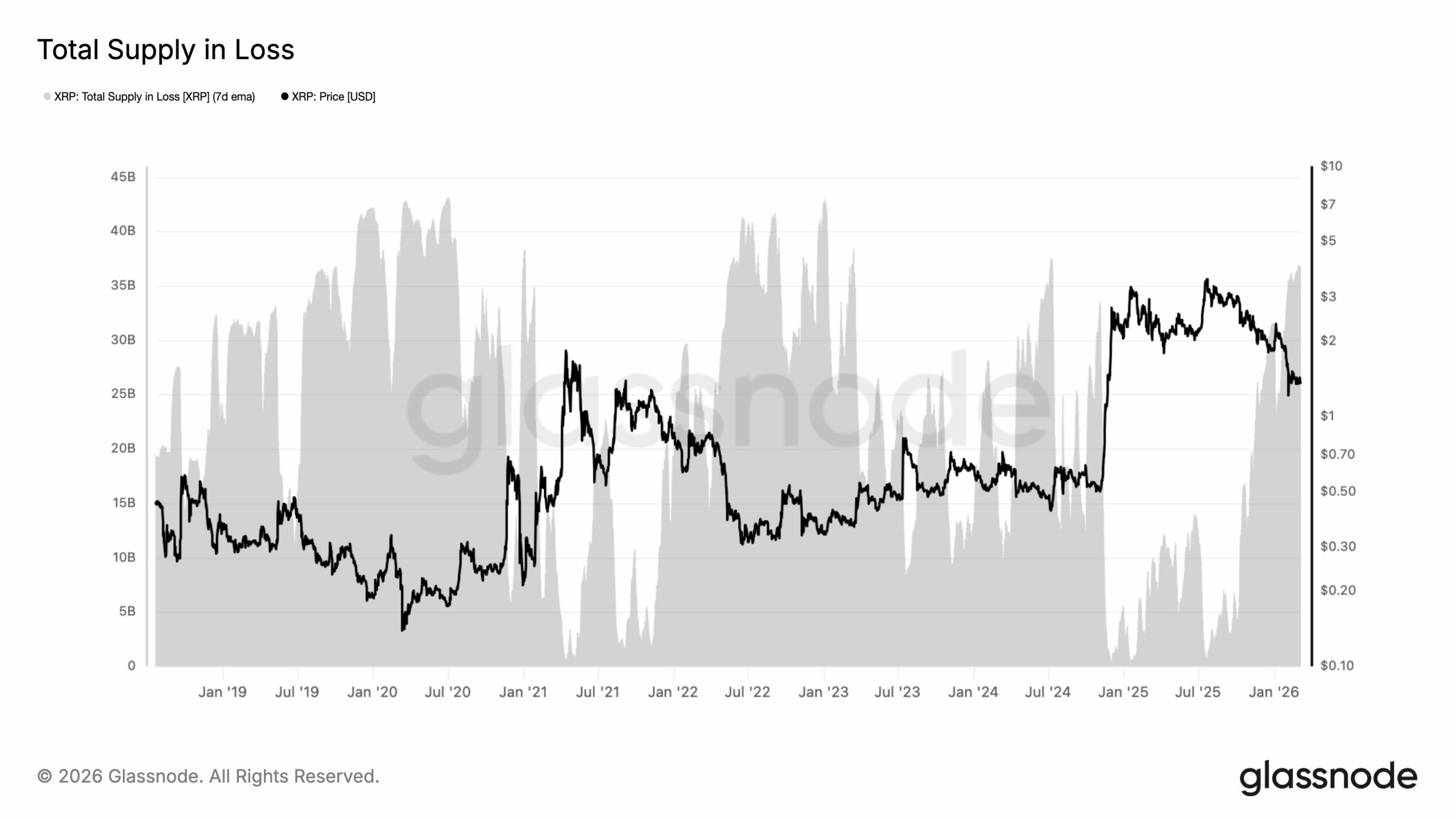
Unrealized losses across Ripple [XRP] expanded sharply after the market reversed from the July 2025 peak near $3.65. During that rally, many investors accumulated positions between $2.50 and $3.50, forming a dense cost basis zone.
However, momentum weakened as prices gradually declined toward $1.35, pushing a large portion of those buyers underwater.
Source: Glassnode
As the price slipped below the estimated $1.38 average holder cost, the scale of losses accelerated.
According to Glassnode, roughly 36.8 billion XRP is now held at a loss, equivalent to about $50.8 billion in Unrealized Loss. This shift reflects how late-cycle buyers absorbed the majority of the drawdown as bullish sentiment faded.
Even so, historical patterns provide context. Similar loss expansions appeared during the 2021–2022 downturn, when extended consolidation eventually stabilized market structure rather than triggering immediate capitulation.
Retail capitulation emerges as XRP holders exit losing positions
As XRP prices declined from the July 2025 peak near $3.65 toward the $1.30–$1.40 range, transaction profitability steadily deteriorated.
Initially, the Spent Output Profit Ratio (SOPR) hovered above 1.1, reflecting profit-taking as early buyers distributed into strength. However, selling pressure intensified once the rally faded and prices moved below recent entry levels.
The ratio then slipped beneath the 1.0 break-even line, falling to roughly 0.96, which signals that many transfers now occur at a loss. This shift indicates that sellers increasingly accept lower prices when exiting positions.
At the same time, transaction activity shows stronger participation from smaller wallets, suggesting retail-driven selling rather than broad institutional distribution.
Short-term holders appear to unwind recent purchases as prices compress.
This pattern highlights a market phase where loss realization dominates transaction flow, revealing that retail participants are actively exiting rather than passively holding underwater positions.
Large Holders absorb supply as Retail capitulates
While smaller holders increasingly realize losses, larger XRP wallets appear to take the opposite side of the trade. As prices slid from $3.65 toward $1.35, exchange flow patterns began shifting noticeably.
Exchanges recorded 7.03 billion XRP in net outflows, the largest since November 2025.
At the same time, wallets holding over 100,000 XRP gradually expanded their share of circulating supply, signaling quiet accumulation during the drawdown before later declining in 2026.
Derivatives positioning still reflects caution.
At press time, Open Interest sat near $2.3 billion, while Funding Rates remained slightly negative around -0.0012%. Liquidations totaled $3.77 million in 24 hours, with longs absorbing most losses.
Taken together, retail appears to supply liquidity while larger holders gradually absorb it, indicating a market dynamic where smaller investors provide the necessary funds for trading while institutional investors capitalize on price movements.
Final Summary
- Ripple’s XRP unrealized losses near $50.8 billion show deep retail capitulation as prices fall below the $1.38 average cost basis.
- Large XRP holders accumulate during the drawdown as exchange outflows and declining reserves signal supply shifting from retail to whales.


