
Finance job openings at 2012 levels, US lost 92K jobs last month

Finance and insurance job openings towards the end of 2025 fell to 13-year lows, according to February data from the Federal Reserve Bank of St. Louis, with markets commentary outlet The Kobeissi Letter arguing on Saturday that the industry may be “bracing for more layoffs.”
In an X post, The Kobeissi Letter highlighted data showing that finance and insurance job openings have declined by 117,000 since December to hit 134,000 last month, with overall finance and insurance job listings nearing recession levels.
“Available vacancies in these sectors have dropped -410,000, or -75%, since the 2022 peak. Openings are now even lower than at the 2001 recession bottom,” The Kobeissi Letter said, adding:
“By comparison, the largest monthly decline during the 2008 Financial Crisis was -125,000. As a result, the finance and insurance job openings rate fell to 1.9%, meaning fewer than 2 out of every 100 jobs in the sector are currently vacant, the lowest since February 2010.”
Finance jobs increased despite challenges
Despite a fall in job openings in December, the finance sector was actually one of the bright spots of a US Bureau of Labor Statistics report on Friday, showing that while US unexpectedly lost 92,000 jobs in February, the “financial activities” sector posted a net employment gain of 10,000.
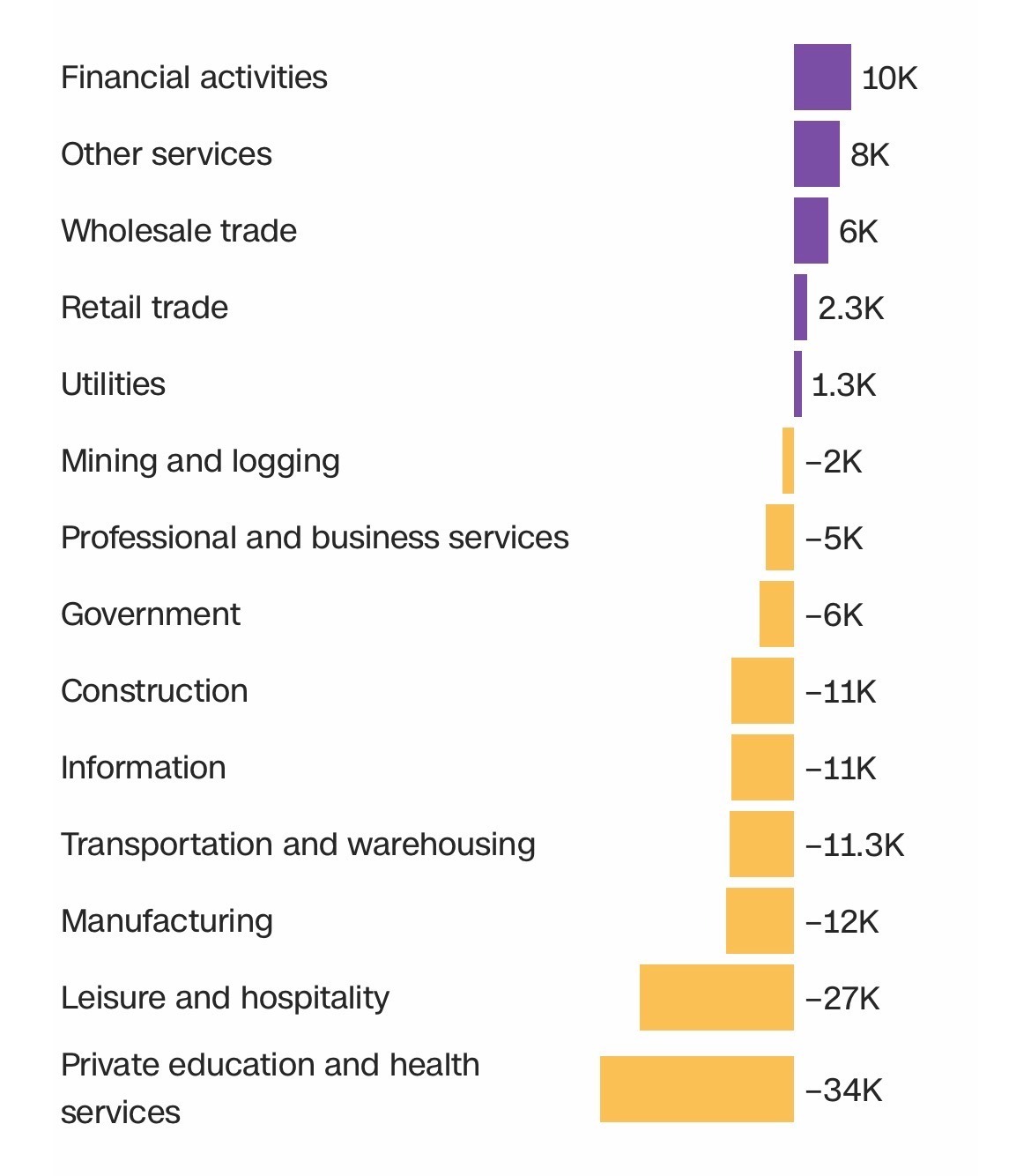
The bureau instead highlighted the healthcare sector as one of the key drivers behind the 92,000 net loss, following a four-week healthcare strike by Kaiser Permanente employees that ended late last month. The healthcare sector lost 28,000 jobs in the month, accounting for 30% of the full total.
Meanwhile, the information sector, transportation and warehousing, and the federal government lost 11,000, 11,000, and 10,000 jobs, respectively.
CNN reported on Saturday that extreme weather conditions may have impacted the numbers, though the bureau’s report indicated that the impact of weather conditions is difficult to quantify.
Related: Crypto Fear and Greed Index falls back down to 'extreme fear' levels
A weak jobs market can increase the chances of the US Federal Reserve cutting interest rates to ease pressure, which could be a boon for the crypto market.
However, it can also be a double-edged sword, as the fragility could spark investors into taking risk-off strategies to weather the storm.
Magazine: The debate over Bitcoin’s four-year cycle is over: Benjamin Cowen
Disclaimer: The content of this article solely reflects the author's opinion and does not represent the platform in any capacity. This article is not intended to serve as a reference for making investment decisions.
You may also like
Federal Reserve meeting minutes: All 19 policymakers support a rate hike in September, but reasons vary; most expect further hikes this year, suggesting no urgency in October.
Most officials view a September interest rate hike as an "insurance" measure against stubborn inflation; a minority see it as a necessary step to curb inflation. Overall, there is no indication of a desire to push for consecutive rate hikes. The "New Fed News Agency" emphasized the minutes: "Most participants believe that it may be appropriate to raise interest rates again before the end of the year." Nearly all officials believe inflation remains elevated and the labor market is close to full employment. Many noted that, despite the rise in long-term U.S. Treasury yields, financial conditions are still conducive to economic growth. Some officials believe that AI will boost investment and productivity, but may also contribute to inflation. The minutes revealed that the U.S.-Japan joint intervention in July to support the yen was a U.S. Treasury action, with no Federal Reserve funds used.
Solana Consolidates After Sharp Expansion
FLOKI Recovery Tests Key Resistance
100 Million Barrels Shrinkage? Reports Say EU Believes Oil Reserve Release Plan Mainly Fulfills Previous Commitments, Not New Quotas
Last Friday, G7 member countries agreed to release up to 100 million barrels of crude oil and diesel reserves. The IEA had announced a plan to release 400 million barrels in March, and as of last Friday, about 75 million barrels had yet to be released. Most EU member states believe that this action is simply fulfilling previous commitments rather than adding new releases. Regarding the earlier-than-scheduled release of diesel stocks emphasized in last week's G7 agreement, EU member states consider it feasible, but on a limited scale.
Crypto prices
More


