
On the Eve of the Oil Crisis

Source: Wall Street Intelligence Circle
The market hasn't even opened yet, and Wall Street is already speculating on $100 oil prices.
On Monday, as soon as Goldman Sachs saw the situation deteriorating, they made a quick estimate:
If the Strait of Hormuz is completely shut down for 6 weeks, oil prices should add an $18/barrel risk premium. At that time, US crude oil was about $67, and Goldman Sachs believed the reasonable price was around $85. However, the market reaction was even more intense than their model; by Friday this week, oil prices had already risen above $91—meaning the market is more pessimistic than Goldman Sachs.
After further research, Goldman Sachs found that the issue might be worse than expected:
First, the volume of oil passing through the strait is actually decreasing
Goldman Sachs estimates that, under normal circumstances, about 18 million barrels of oil are transported through the Strait of Hormuz every day, but now the flow is down to only about 10%. The risk is no longer theoretical—it has begun to impact real supply. If the situation lasts, inventories will be quickly depleted.
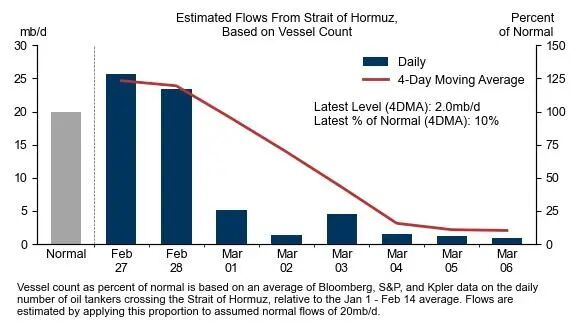
Note: If oil prices gap above $100 at Monday's opening, it's not hype—it's a collapse in physical delivery capacity.
Second, alternative routes are far from sufficient
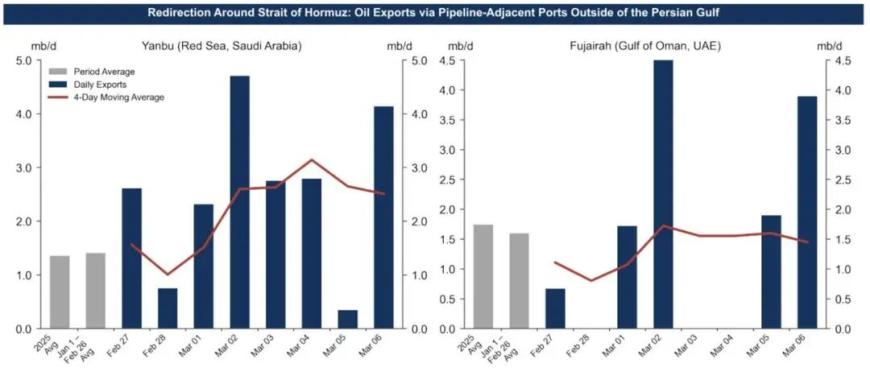
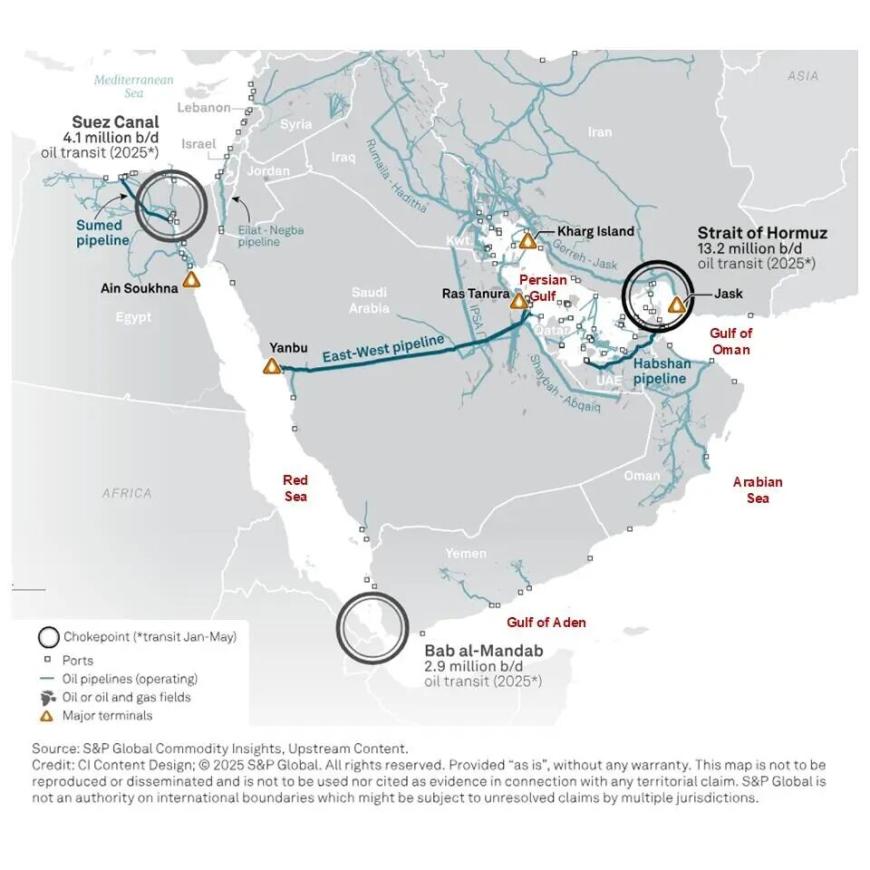
Can't the shipments be rerouted? In theory, yes. For example, via Saudi Arabia’s Yanbu Port or the UAE's Fujairah Port. Theoretically, 3.6 million barrels/day can be rerouted, but in reality, only 900,000 barrels/day have been rerouted so far—replacement capacity is far below expectations.
Third, shipping companies have started to wait and see
Goldman Sachs also did an interesting survey. They found that many shipping companies are currently adopting a “wait and see” approach. Many people think oil tankers are not moving because insurance costs are too high, but that's not the main reason. Even with increased insurance costs, transporting oil is still profitable—the real issue is the fear of missile attacks. So, many ships are choosing to pause operations for now.
Fourth, this supply shock is extremely severe
Goldman Sachs did the math. This Middle East oil supply shock involves 17.1 million barrels/day. By comparison, the peak supply shock during the 2022 Russia-Ukraine war was only about 1 million barrels/day—meaning this time, the scale is 17 times larger, and the market is suddenly panicking.
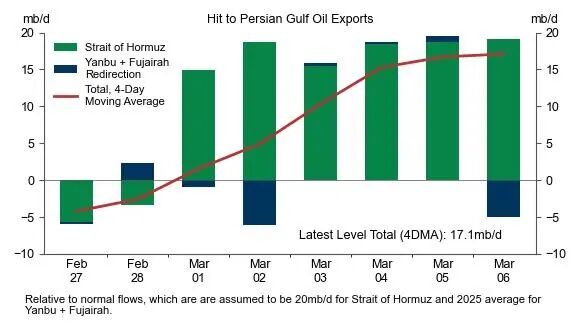
Note: The 17.1 million barrels/day gap given by Goldman Sachs is compared to the current global demand of about 100 million barrels/day, which means that one in every six barrels of oil worldwide would be unavailable.
Therefore, Goldman Sachs gave a very important judgment—if there are no signs of resolution in the next few days, oil prices are likely to break $100 next week. It's not that inventory is insufficient; it's that the market will start pricing in risk in advance.
The real danger here isn't just the oil price—it's the chain reaction. Historically, almost every oil shock has triggered the same sequence: rising energy prices → higher inflation → higher interest rates → economic slowdown → stock market decline.
What the market really fears is not oil reaching $100, but that once it does, prices won’t stop rising. When the market opens on Monday, it will no longer be about “the situation,” but about “the math.”
Disclaimer: The content of this article solely reflects the author's opinion and does not represent the platform in any capacity. This article is not intended to serve as a reference for making investment decisions.
You may also like
Federal Reserve meeting minutes: All 19 policymakers support a rate hike in September, but reasons vary; most expect further hikes this year, suggesting no urgency in October.
Most officials view a September interest rate hike as an "insurance" measure against stubborn inflation; a minority see it as a necessary step to curb inflation. Overall, there is no indication of a desire to push for consecutive rate hikes. The "New Fed News Agency" emphasized the minutes: "Most participants believe that it may be appropriate to raise interest rates again before the end of the year." Nearly all officials believe inflation remains elevated and the labor market is close to full employment. Many noted that, despite the rise in long-term U.S. Treasury yields, financial conditions are still conducive to economic growth. Some officials believe that AI will boost investment and productivity, but may also contribute to inflation. The minutes revealed that the U.S.-Japan joint intervention in July to support the yen was a U.S. Treasury action, with no Federal Reserve funds used.
Solana Consolidates After Sharp Expansion
FLOKI Recovery Tests Key Resistance
100 Million Barrels Shrinkage? Reports Say EU Believes Oil Reserve Release Plan Mainly Fulfills Previous Commitments, Not New Quotas
Last Friday, G7 member countries agreed to release up to 100 million barrels of crude oil and diesel reserves. The IEA had announced a plan to release 400 million barrels in March, and as of last Friday, about 75 million barrels had yet to be released. Most EU member states believe that this action is simply fulfilling previous commitments rather than adding new releases. Regarding the earlier-than-scheduled release of diesel stocks emphasized in last week's G7 agreement, EU member states consider it feasible, but on a limited scale.
Crypto prices
More


