
Brazil's Pix instant payments system expands to Argentina

Banco Central do Brasil said on Friday that it expanded its Pix digital payments system to allow Brazilians living in Argentina to access the service to pay for goods, services and send payments in both countries.
The central bank’s instant payments platform is accepted by major crypto platforms and service providers operating in Brazil for fiat onramping, including the Lemon crypto application, Binance Pay, Crypto.Com, the Mercado Bitcoin exchange and the Kraken crypto exchange.
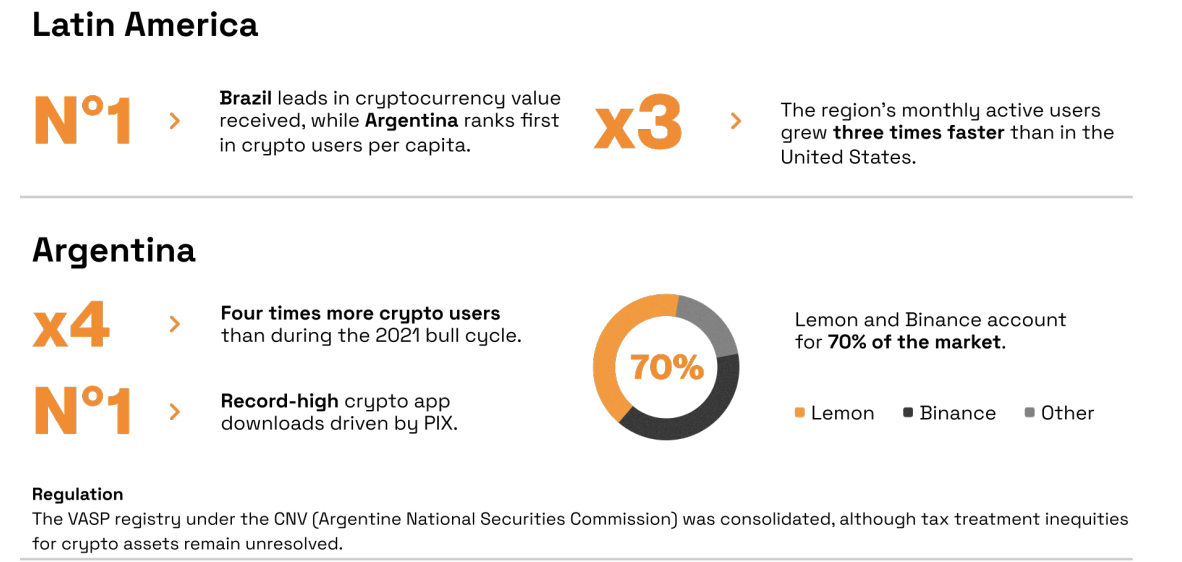
Argentina ranks as the number one country for crypto adoption per capita in LATAM, while Brazil ranks as number one in terms of total crypto value received, according to Lemon’s State of the Crypto Industry in Latin America 2025 report.
Argentina has about 4x the number of crypto users it had during the 2021 market cycle, the report said, and the Latin America region has about a 3x higher adoption rate than the United States.
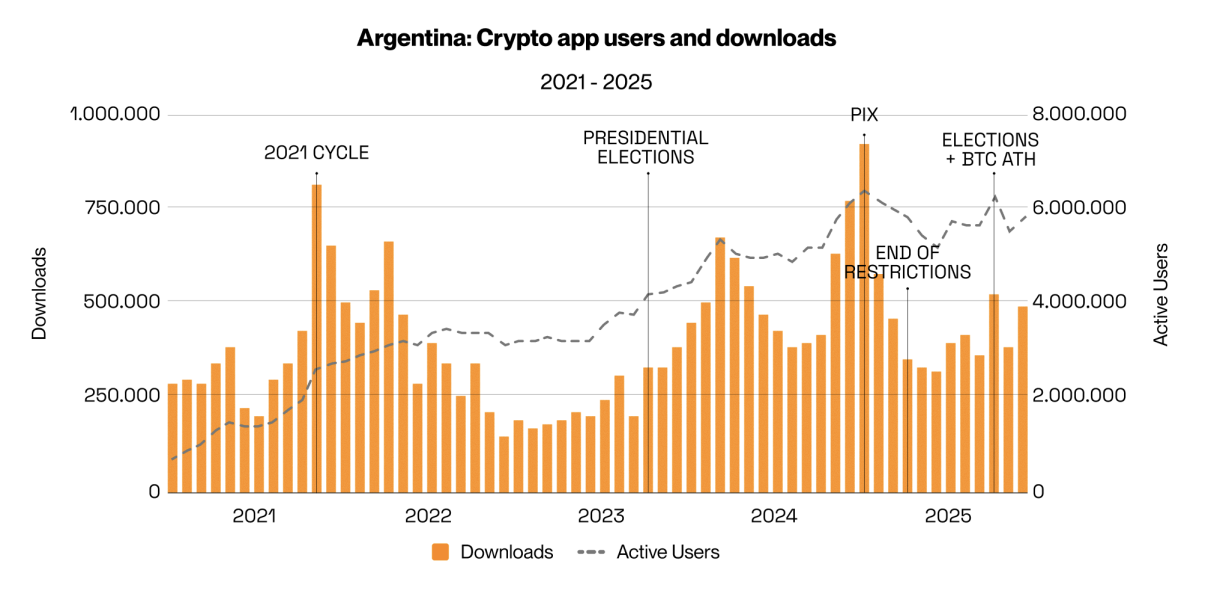
Lemon also attributed a surge in user downloads of its crypto application to the PIX payments system.
“Argentina recorded 5.4 million crypto app downloads in 2025, with more than 90% corresponding to wallets that implemented Pix payments in Brazil,” the authors of the report said.
Users in Latin America and other jurisdictions with high inflation have turned to digital assets as an alternative to traditional fiat currencies and the legacy financial system, which features relatively higher transaction fees and potential currency controls.
Related: Western Union teams with Crossmint to support USDPT stablecoin on Solana
Inflation is declining in Argentina, but still remains high
The Argentine peso clocked its lowest annual inflation rate in eight years in 2025, when inflation climbed back down to 37%, a threefold reduction from the previous year, according to Lemon.
Argentina’s government also removed currency controls, allowing residents in Argentina to sell and buy US dollars on the open market, improving economic conditions for those living in the country.
Previously, Argentine residents were not allowed to sell or buy US dollars, creating a black market for the greenback and dollar-pegged stablecoins.
This improvement has opened the door for new crypto use cases beyond savings and cross-border remittances, the report said.
Magazine: El Salvador’s national Bitcoin chief has been orange-pilling Argentina
Disclaimer: The content of this article solely reflects the author's opinion and does not represent the platform in any capacity. This article is not intended to serve as a reference for making investment decisions.
You may also like
Federal Reserve meeting minutes: All 19 policymakers support a rate hike in September, but reasons vary; most expect further hikes this year, suggesting no urgency in October.
Most officials view a September interest rate hike as an "insurance" measure against stubborn inflation; a minority see it as a necessary step to curb inflation. Overall, there is no indication of a desire to push for consecutive rate hikes. The "New Fed News Agency" emphasized the minutes: "Most participants believe that it may be appropriate to raise interest rates again before the end of the year." Nearly all officials believe inflation remains elevated and the labor market is close to full employment. Many noted that, despite the rise in long-term U.S. Treasury yields, financial conditions are still conducive to economic growth. Some officials believe that AI will boost investment and productivity, but may also contribute to inflation. The minutes revealed that the U.S.-Japan joint intervention in July to support the yen was a U.S. Treasury action, with no Federal Reserve funds used.
Solana Consolidates After Sharp Expansion
FLOKI Recovery Tests Key Resistance
100 Million Barrels Shrinkage? Reports Say EU Believes Oil Reserve Release Plan Mainly Fulfills Previous Commitments, Not New Quotas
Last Friday, G7 member countries agreed to release up to 100 million barrels of crude oil and diesel reserves. The IEA had announced a plan to release 400 million barrels in March, and as of last Friday, about 75 million barrels had yet to be released. Most EU member states believe that this action is simply fulfilling previous commitments rather than adding new releases. Regarding the earlier-than-scheduled release of diesel stocks emphasized in last week's G7 agreement, EU member states consider it feasible, but on a limited scale.
Crypto prices
More


