
Bitcoin ‘bull trap’ forming as bear market enters middle phase: Willy Woo

Bitcoin could experience a short-term rally that catches investors off guard before the broader downtrend resumes, according to on-chain analyst Willy Woo.
“Bull trap forming,” Woo said in an X post on Saturday, referring to a fake breakout suggesting that the market is entering a sustained uptrend. He added that it may last “out to [the] end of April.”
Woo said his outlook is based on liquidity conditions rather than price levels. “If capital comes back in force with the right type of long-term investors, then I'll happily change my views,” Woo said.
Bitcoin is “solidly” in the middle of a bear market
From a long-range liquidity perspective, Woo said Bitcoin (BTC) is “solidly in the middle of its bear market.” “Typically, after fast downward flushes like we have had, BTC likes to go sideways and mount a rally where resistance is tested,” Woo said.
Bitcoin has fallen approximately 46.82% since reaching its October all-time highs of $126,000, trading at $67,012 at the time of publication, according to CoinMarketCap.
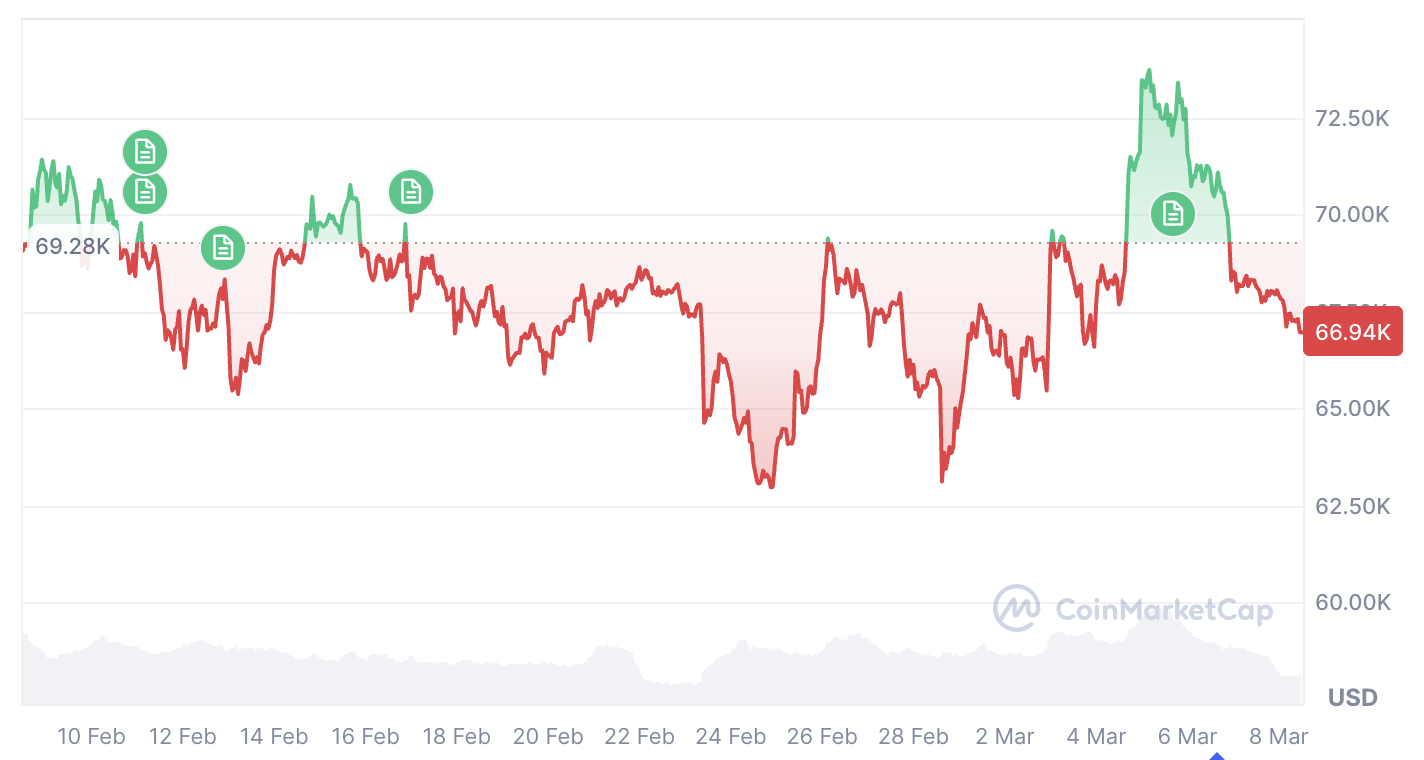
Woo said that this level isn’t the bottom for Bitcoin and the asset may see further downside. Crypto sentiment platform Santiment shared a similar view on Saturday, pointing to whales aggressively selling while retail investors buy below $70,000.
“When retail buys while whales sell, it typically signals that the correction is not yet over,” Santiment said.
Bitcoin investor flows have been in “consistent recovery”
Woo said that despite Bitcoin failing to hold the “mid-70s” range after it soared to $74,000 on Wednesday, investor flows have been in “consistent recovery” since the middle of February.
Woo isn’t the only analyst who thinks Bitcoin is in a bear market. Crypto analyst Benjamin Cowen recently told Magazine that 2026 is a “bear market year” for Bitcoin and unlikely to bring new all-time highs.
On-chain analytics company CryptoQuant said on Thursday that “Bitcoin is still in a bear market despite the recent rally.”
It comes after the Crypto Fear and Greed Index, one of the most widely used gauges of crypto investor sentiment, fell back to “extreme fear” levels after briefly recovering on Wednesday.
Disclaimer: The content of this article solely reflects the author's opinion and does not represent the platform in any capacity. This article is not intended to serve as a reference for making investment decisions.
You may also like
Federal Reserve meeting minutes: All 19 policymakers support a rate hike in September, but reasons vary; most expect further hikes this year, suggesting no urgency in October.
Most officials view a September interest rate hike as an "insurance" measure against stubborn inflation; a minority see it as a necessary step to curb inflation. Overall, there is no indication of a desire to push for consecutive rate hikes. The "New Fed News Agency" emphasized the minutes: "Most participants believe that it may be appropriate to raise interest rates again before the end of the year." Nearly all officials believe inflation remains elevated and the labor market is close to full employment. Many noted that, despite the rise in long-term U.S. Treasury yields, financial conditions are still conducive to economic growth. Some officials believe that AI will boost investment and productivity, but may also contribute to inflation. The minutes revealed that the U.S.-Japan joint intervention in July to support the yen was a U.S. Treasury action, with no Federal Reserve funds used.
Solana Consolidates After Sharp Expansion
FLOKI Recovery Tests Key Resistance
100 Million Barrels Shrinkage? Reports Say EU Believes Oil Reserve Release Plan Mainly Fulfills Previous Commitments, Not New Quotas
Last Friday, G7 member countries agreed to release up to 100 million barrels of crude oil and diesel reserves. The IEA had announced a plan to release 400 million barrels in March, and as of last Friday, about 75 million barrels had yet to be released. Most EU member states believe that this action is simply fulfilling previous commitments rather than adding new releases. Regarding the earlier-than-scheduled release of diesel stocks emphasized in last week's G7 agreement, EU member states consider it feasible, but on a limited scale.
Crypto prices
More


