
US Treasury report acknowledges legitimate uses of crypto mixers

The United States Treasury Department acknowledged the legitimate use of mixers, which obfuscate crypto transfers to preserve user privacy, in its report to Congress on “Innovative Technologies to Counter Illicit Finance Involving Digital Assets.”
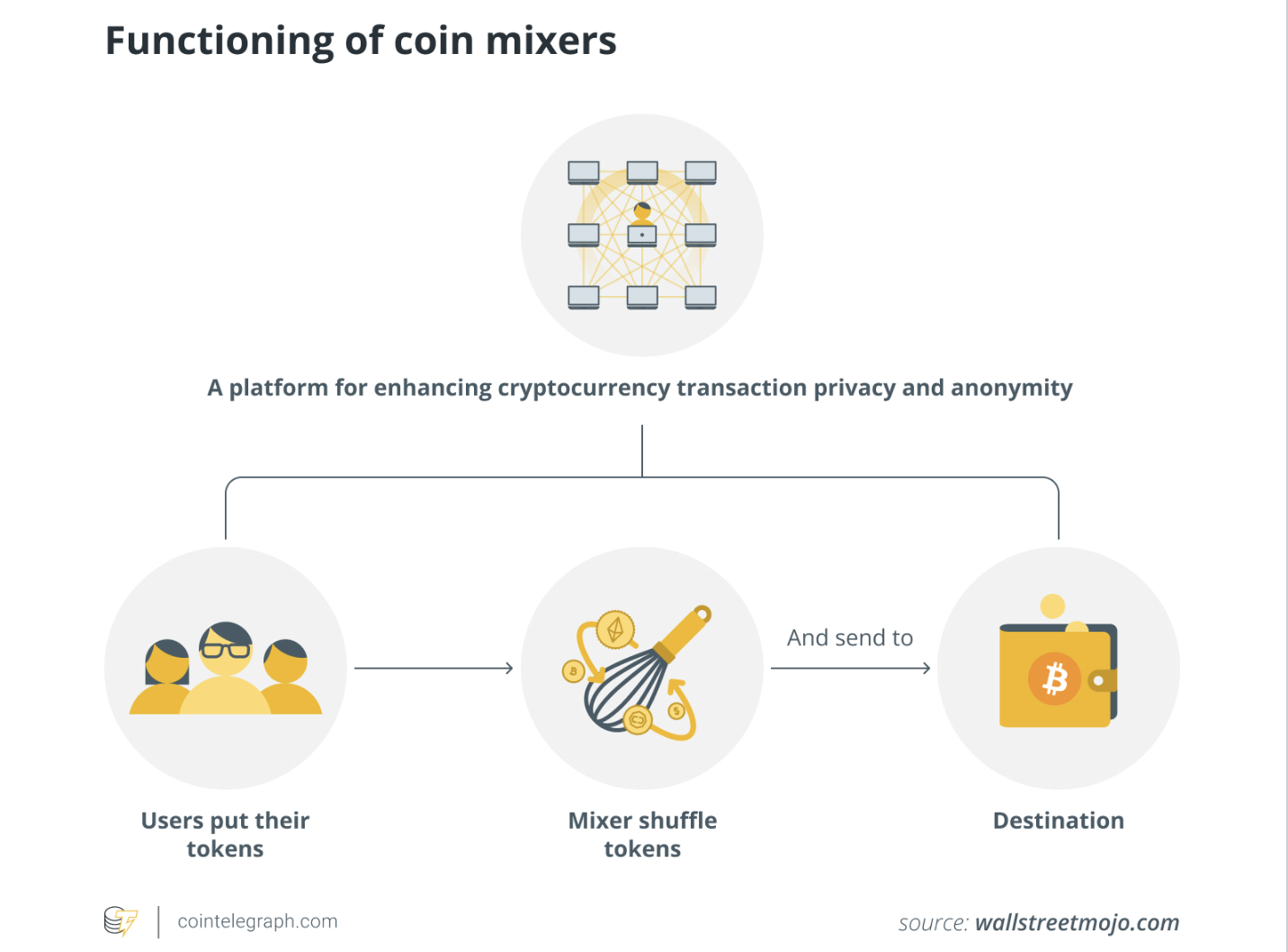
“As consumers increase their use of digital assets for payments, individuals may want to use mixers to maintain more privacy in their consumer spending habits,” the report said. The Treasury report continued:
“Lawful users of digital assets may leverage mixers to enable financial privacy when transacting through public blockchains. For instance, individuals may use mixers to protect sensitive information on personal wealth, business payments or charitable donations from appearing on a public blockchain.”
However, the report also noted the dangers of “darknet” or non-custodial, decentralized mixers. The Treasury said that non-custodial mixers are used for money laundering or shifting illicit funds by cybercriminals, including North Korea-linked hackers.
The authors suggested that custodial mixers, centralized services that take possession of user funds during the process, could provide identifying information that could be used to track users and transaction flows.
Privacy in crypto became a hot-button issue in 2025, as financial surveillance increases and US lawmakers attempt to impose know-your-customer (KYC) requirements on digital asset service providers and even decentralized finance (DeFi) platforms.
Related: Dash Evolution chain integrates Zcash Orchard privacy pool
DeFi leaders and seasoned investors warn about the threat to privacy
DeFi leaders and advocates sounded the alarm on ambiguous language in the Digital Asset Market Clarity Act of 2025, also known as the CLARITY bill, that could force DeFi platforms to collect identifying information from users.
The bill also lacked sufficient protections for open-source software developers in the US, according to Alexander Grieve, vice president of government affairs at crypto investment company Paradigm.
Former hedge fund manager Ray Dalio also warned that central bank digital currencies (CBDCs), onchain fiat currencies managed by a central banking institution or the government, are coming and pose a major risk to digital privacy.
In an interview with independent journalist Tucker Carlson, Dalio said CBDCs are a “very effective controlling mechanism” for the government.
Magazine: Can privacy survive in US crypto policy after Roman Storm’s conviction?
Disclaimer: The content of this article solely reflects the author's opinion and does not represent the platform in any capacity. This article is not intended to serve as a reference for making investment decisions.
You may also like
Federal Reserve meeting minutes: All 19 policymakers support a rate hike in September, but reasons vary; most expect further hikes this year, suggesting no urgency in October.
Most officials view a September interest rate hike as an "insurance" measure against stubborn inflation; a minority see it as a necessary step to curb inflation. Overall, there is no indication of a desire to push for consecutive rate hikes. The "New Fed News Agency" emphasized the minutes: "Most participants believe that it may be appropriate to raise interest rates again before the end of the year." Nearly all officials believe inflation remains elevated and the labor market is close to full employment. Many noted that, despite the rise in long-term U.S. Treasury yields, financial conditions are still conducive to economic growth. Some officials believe that AI will boost investment and productivity, but may also contribute to inflation. The minutes revealed that the U.S.-Japan joint intervention in July to support the yen was a U.S. Treasury action, with no Federal Reserve funds used.
Solana Consolidates After Sharp Expansion
FLOKI Recovery Tests Key Resistance
100 Million Barrels Shrinkage? Reports Say EU Believes Oil Reserve Release Plan Mainly Fulfills Previous Commitments, Not New Quotas
Last Friday, G7 member countries agreed to release up to 100 million barrels of crude oil and diesel reserves. The IEA had announced a plan to release 400 million barrels in March, and as of last Friday, about 75 million barrels had yet to be released. Most EU member states believe that this action is simply fulfilling previous commitments rather than adding new releases. Regarding the earlier-than-scheduled release of diesel stocks emphasized in last week's G7 agreement, EU member states consider it feasible, but on a limited scale.
Crypto prices
More


