
BioMarin Pharmaceutical's (NASDAQ:BMRN) Q4 CY2025 Sales Beat Estimates


Biotech company BioMarin Pharmaceutical (NASDAQ:BMRN) reported Q4 CY2025 results
Is now the time to buy BioMarin Pharmaceutical?
BioMarin Pharmaceutical (BMRN) Q4 CY2025 Highlights:
- Revenue: $874.6 million vs analyst estimates of $834.3 million (17% year-on-year growth, 4.8% beat)
- Adjusted EPS: $0.46 vs analyst expectations of $0.56 (17.9% miss)
- Adjusted EBITDA: -$39.76 million vs analyst estimates of $198.8 million (-4.5% margin, significant miss)
- Adjusted EPS guidance for the upcoming financial year 2026 is $5.05 at the midpoint, missing analyst estimates by 5.3%
- Operating Margin: -5.1%, down from 21.6% in the same quarter last year
- Free Cash Flow Margin: 6.7%, down from 22.2% in the same quarter last year
- Market Capitalization: $12.31 billion
"In 2025, operational excellence led to strengthening financial results, including double-digit topline growth, strong profitability and increasing cash flow. We also advanced multiple medicines in our pipeline and closed the year by announcing the acquisition of Amicus," said Alexander Hardy, President and Chief Executive Officer of BioMarin.
Company Overview
Pioneering treatments for conditions that often had no previous therapeutic options, BioMarin Pharmaceutical (NASDAQ:BMRN) develops and commercializes therapies that address the root causes of rare genetic disorders, particularly those affecting children.
Revenue Growth
A company’s long-term sales performance is one signal of its overall quality. Any business can experience short-term success, but top-performing ones enjoy sustained growth for years. Thankfully, BioMarin Pharmaceutical’s 11.6% annualized revenue growth over the last five years was decent. Its growth was slightly above the average healthcare company and shows its offerings resonate with customers.
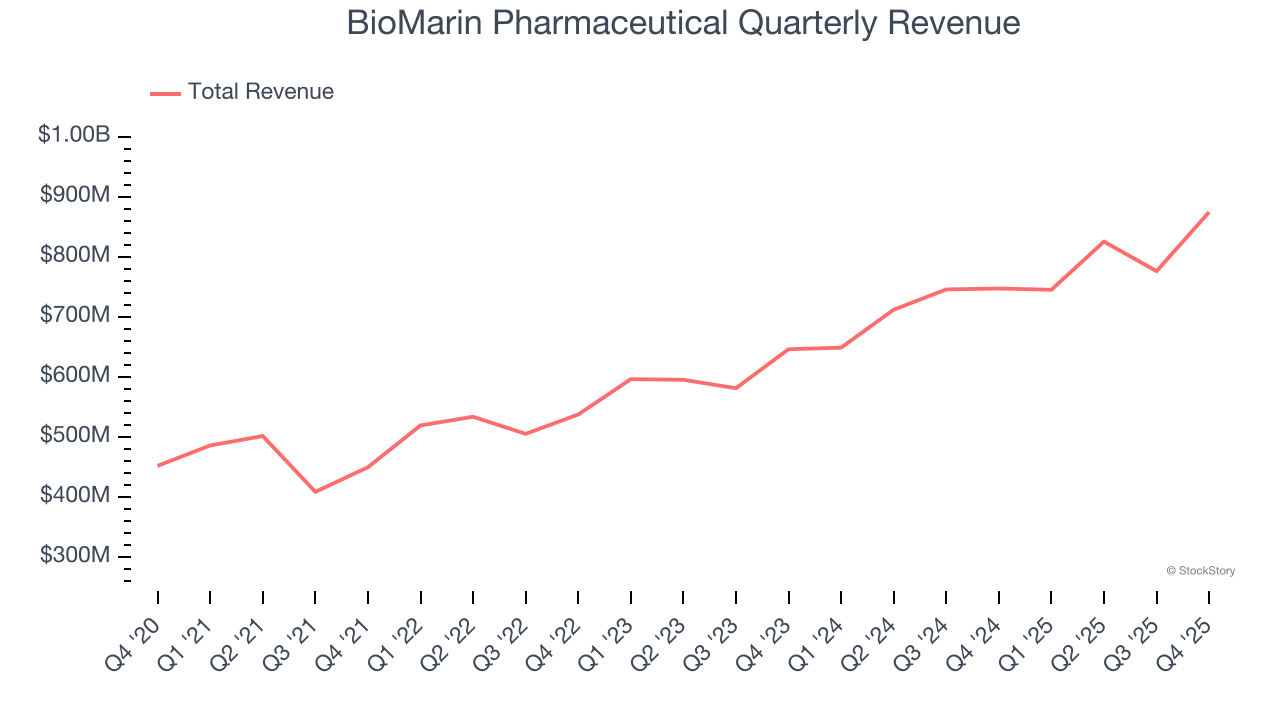
Long-term growth is the most important, but within healthcare, a half-decade historical view may miss new innovations or demand cycles. BioMarin Pharmaceutical’s annualized revenue growth of 15.4% over the last two years is above its five-year trend, suggesting its demand recently accelerated.
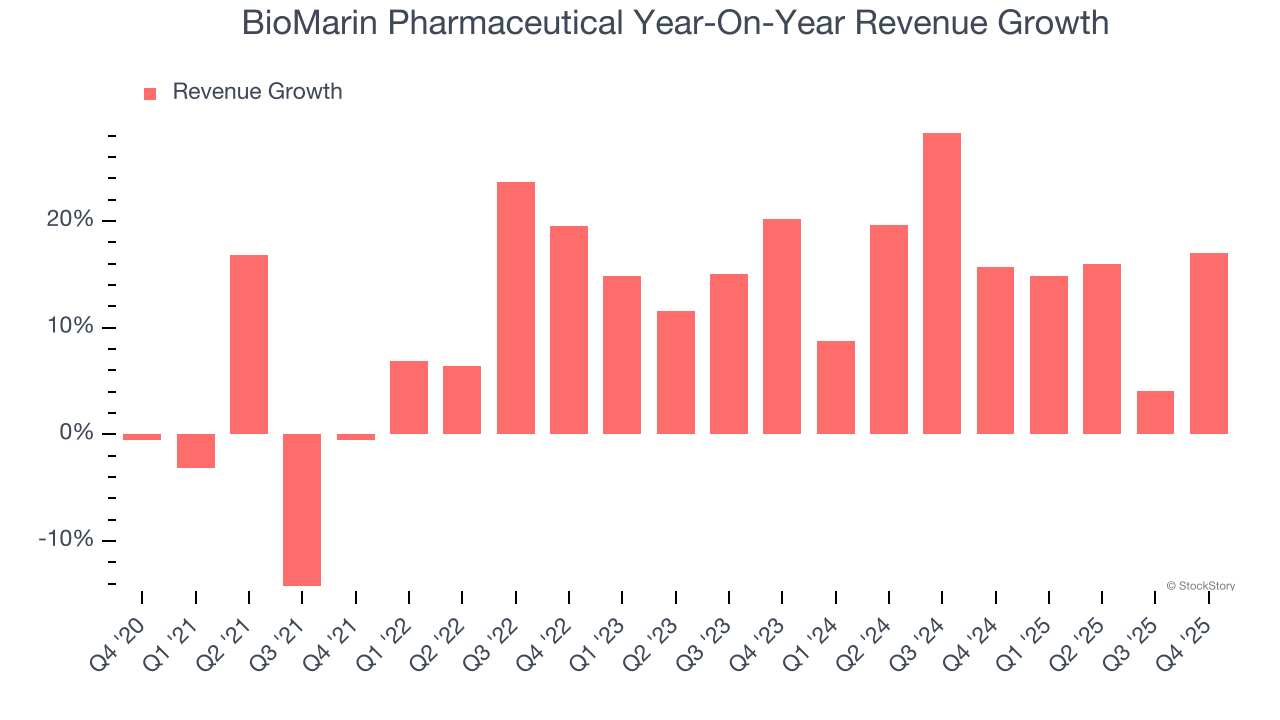
This quarter, BioMarin Pharmaceutical reported year-on-year revenue growth of 17%, and its $874.6 million of revenue exceeded Wall Street’s estimates by 4.8%.
Looking ahead, sell-side analysts expect revenue to grow 13.4% over the next 12 months, a slight deceleration versus the last two years. Still, this projection is admirable and implies the market is forecasting success for its products and services.
While Wall Street chases Nvidia at all-time highs, an under-the-radar semiconductor supplier is dominating a critical AI component these giants can’t build without.
Operating Margin
Operating margin is an important measure of profitability as it shows the portion of revenue left after accounting for all core expenses – everything from the cost of goods sold to advertising and wages. It’s also useful for comparing profitability across companies with different levels of debt and tax rates because it excludes interest and taxes.
BioMarin Pharmaceutical was profitable over the last five years but held back by its large cost base. Its average operating margin of 9.1% was weak for a healthcare business.
On the plus side, BioMarin Pharmaceutical’s operating margin rose by 17.2 percentage points over the last five years, as its sales growth gave it immense operating leverage. Zooming in on its more recent performance, we can see the company’s trajectory is intact as its margin has also increased by 5.9 percentage points on a two-year basis. These data points are very encouraging and show momentum is on its side.
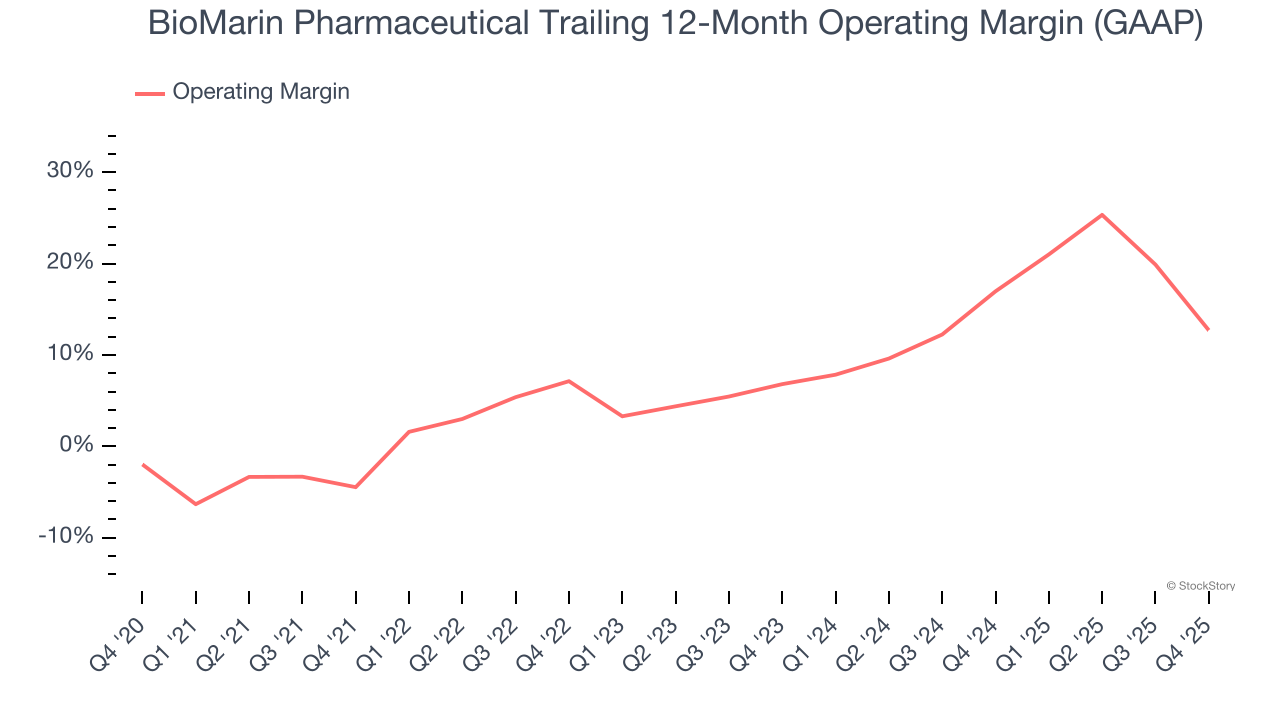
In Q4, BioMarin Pharmaceutical generated an operating margin profit margin of negative 5.1%, down 26.7 percentage points year on year. This contraction shows it was less efficient because its expenses grew faster than its revenue.
Earnings Per Share
We track the long-term change in earnings per share (EPS) for the same reason as long-term revenue growth. Compared to revenue, however, EPS highlights whether a company’s growth is profitable.
BioMarin Pharmaceutical’s EPS grew at a spectacular 13.8% compounded annual growth rate over the last five years, higher than its 11.6% annualized revenue growth. This tells us the company became more profitable on a per-share basis as it expanded.
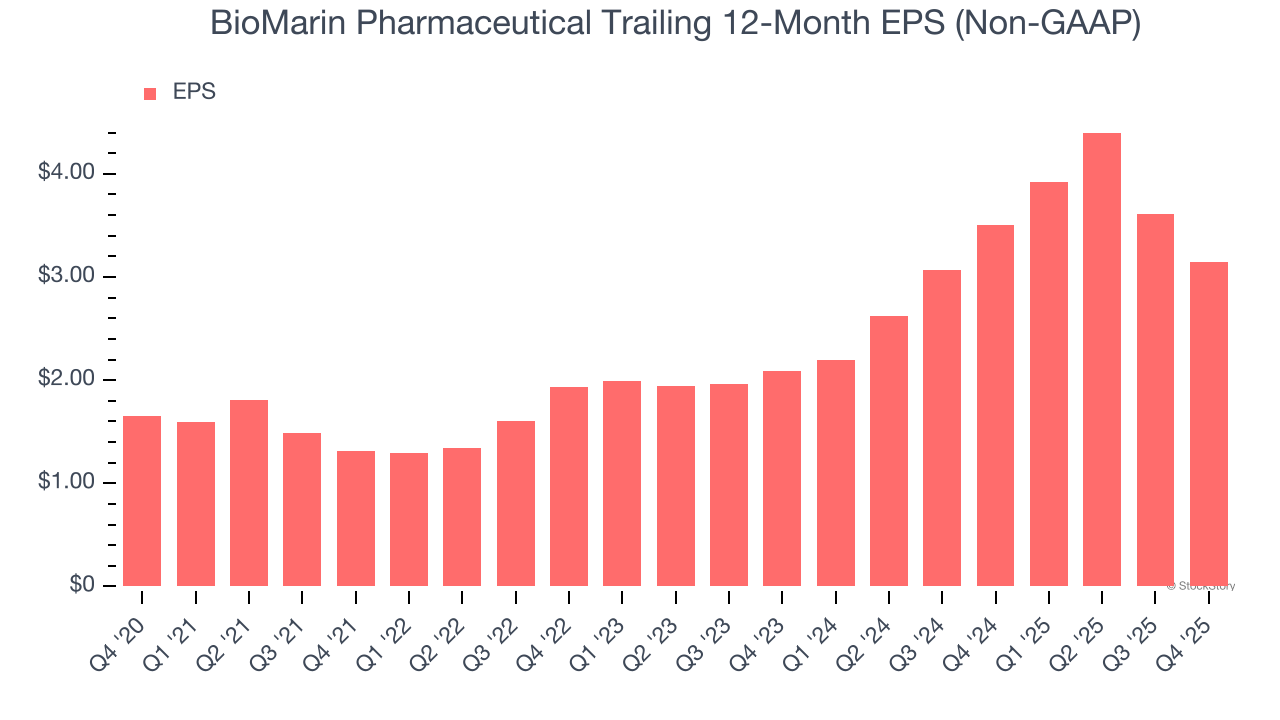
We can take a deeper look into BioMarin Pharmaceutical’s earnings to better understand the drivers of its performance. As we mentioned earlier, BioMarin Pharmaceutical’s operating margin declined this quarter but expanded by 17.2 percentage points over the last five years. This was the most relevant factor (aside from the revenue impact) behind its higher earnings; interest expenses and taxes can also affect EPS but don’t tell us as much about a company’s fundamentals.
In Q4, BioMarin Pharmaceutical reported adjusted EPS of $0.46, down from $0.92 in the same quarter last year. This print missed analysts’ estimates, but we care more about long-term adjusted EPS growth than short-term movements. Over the next 12 months, Wall Street expects BioMarin Pharmaceutical’s full-year EPS of $3.15 to grow 71.1%.
Key Takeaways from BioMarin Pharmaceutical’s Q4 Results
We enjoyed seeing BioMarin Pharmaceutical beat analysts’ revenue expectations this quarter. On the other hand, its full-year EPS guidance missed and its EPS fell short of Wall Street’s estimates. Overall, this was a weaker quarter. The stock traded down 4.1% to $60.32 immediately after reporting.
BioMarin Pharmaceutical may have had a tough quarter, but does that actually create an opportunity to invest right now? What happened in the latest quarter matters, but not as much as longer-term business quality and valuation, when deciding whether to invest in this stock.
Disclaimer: The content of this article solely reflects the author's opinion and does not represent the platform in any capacity. This article is not intended to serve as a reference for making investment decisions.
You may also like
If US Treasury yields continue to rise, what will Washington do next?
The Treasury has maintained liquidity by increasing the issuance of short-term Treasury bills and conducting small-scale buybacks. Some advocate for reducing expenditures to address the debt burden. Political constraints tilt the risk toward inflation, which harms bondholders' interests. Karen Brettell, Reuters, October 5 - The cost of borrowing for the U.S. government is rising, while it has almost exhausted straightforward ways to control those costs. Long-term Treasury yields are now near their highest levels in two decades, and the causes don't appear to be temporary. Washington is issuing large amounts of government debt to cover a fiscal deficit that shows no signs of shrinking. Inflation is cooling only slowly. Moreover, while the real estate and automotive sectors are struggling, the artificial intelligence investment boom is keeping the economy robust enough to prevent interest rates from falling. As a result, with over $40 trillion in debt, annual interest payments alone amount to around $1 trillion. Washington has options, from relying more on short-term borrowing to, in the most extreme case, having the Federal Reserve cap long-term yields. The more policymakers resort to such measures, the higher the risk of fueling inflation, potentially causing more pain for bondholders in the future. Torsten Slok, Chief Economist at Apollo Global Management, noted that for every $5 the government collects in taxes, $1 goes to service the debt. "That's a very, very high number, and it's only going to grow." U.S. President Donald Trump said in a September 28 interview with Time magazine that debt can be repaid through economic growth or inflation. But if these methods fail, the Treasury has other options ranging from moderate to radical. At present, the Treasury is increasingly relying on issuing short-term bills and conducting small-scale buybacks of old debt to help boost market liquidity. In a worse scenario, the next step would require Fed intervention. One method is large-scale purchases of long-term bonds, akin to 1961's "Operation Twist", another is directly capping long-term yields—a measure not used by the U.S. since World War II. The more aggressive the measures, the more they can suppress rates, but also the greater the risk of spurring inflation. “We are getting to a point where it's clear the government is uncomfortable with current rate levels," said Jeffrey Gundlach, CEO of DoubleLine Capital, at a recent investment event. Operation Twist Historically, the next escalation would likely be a full-scale reactivation of "Operation Twist." Launched in 1961, this strategy involved selling short-term Treasuries and purchasing long-term ones to flatten the yield curve. Implementing a substantial twist would require the Fed's assistance, but the Fed may stand pat unless there is an obvious financial emergency. Slok said that without the Fed's balance sheet, the Treasury has very limited tools for lowering rates. However, Fed Chair Kevin Warsh has criticized holding large amounts of government debt and other securities, arguing that massive bond buying blurs the line between monetary policy and government debt management. He has called for a new agreement between the Treasury and the Fed, under which the Fed Chair and Treasury Secretary would communicate publicly about the Fed's balance sheet and the Treasury’s debt issuance plans. Yield Curve Control If Operation Twist–style purchases don't work, the next move would be explicit yield curve control. In this scenario, the central bank commits to buying an unlimited amount of government debt to keep long-term rates under a set cap. From 1942 until the 1951 Treasury-Fed Accord, the Fed capped long-term Treasury yields at 2.5% to help fund WWII and the postwar recovery. The Bank of Japan implemented a version of this policy from 2016 to 2024. By artificially lowering rates, yield curve control can ease the political pressure of fiscal deficits. But it only works as long as investors aren't worried about being repaid with dollars devalued by inflation. Once that confidence is shaken, bond-buying meant to suppress rates only fuels the inflation it's designed to conceal. Veronique de Rugy, Senior Research Fellow at the Mercatus Center at George Mason University, said that ultimately, the only way to solve the debt problem is by cutting expenditures. “Congress needs to implement fiscal consolidation—in other words, austerity. The Fed cannot do this alone.” Divergent Paths John Higgins, Chief Economic Advisor at Capital Economics, notes that since World War II, the U.S. has only significantly reduced its debt-to-GDP ratio twice, but bondholders' experiences differed substantially each time. After the war, the debt-to-GDP ratio fell from about 106% in 1946 to 23% in 1974, while the 10-year Treasury yield climbed from 2.2% to 7.5%. In the 1990s, the ratio declined from 48% to 32%, and yields fell as well. What made the difference? After WWII, restr
MercadoLibre stock closes up 0.68% at $1,696.56, still below every key moving average
Crypto token unlocks hit $1.11B as Hyperliquid frees $340M for one buyer
Crypto prices
More


