
DELL vs. SMCI: Which AI-Server Stock Offers Better Growth Opportunity?

Dell Technologies DELL and Super Micro Computer SMCI are leading players in the fast-growing AI server market. Dell stands out as a diversified infrastructure giant with strengths across PCs, storage and data center solutions, backed by its AI-optimized PowerEdge servers. Super Micro Computer, on the other hand, is a pure-play server specialist known for high-performance, customizable systems built for AI and cloud workloads.
Both companies are riding the strong demand for GPU-powered AI servers. Dell shipped $5.6 billion of AI servers and a robust $18.4 billion backlog in the third quarter of fiscal 2026, while SMCI generated $12.7 billion in second-quarter fiscal 2026 revenues, driven largely by AI platforms.
As the AI server market continues to expand at a rapid pace, investors must decide whether Dell’s scale, diversification and operational strength or Super Micro Computer’s focused, high-growth AI strategy offers the more attractive investment opportunity. Let us delve deeper.
The Case for DELL Stock
Dell remains highly exposed to the cyclical and capital-intensive nature of the AI server buildout. Even with strong demand, margins have come under pressure due to rising component costs and an unfavorable product mix tilted toward lower-margin AI systems. Management realized that elevated pricing across memory and semiconductor components is likely to weigh on profitability across product categories. The company also operates with meaningful financial leverage, making its balance sheet more sensitive during periods of industry volatility. These factors suggest that while growth is strong, earnings quality and margin stability remain key risks.
However, AI momentum remains powerful. Record revenues were driven by accelerating AI server demand and a solid order pipeline. Its Infrastructure Solutions Group continues to benefit from strong demand for GPU-powered systems, driven by enterprise AI adoption and large-scale deployments.
Strategic partnerships with NVIDIA, alongside collaborations with AMD and hyperscale customers such as xAI and CoreWeave, strengthen Dell’s position within next-generation AI infrastructure. Management expects full-year fiscal 2026 AI shipments to reach roughly $25 billion, marking triple-digit growth year over year. With expanding AI shipments and a strong ecosystem, Dell has rapidly evolved into a leading enterprise AI server provider despite near-term margin pressures.
The Zacks Consensus Estimate for DELL’s fiscal 2027 earnings is pegged at $11.28 per share, edging down by 2 cents over the same period, indicating slightly tempered earnings expectations.
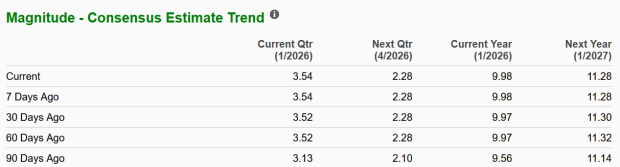
Image Source: Zacks Investment Research
The Case for SMCI Stock
Super Micro Computer continues to solidify its position as a leading AI-server supplier, benefiting from surging hyperscale AI deployments and rack-scale GPU adoption. In the second quarter of fiscal 2026, revenues surged to $12.68 billion, up 123% year over year, with AI GPU platforms representing over 90% of revenues. Management highlighted rapid scaling of AI factories and high-volume shipments of NVIDIA GB300 NVL72, HGX B300 and AMD MI350/355 systems.
SMCI’s vertically integrated Data Center Building Block Solutions strategy helps it stand out from competitors. The company provides a full set of data center components, including cooling distribution units, direct liquid cooling, chilled doors, power shelves, battery backup units, networking switches and management software. This integrated approach allows customers to deploy AI infrastructure faster and more efficiently. The company is also rapidly increasing production capacity, targeting up to 6,000 racks per month — including 3,000 liquid-cooled racks — by the end of fiscal 2026. With $4.1 billion in cash on hand, SMCI has strong financial flexibility to fund expansion, scale manufacturing and support growing AI demand.
Despite rapid revenue growth, profitability remains under pressure. Gross margin declined to 6.3% from 11.8% last year, reflecting a heavier mix of large hyperscale customers, supply chain constraints, higher logistics costs and tariff impacts. Revenue concentration is notable, with a single datacenter customer contributing 63% of total revenues. As of December 2025, the company carried $4.9 billion in bank debt and convertible notes, reflecting leverage used to support expansion.
The Zacks Consensus Estimate for SMCI’s fiscal 2026 earnings is pegged at $2.22 per share, increased by 4.2% over the past 30 days. This indicates 7.77% growth from the figure reported in the year-ago quarter.
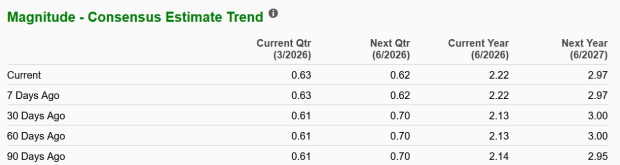
Image Source: Zacks Investment Research
DELL vs. SMCI: Price Performance & Valuation
Year to date, Dell’s shares have fallen 7.6%, while Super Micro Computer has gained 3.2%. SMCI’s outperformance reflects stronger investor confidence in its AI-driven growth. Surging AI demand is boosting the need for advanced hardware, directly benefiting the company. Super Micro Computer’s integrated Data Center Building Block Solutions are seeing rising adoption among AI customers, supporting its momentum.
Dell, on the other hand, faces headwinds from rising input costs and tight hardware margins. Ongoing concerns about AI server profitability and weak consumer PC sales are limiting investor optimism.
DELL and SMCI Stock Performance
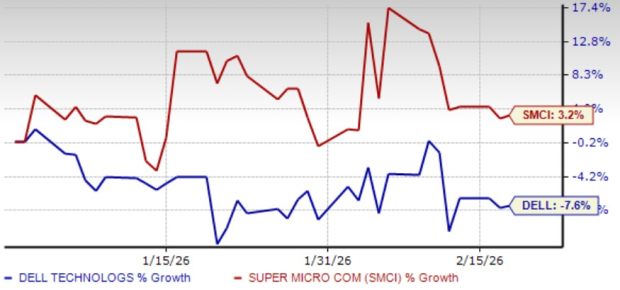
Image Source: Zacks Investment Research
On the valuation front, Dell trades at a forward 12-month price-to-sales (P/S) multiple of 0.61, compared with Super Micro Computer’s 0.4. The relatively lower valuation of SMCI suggests a more attractive entry point for investors and may make the stock more appealing at current levels.
DELL vs. SMCI: P/S F12M Ratio
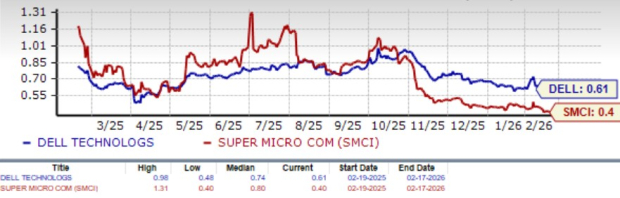
Image Source: Zacks Investment Research
Conclusion
While Dell offers scale, diversification and a strong enterprise ecosystem, margin pressures, component cost inflation and cyclical exposure temper its near-term upside. Super Micro Computer’s AI-focused strategy, rapid revenue growth, expanding rack-scale capacity and improving earnings outlook position it for stronger momentum. Despite margin volatility, SMCI’s pure-play AI leverage and valuation make it a better investment choice.
Compared with Super Micro Computer’s Zacks Rank #3 (Hold), Dell’s Zacks Rank #4 (Sell) suggests lower analyst confidence in near-term performance.
Disclaimer: The content of this article solely reflects the author's opinion and does not represent the platform in any capacity. This article is not intended to serve as a reference for making investment decisions.
You may also like
As Starlink challenges telecom operators' pricing power, AT&T (T.US) sells its Mexico business for $2 billion, shifting focus to AI connectivity demand.
AT&T has agreed to sell its Mexico operations to Televisa and Fintech for $2 billion. The transaction is expected to be completed in the first quarter of 2027, pending approval from Mexican regulators.


Dovish Signals Boost Markets: Asia-Pacific Stocks Rebound, South Korea Shares Jump Over 1% Ending Five-Day Slide, Taiyo Yuden Surges 7%
On Wednesday, the MSCI Asia-Pacific Index rose by 0.2%, making a slight rebound from the low point reached on Tuesday, the lowest since August. South Korea's Composite Index briefly rose by over 2%. SK Hynix and Samsung Electronics both surged more than 3% during trading, then fell back. The Nikkei 225 expanded its gains to 0.53%. MLCC giant Taiyo Yuden led the AI hardware sector, while Fujikura rose nearly 4%. The yield on 10-year US Treasury futures remained at 5.21%, up 0.5 basis points from Tuesday.

Apple (AAPL.US) is the “ultimate answer” for AI investments? Amid a semiconductor crash, it hits $5 trillion again; foldable iPhone and AI home devices ignite growth imagination
While the Philadelphia Semiconductor Index has fallen for five consecutive days with a cumulative drawdown of over 8%, Apple hit a historic intraday high of $348.15 on October 13, with its market capitalization surpassing $5 trillion again; it closed at $341.27, with a market value of approximately $4.98 trillion.

Crypto prices
More


