
Crypto lobby forms working group seeking prediction market clarity

Blockchain advocacy group The Digital Chamber has launched a new unit focused on supporting prediction markets and helping gain regulatory clarity for the sector in the US.
In an announcement via X on Tuesday, The Digital Chamber unveiled the Prediction Markets Working Group, outlining a multi-year plan to bring clarity to what it called a “misunderstood segment of finance.”
The Digital Chamber said the first course of action was sending a letter to Commodity Futures Trading Commission (CFTC) chairman Mike Selig praising his efforts to maintain federal jurisdiction over prediction markets, while also calling for an end to regulation by enforcement.
“In our letter, we applauded Chair Selig’s recent statements regarding the intent for CFTC staff to provide tailored rulemaking and guidance for this rapidly growing segment of the financial and digital asset industries,” The Digital Chamber said.
“For too long, operators in this space have navigated a maze of regulatory ambiguity including unclear overlaps between federal and state regulators,” it added.
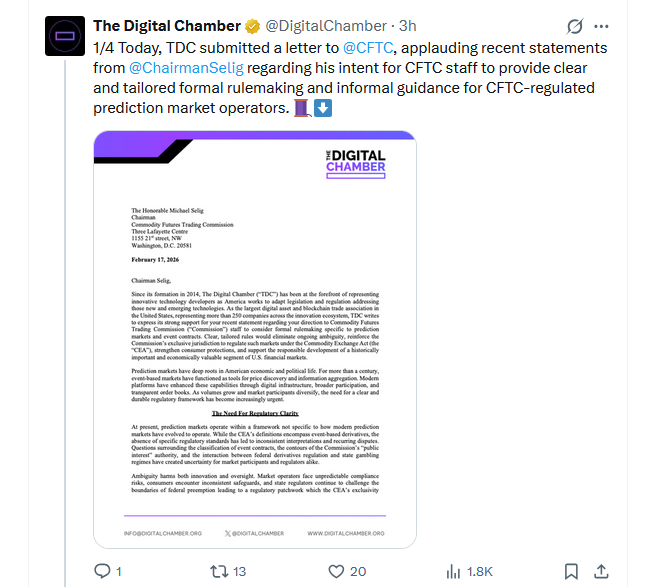 Source:
The Digital Chamber
Moving forward, the group plans to continue engaging with the CFTC, develop policy principles, submit policy recommendations, publish research and build a coalition of industry stakeholders and participants.
It also mentioned “participating in litigation” via friend-of-the-court briefings to educate courts on what it deems the “CFTC’s historic regulatory exclusivity” over the sector.
Prediction markets are heading to court
The move comes amid intense scrutiny of the sector from state governments and regulators.
Kalshi, one of the leading prediction market platforms, was hit with a civil enforcement action by the Nevada Gaming Control Board on Tuesday. The gaming board is calling for an injunction to stop Kalshi from offering “unlicensed wagering” in the state.
Both Kalshi and competitor Polymarket have seen multiple state regulators push to stop them from offering markets such as sports contracts in their respective states, arguing that they are offering unlicensed gambling products.
Last week, Polymarket filed a federal lawsuit against the state of Massachusetts to preemptively block any potential enforcement action, arguing that the CFTC has primary oversight over the sector, not state governments.
Related: Prediction markets should become hedging platforms, says Buterin
The CFTC chair has also been echoing such sentiments recently, urging state governments to respect the CFTC’s authority and oversight over the sector or risk facing them in court.
“Prediction markets aren’t new — the CFTC has regulated these markets for over two decades,” Selig emphasized in a video posted to X on Monday.
Responding to Selig on Tuesday, Utah Governor Spencer Cox welcomed any possible legal stoushes with the CFTC, labeling prediction markets as a form of gambling, which is “destroying the lives” of Americans.
“Mike, I appreciate you attempting this with a straight face, but I don’t remember the CFTC having authority over the ‘derivative market’ of LeBron James rebounds. These prediction markets you are breathlessly defending are gambling—pure and simple.”
Magazine: Big questions: Should you sell your Bitcoin for nickels for a 43% profit?
Disclaimer: The content of this article solely reflects the author's opinion and does not represent the platform in any capacity. This article is not intended to serve as a reference for making investment decisions.
You may also like
J.P. Morgan reiterates "Overweight" rating on CoreWeave (CRWV.US): Market's debt concerns are "overblown"; project IRR exceeds cost of capital
JP Morgan believes that the market's concerns about CoreWeave are overblown, and that debt worries reflect a certain sentiment about the timing of cash flows; this stands in sharp contrast to solid contract economics, investment returns, and outstanding executive leadership.

MSCI downgrade warning triggers "panic" selling! Indonesian stock market plunges for two consecutive days, hitting a six-year low
After MSCI, the index compiler, stated that it was considering downgrading the Indonesian stock market and removing it from global indices, concerns over capital outflows were triggered, resulting in "panic" selling in the Indonesian stock market and heavy losses for two consecutive days.
The market only gives a 17% probability, but economists claim it's "fifty-fifty": Is the suspense over a Federal Reserve rate hike in October being seriously underestimated?
In September, the U.S. CPI rose 3.7% year-on-year, while the PPI surged to 6.3%. Additionally, prices of goods except for energy accelerated, indicating that inflation has structural stickiness. Based on this, several economists predict that the likelihood of a rate hike in October far exceeds market pricing, with some directly forecasting consecutive hikes in October and December. Despite being just six days away from the midterm elections, a politically sensitive period, if the Federal Reserve unexpectedly acts to curb inflation, it will severely impact a market that is currently unprepared.

Anthropic allocates 5% equity to establish a public welfare fund in response to the impact of AI on the job market
Anthropic also announced the implementation of a dynamic increment mechanism—whenever the valuation rises 50% above the baseline, the board can allocate an additional 2% of shares. Combined with the founders and employees’ donation plan, about 20% of shares will be used for public interest purposes. This comes as Anthropic plans for an IPO in November and reported $16.8 billion in revenue for Q3, with industry insiders seeing this as a strategic move balancing necessity and image.
Crypto prices
More


