
ETH open interest falls to 3-year low: What does it mean for Ether price?

Ether (ETH) traded back above $2,000 on Friday, and its gains extended after the US Consumer Price Index (CPI) print came in cooler than expected.
The recovery put ETH/USD on track for its first bullish weekly candle close since mid-January, fueling speculation for a rally toward $2,500.
Key takeaways:
Ether futures’ open interest fell by 80 million ETH in 30 days, and funding rates hit three-year lows, indicating a weakening bearish trend.
ETH price has established strong support around $2,000, a level that must hold to secure the recovery.
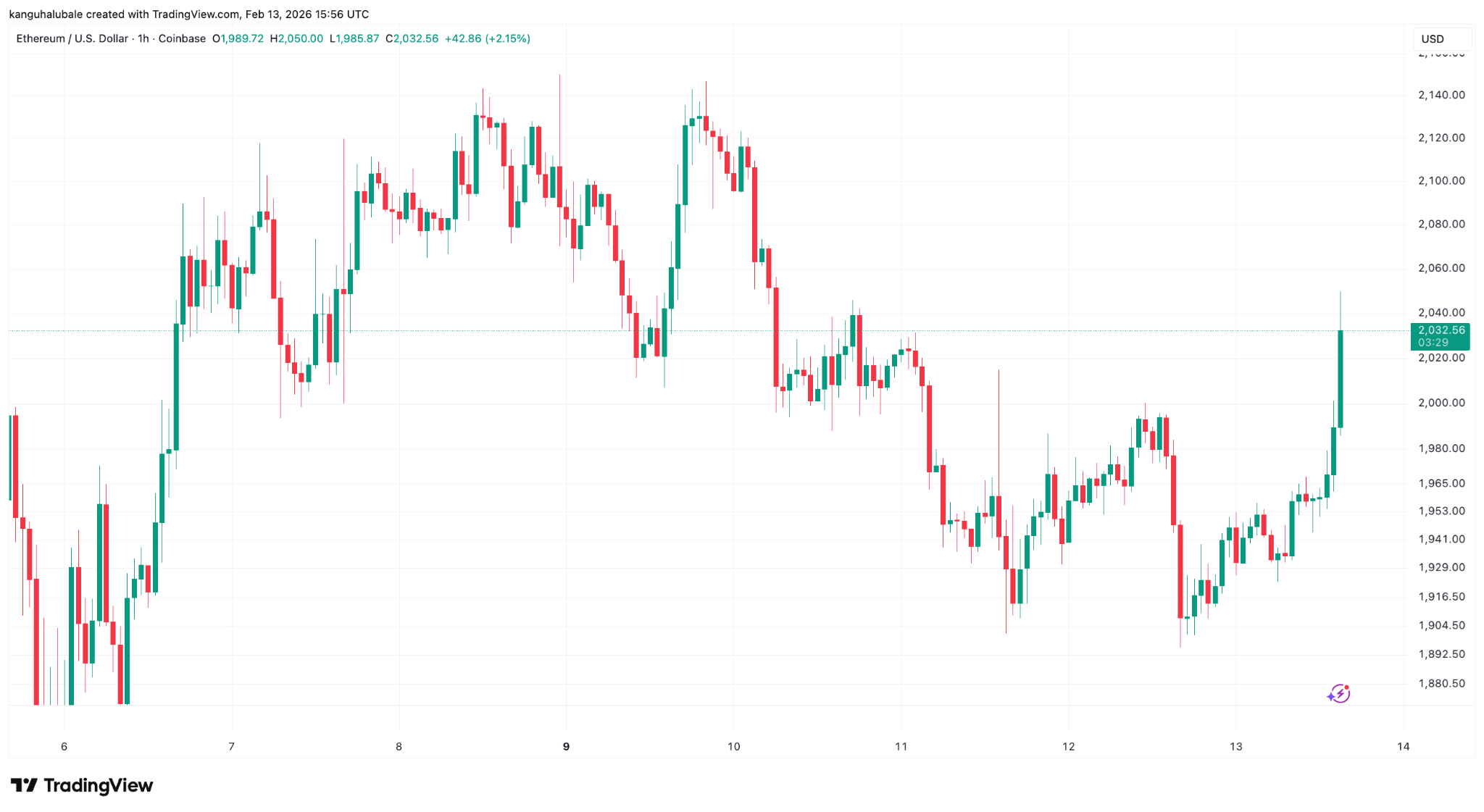 ETH/USD hourly chart. Source: Cointelegraph/
Ether open interest falls by 80 million ETH
CryptoQuant data shows Ether futures open interest (OI) across all major exchanges has dropped by over 80 million ETH in the past 30 days.
Binance, the world’s largest cryptocurrency exchange by trading volume, recorded the largest decline of about 40 million ETH (50%) over the last 30 days.
Related: ETH ETF holders in ‘worse position’ than BTC ETF peers as crypto market looks for bottom
Ether’s OI on Gate exchange fell by more than 20 million ETH (25%), while Bybit and OKX saw declines of 8.5 million ETH and 6.8 million ETH, respectively. Cumulatively, the four major platforms saw a total decline of about 75 million ETH, while other platforms accounted for the remaining five million ETH, confirming that the phenomenon is widespread and not limited to a single exchange.
This suggests that leverage traders are “reducing their exposure rather than opening new positions,” CryptoQuant analyst Arab Chain said in a Quicktake analysis.
This significant drop in OI amid dropping prices can be “viewed as a clean-up of weaker positions, thereby reducing the likelihood of sharp forced liquidations later on,” the analyst said, adding:
“This environment may pave the way for a period of relative stability or the formation of a more solid price base for Ethereum in the near future.”
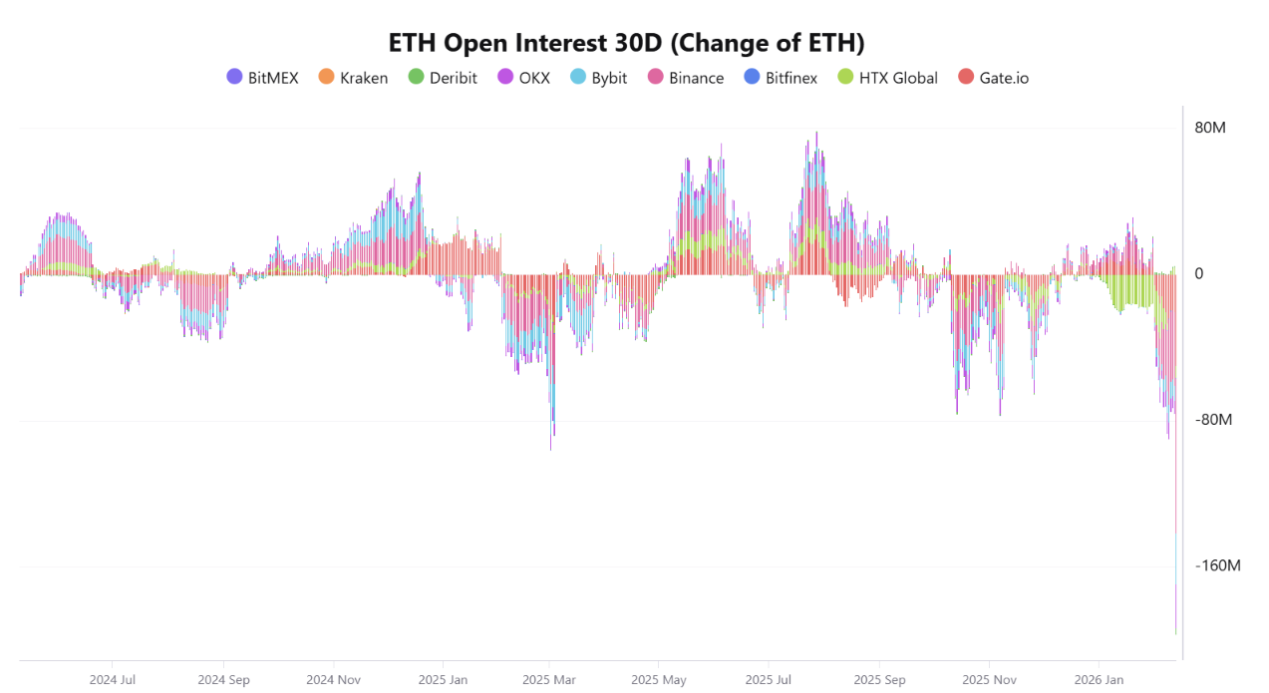 ETH open interest 30-day change. Source: CryptoQuant
Ether futures funding rates on Binance have plunged deep into negative territory at -0.006, marking the lowest value recorded since early December 2022.
“It indicates that the bearish sentiment has reached an extreme peak not seen in the last three years,” CryptoQuant contributor CryptoOnchain said in a Thursday Quicktake analysis.
Historically, extreme negative funding rates at major price support levels often precede a short squeeze.
“When the crowd is this convinced that prices will fall further, the market tends to move in the opposite direction to liquidate late bears,” the analyst said, adding:
“Current data suggests we may be witnessing a classic capitulation event, mirroring the bottom formation of late 2022, potentially setting the stage for a sharp recovery.”
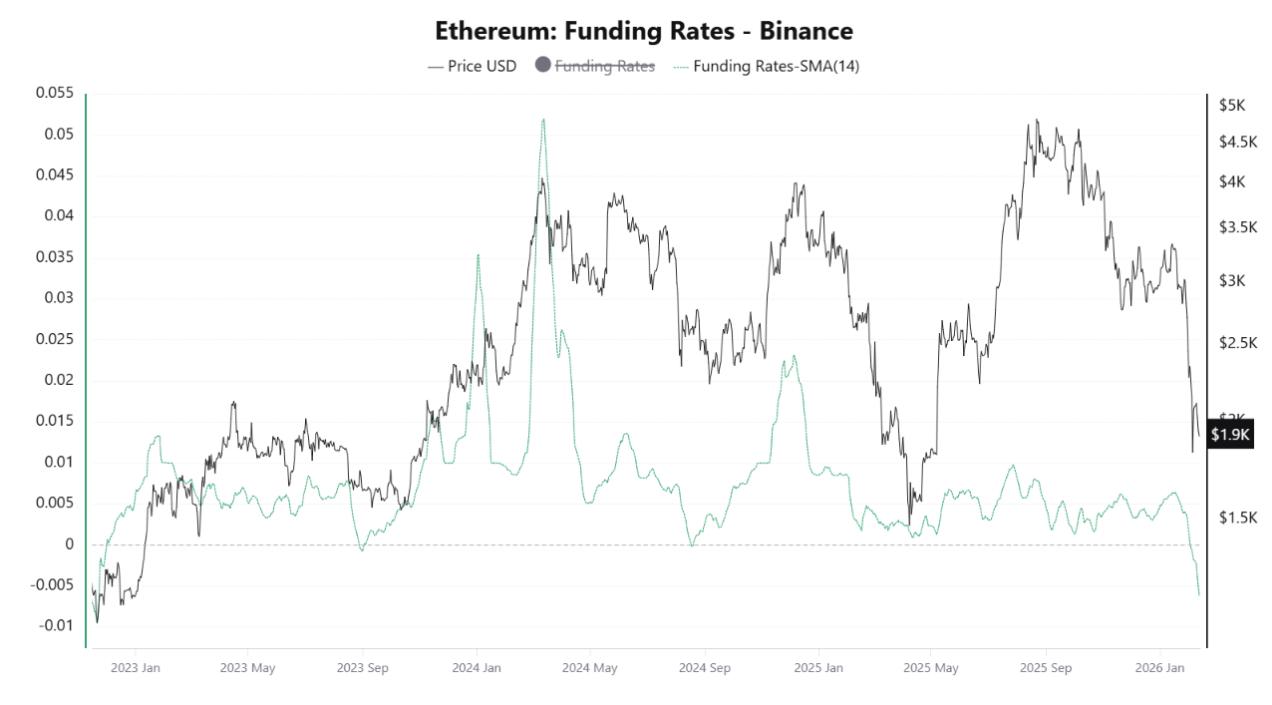 Ether futures finding rates. Source: CryptoQuant
As Cointelegraph reported, Ether’s surging network activity and rising institutional investor inflows are significant tailwinds for any short-term ETH price gains.
ETH price technicals: Bulls must keep Ether above $2,000
The ETH/USD pair broke out of a falling wedge on the four-hour chart, to trade at $2,050 at the time of writing.
The measured target of the falling wedge, calculated by adding the wedge's maximum height to the breakout point at $1,950, is $2,150.
Higher than that, the price may rise to retest the 100-period simple moving average (SMA) at $2,260 and later toward $2,500.
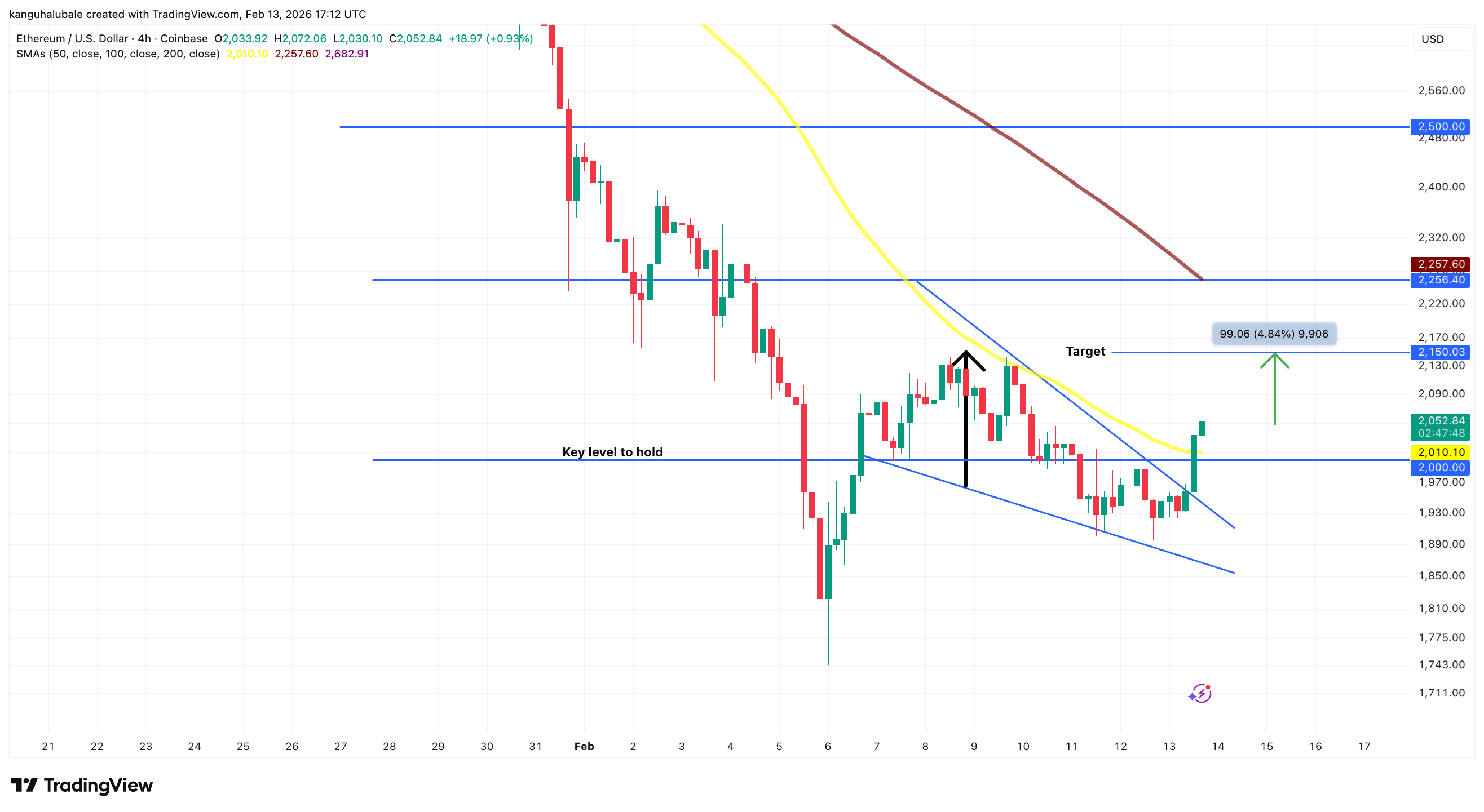 ETH/USD four-hour chart. Source: Cointelegraph/
On the downside, a key area to hold is the $2,000 psychological level, embraced by the 50-period SMA, as shown in the chart below.
The Glassnode cost basis distribution heatmap reveals a significant support area recently established between $1,880 and $1,900, where investors acquired approximately 1.3 million ETH.
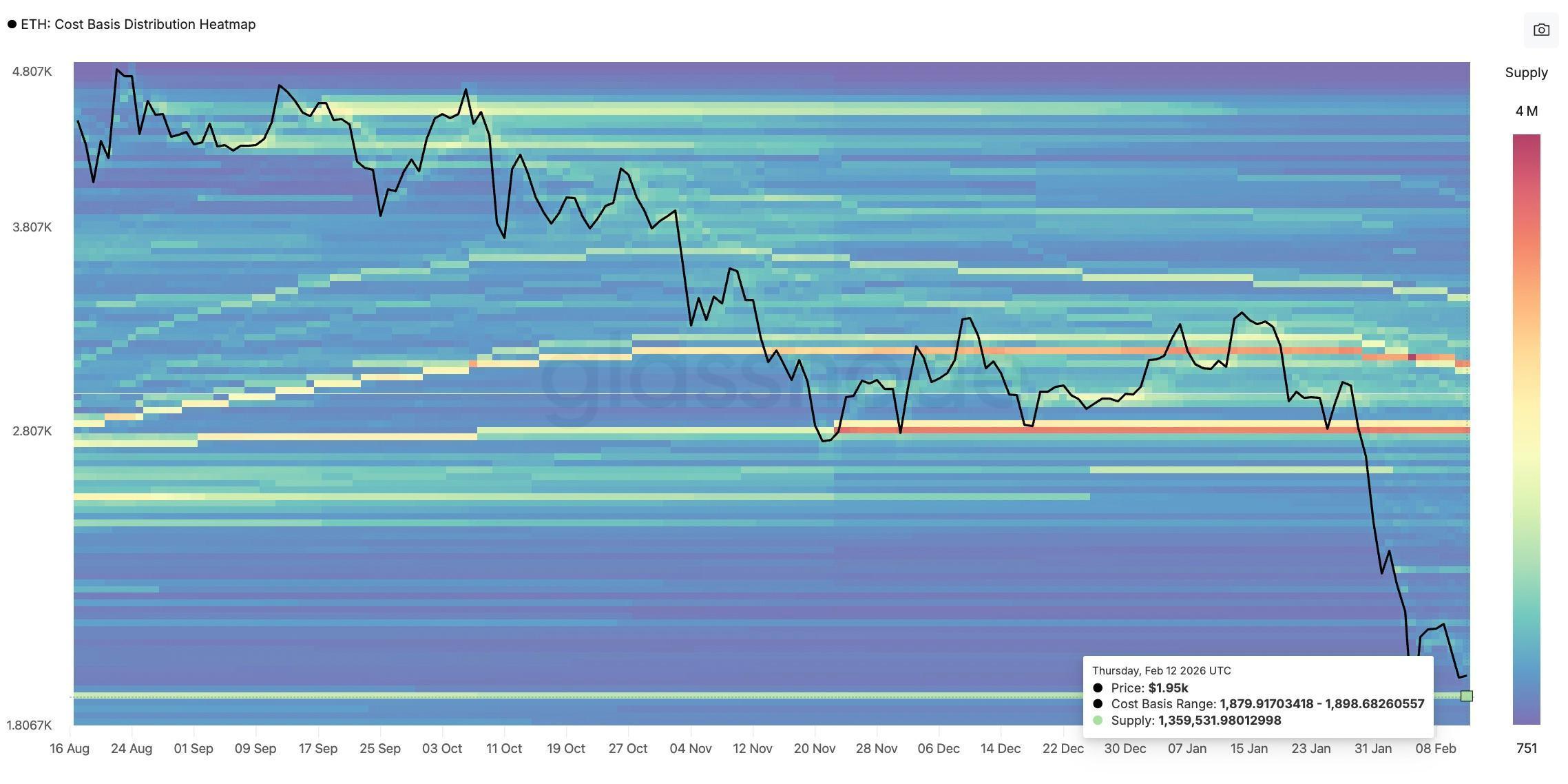 ETH cost basis distribution heatmap. Source: Glassnode
As Cointelegraph reported, Ether accumulation addresses witnessed a surge in daily inflows as ETH dropped below $2,000 last week, signalling strong investor confidence in its long-term potential.
Disclaimer: The content of this article solely reflects the author's opinion and does not represent the platform in any capacity. This article is not intended to serve as a reference for making investment decisions.
You may also like
Micron Conference Call: 75% of 2027 Capacity Already Sold, No Supply-Demand Inflection Point in Sight, Physical AI Will Be the Next Breakout Point
During the earnings call, company executives stated bluntly that "there is no end in sight for the supply-demand imbalance." The company has already signed 26 long-term agreements securing approximately $150 billion in long-term orders and anticipates that the storage market will be even tighter in 2027 and 2028 compared to 2026. Supported by strong cash flows, Micron announced capital expenditures of $25 billion in the first half of fiscal year 2027, and committed to returning 100% of excess cash to shareholders in the future.
Trump Plans Midterm Elections Again: Announces $200 Billion Korean Investment in the US, with $54 Billion Allocated to Alaska LNG
This investment marks the official announcement of the first batch of large-scale strategic investment projects under last year’s US-Korea trade agreement framework. In addition to the Alaska LNG project, the investments also include the construction of eight large nuclear power stations, as well as a 6 GW gas-fired power facility in Texas. Alaska’s election situation is currently close; Republican Senator Dan Sullivan has been a longtime supporter of the project and is facing a re-election challenge from Democratic candidate Mary Peltola.
The Fed's favorite inflation indicator comes in below expectations; Goldman Sachs no longer expects a rate hike in October
Goldman Sachs: A rate hike in October is unlikely, and the second rate hike may be postponed until December.
Crypto prices
More


