

Oasis Network trades at $0.01766 after surging 39% on January 20 to become top-performing Layer-1, as July 2025’s ROFL mainnet enables complex AI computations off-chain with blockchain-level trust, Franklin Templeton and Zodia Custody pilot uses tokenized money-market fund BENJI as collateral proving institutional RWA use case, December 2025 strategic investment arm targets SemiLiquid credit infrastructure, and Sapphire confidential EVM solves compliance-privacy conflict blocking institutional adoption.
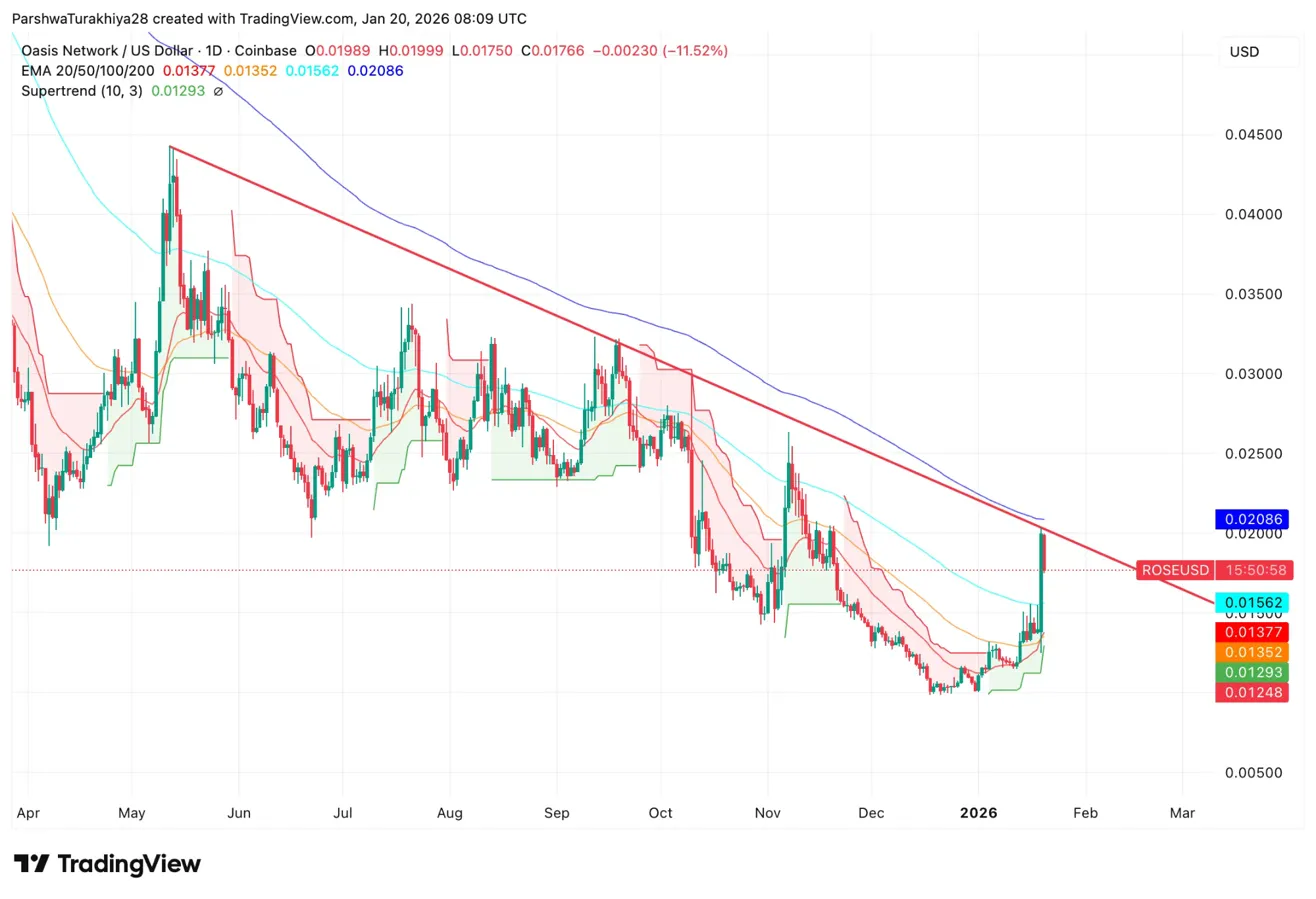
ROSE at $0.01766 bounces from $0.01248 December lows but remains in long-term downtrend. Price below EMAs at $0.01377/$0.01352/$0.01562/$0.02086—bearish structure. Supertrend at $0.01293 provides support.
Support at $0.01293-$0.01377. Bulls need sustained volume above $0.01562-$0.02086 EMA cluster to break downtrend toward $0.025-$0.030. Failure risks $0.01293 retest or $0.01248 lows.
Launched July 2, 2025, Runtime Offchain Logic (ROFL) enables developers to perform complex computations off-chain while retaining blockchain-level trust, verification, and privacy. This solves a critical Web3 gap: running intensive workloads like AI model training, inference, and data analysis without sacrificing decentralization.
Developers execute resource-intensive operations within secure enclaves, then cryptographically verify results on-chain. This makes Oasis a white-label compute layer for deploying powerful services with built-in privacy, trust, and scalability. Early adopters include WT3 (autonomous AI trading agent with $100,000 seed funding from Oasis Foundation) leveraging ROFL for fully private, trustless key management and trade execution.
The framework supports game hosting, MCP servers, LLM oracles, price oracles, and AI chatbots. Upcoming Intel TDX and NVIDIA TEE upgrades enable training larger AI models in decentralized, verifiable fashion, significantly expanding compute capabilities.
December 2025 saw Oasis launch strategic investment arm targeting scalable real-world asset infrastructure. First investment: SemiLiquid, a credit infrastructure firm for tokenized assets.
The breakthrough: SemiLiquid completed successful pilot with Franklin Templeton, Zodia Custody, and Ava Labs demonstrating trustless, decentralized credit for RWA while maintaining custody-based assurances. The pilot used Franklin Templeton’s tokenized money-market fund BENJI as collateral—assets remained in custody while generating daily returns.
SemiLiquid plans early 2026 expansion with more custody partners, additional collateral types, broader jurisdiction coverage, and under-collateralized credit support. If Oasis’s confidential compute becomes preferred layer for compliant, private RWA transactions, it unlocks substantial institutional demand.
Sapphire is the first confidential EVM empowering Web3 and Decentralized AI developers to build dApps with Smart Privacy natively on Oasis or other EVM-based chains. This differentiates ROSE from generic Layer-1s by solving blockchain’s fundamental transparency-compliance conflict—the barrier preventing institutional adoption.
Unlike anonymous privacy coins facing regulatory crackdowns, Oasis offers programmable, compliance-friendly privacy. This critical distinction positions ROSE for institutional adoption as companies need confidential transactions for trade secrets, contractor payments avoiding bank fees, and automated treasury management.
Q1 2026 brings mobile wallet apps for secure staking and transactions. ROFL App Deployment Marketplace enables developers to monetize and distribute privacy-preserving AI/ML models. Native ROSE bridge to Ethereum creates trustless liquidity flow complementing Sapphire’s confidential contracts.
Developer tooling expands to support TypeScript, Rust, Go, and Python—broadening accessibility. TDX container support simplifies development while dedicated “ROFL functions” apps streamline AI deployment.
February 18, 2026 unlock releases tokens to Foundation Endowment. Approximately 74.88% of total supply already unlocked via cliff vesting. Allocation: backers 23%, core contributors 20%, community/ecosystem 18.5%. Remaining unlocks represent modest dilution relative to circulating supply.
As privacy-enabled blockchain, Oasis faces dual-edged sword: potential scrutiny like Monero, or growing demand for compliant privacy infrastructure from institutions. However, Oasis differentiates through programmable, compliance-friendly privacy versus opaque anonymity—critical distinction for institutional adoption as EU bans anonymous privacy coins in July 2027.
Q1 2026: $0.018-$0.028 Mobile wallet launch, ROFL developer onboarding, SemiLiquid expansion begins. Break $0.01562-$0.02086 toward $0.025-$0.028.
Q2 2026: $0.022-$0.038 Franklin Templeton pilot converts to production, RWA partnerships scale, ROFL App Marketplace launches. Challenge $0.035-$0.038.
Q3 2026: $0.028-$0.048 Ethereum bridge activates, AI model training on Intel TDX/NVIDIA TEEs, institutional adoption metrics. Target $0.045-$0.048.
Q4 2026: $0.035-$0.060 Year-end RWA transaction volume, ROFL adoption validation, regulatory clarity favoring compliant privacy. Maximum $0.055-$0.060 requires breakthrough enterprise deployments.
| Quarter | Low | High | Key Catalysts |
| Q1 | $0.018 | $0.028 | Mobile wallet, ROFL devs, SemiLiquid |
| Q2 | $0.022 | $0.038 | Franklin production, RWA scales, marketplace |
| Q3 | $0.028 | $0.048 | ETH bridge, AI TEEs, institutions |
| Q4 | $0.035 | $0.060 | RWA volume, adoption proof, clarity |
- Base case ($0.030-$0.045): ROFL attracts 500-1,000 developers, Franklin Templeton pilot leads to 2-3 production RWA deployments, Sapphire processes $100M-$500M confidential transactions, mobile wallet onboards 50K-100K users, $0.02086 breaks toward $0.035-$0.045.
- Bull case ($0.050-$0.060): ROFL becomes standard for AI compute with 2,000+ developers, multiple Fortune 500 RWA deployments processing $1B+ volumes, regulatory clarity explicitly favors compliant privacy over anonymous coins, Ethereum bridge drives liquidity surge, sustained break above $0.050.
Bear case ($0.012-$0.020): Pilots remain experiments without production adoption, ROFL developer interest stalls, RWA partnerships canceled, regulatory environment unclear, $0.01293 breaks extending consolidation toward $0.012.


