
Fuel and Bubblemaps, both valued at $1 billion by VCs, currently have market capitalizations of only $11 million and $6 million, respectively.

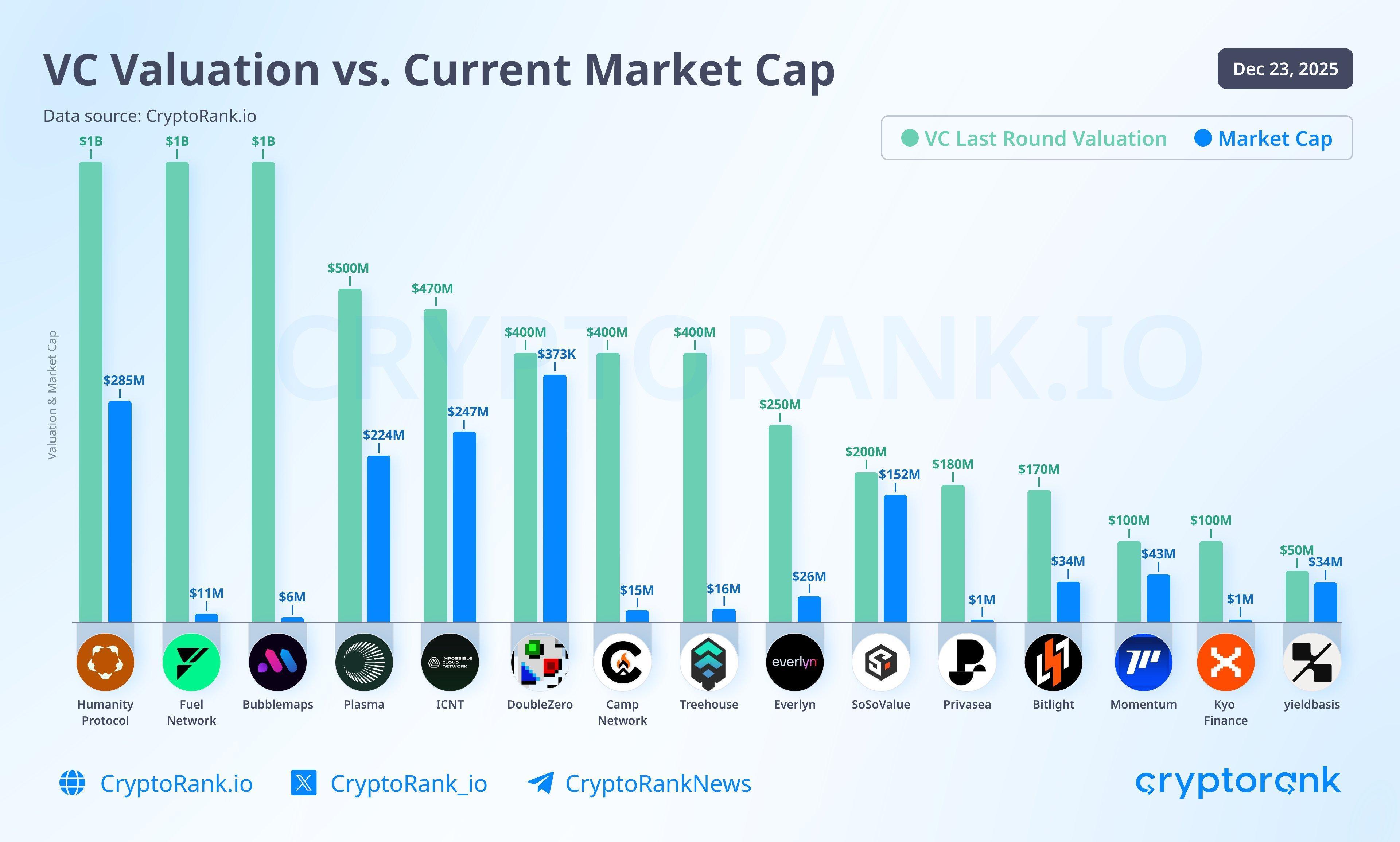
PANews, December 23 – According to a VC valuation and current market cap comparison chart released by CryptoRank, the market cap of most projects has shrunk significantly compared to their VC valuations, reflecting a correction of overvalued projects following a shift in market sentiment.
Data shows that Humanity Protocol, Fuel Network, and Bubblemaps each had a VC valuation of $1 billion, but their current market caps are only $285 million, $11 million, and $6 million, respectively. The market caps of projects such as Plasma, ICNT, DoubleZero, Camp Network, and Treehouse are also far below their VC valuations, standing at $224 million, $247 million, $373,000, $15 million, and $16 million, respectively.
In addition, the market caps of projects like Everlyn, SoSoValue, Privasea, Bitlight, Momentum, Kyo Finance, and Yieldbasis are all lower than their VC valuations. For example, Everlyn's market cap is only $26 million, while its VC valuation reached $250 million. CryptoRank reminds investors to calmly assess risks before investing and avoid being misled by market sentiment or hype.
Disclaimer: The content of this article solely reflects the author's opinion and does not represent the platform in any capacity. This article is not intended to serve as a reference for making investment decisions.
You may also like
Bank of England hawkish official: Growth exceeds expectations and employment is resilient, which precisely proves that further rate hikes are necessary.
Megan Greene, a policymaker at the Bank of England, stated that the UK's economic growth surpassing expectations and the resilience of the job market indicate that the Bank of England's efforts to curb inflation are still insufficient.
24 Hour Crypto Recap: Here’s What Happened in the Market
AI investment is reshaping the bond market! Sunak: By 2027, the net issuance of long-term bonds by technology companies may surpass that of the US government
By 2027, tech companies are expected to become larger net issuers of long-term debt than the U.S. government.
Crypto prices
More


