
Polymarket coming of age: Farewell, Polygon

As trading volume and compliance requirements increase, Polymarket is reconstructing the underlying infrastructure of the prediction market, bidding farewell to the Polygon era.
Written by: Sanqing, Foresight News
Recently, news that Polymarket will launch its own L2 blockchain has spread on Twitter. Upon verification, the information originated from the official Discord community, where Polymarket team member Mustafa confirmed in response to a user’s question that building a proprietary L2 has become the platform’s top priority.
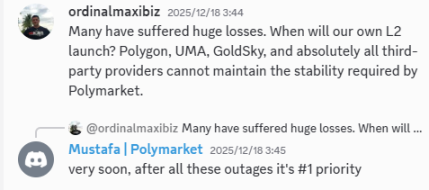
Image source: Polymarket’s Discord community, project member Mustafa replying to user messages
This statement means that Polymarket is transitioning from an application-layer protocol running on a general-purpose public chain to an infrastructure provider deeply customized for prediction markets. Whether it’s the frequently exposed performance bottlenecks, the controversial external oracle mechanism, or the pressures of IPO and compliance, all are pushing Polymarket toward a more sovereign technical route.
Farewell to Polygon: Breaking Free from the Performance Shackles of “Living Under Someone Else’s Roof”
For a long time, Polymarket was rooted in the Polygon network, enjoying the early benefits of low-cost scaling. However, as the application’s scale grew exponentially, the limitations of a general-purpose public chain began to evolve into a “ceiling” for business development.
In 2025, the Polygon mainnet experienced 15 different network anomalies, maintenance events, or outages, some of which caused delays in Polymarket’s order matching.
One severe incident occurred from December 12 to 13, when the Polygon network fell into a bizarre state of “Intermittent Stuck Transactions” for nearly 24 hours. This incident resulted in slow mainnet RPC responses, with a large number of betting orders stuck in the mempool, unable to proceed or retreat.
Another was the “Consensus Finalization Delay” on September 10, where although transaction confirmations on the Polygon mainnet were progressing, the consensus layer could not provide a “finality” determination. Settlements on the Polymarket platform entered a vacuum period lasting several hours, with predictions unable to be finally settled due to delays in the underlying public chain.
For a platform preparing for an IPO and backed by traditional financial giants such as ICE (the parent company of the New York Stock Exchange), such unreliability in underlying infrastructure is a compliance risk.
For users, missing the best betting opportunities due to network congestion during rapidly changing news events directly undermines the platform’s foundation of trust.
By building its own L2, Polymarket can escape the predicament of competing for block space with other dApps on Polygon and optimize for the trading characteristics of prediction markets.
This not only means a more stable network environment, but also that the platform will have more control over block ordering rights, thereby reducing transaction friction and reclaiming fees that would otherwise flow to external public chains.
In addition, Polymarket has long set up a dedicated Builder section and Wiki documentation on its website, systematically opening interfaces and tools to external developers and encouraging third parties to build applications and derivative products based on Polymarket’s prediction market capabilities.
Under the general-purpose public chain framework, these applications find it difficult to form a true ecological closed loop. But with the advancement of its own L2, these applications built around prediction, settlement, and information games will be able to migrate entirely to the native network, providing L2 with users, trading volume, and real use cases.
Oracle Reshaping: Filling the Trust Gap of Third-Party Mechanisms
If a high-performance, low-failure-rate L2 is the skeleton supporting the prediction empire, then the oracle is the heart that keeps this machine alive.
For a long time, Polymarket has deeply relied on the “optimistic mechanism” of the external UMA oracle, but with the surge in trading volume, this reliance is gradually becoming a fatal vulnerability.
UMA’s dispute resolution mechanism often requires a confirmation period of up to 48 hours when handling complex disputes, with 24 hours of anonymous voting followed by 24 hours of vote reveal.
This lengthy wait not only greatly delays capital turnover efficiency, but also leaves a backdoor for manipulation by large holders in the system’s design. Several major dispute incidents in 2025 have already become painful lessons of UMA’s mechanism failure.
The most notable among these was the “Zelensky Suit Case” involving $237 million in trading volume. Although Zelensky’s attire at the NATO summit was confirmed by multiple authoritative media outlets to meet the definition of a suit, UMA whales, for their own interests, forcibly voted the result as “No.”
The subsequent “Ukraine Mineral Agreement Case” made matters worse. In the absence of any official confirmation, UMA whales once again used their governance advantage to force a decision. Although Polymarket acknowledged the decision as “unexpected,” it refused compensation due to the underlying protocol’s permissions.
This “governance tyranny” that goes against objective consensus not only caused millions of dollars in losses, but also fundamentally mocked the fairness of decentralized prediction markets.
Previously, Polymarket had already begun shifting price feeds for cryptocurrency prediction markets to Chainlink. This shows that the platform has realized that in prediction markets requiring high accuracy and anti-manipulation, generic external voting mechanisms are no longer up to the task.
By vertically integrating a native oracle, Polymarket can build a trust system based on POLY token staking at the protocol’s core.
Routine settlements will be completed quickly and cheaply by highly automated native nodes, while extremely complex disputes will be adjudicated by real stakeholders of POLY.
This integration of a sovereign-level oracle not only shortens settlement cycles, but also eliminates the governance rent-seeking space created by external middleware.
The Dichotomy of Equity and Token Rights: POLY Token as Consumable
In discussions about the POLY token, the most noteworthy aspect is how to handle the relationship between “equity” and “token rights.”
Previously, as Polymarket’s valuation soared to $9 billion and IPO plans emerged, the market once worried that the tokenization path would be replaced by the compliant IPO process. However, its CMO Matthew Modabber later confirmed the issuance and airdrop plan for the POLY token on Twitter on October 24.
Therefore, combined with its infrastructure plan, it is clear that Polymarket is taking a unique “dual-track” approach.
The equity structure, as the carrier in the traditional fiat world, bears brand value, compliance licenses, and company profits, providing a long-term anchor for traditional investors; while the POLY token is defined as the “industrial raw material” and “operational consumable” of the entire prediction market.
It is no longer a vague governance credential, but the fuel that powers the L2 network, the necessary vehicle for staking oracle nodes, and the physical medium for settlement, clearing, and transaction fees within the ecosystem.
This concept of making the token a “consumable” can avoid being classified as a security and thus reduce regulatory risk. The token can also be deeply embedded into the protocol and applications, achieving a coupling of value capture and practical utility.
Disclaimer: The content of this article solely reflects the author's opinion and does not represent the platform in any capacity. This article is not intended to serve as a reference for making investment decisions.
You may also like
Tesla's sports car can really fly!
Tesla's second-generation Roadster was unveiled at the SpaceX test site, marking a significant debut nine years after pre-orders first began in 2017. Mass production is scheduled for 2028. The new vehicle features a fan suction system and compressed air thrusters, enabling genuine "flight." Elon Musk confirmed that this will be Tesla's last model to support manual driving. Analysts predict that sales of 7,000 units in the first year could generate nearly $2 billion in revenue, with extremely high profit margins being its core commercial value.
Earnings season is here! Citadel Securities: The next few weeks will be the real stress test for U.S. stock fundamentals
The US stock market enters Q3 earnings season, with market expectations for S&P 500 earnings per share to grow 27% year-over-year, marking the third highest threshold ahead of earnings seasons since 2010. However, the growth is highly concentrated—Micron and Nvidia alone contribute 36% of expected gains. Retail investors’ weekly net buying surged to $9.1 billion, with semiconductor purchases reaching a historic peak. Citadel Securities warns that index volatility has fallen to its calmest range in nearly 30 years, while individual stock risks are quietly rising, making stock picking preferable to simply increasing index allocations.
Dangerous signal? CoreWeave founders cash out $3.3 billion after IPO
The founder's sell-off objectively avoided a 60% drop in share price, and some have already liquidated nearly 40% of their wealth. Behind this stark contrast, the company is burdened with a massive $52 billion debt, with a five-year default probability exceeding 60%. The current debt stands at $52 billion, and the cumulative negative free cash flow for 2026-2028 is projected to reach $71 billion. Its model of "borrowing at 9% interest to earn a 1% return" has been harshly criticized as the "subprime crisis" of the AI industry. The high-leverage computing power financing game is now facing the market's ultimate test.

Strategy Braces for $2.8B Liquidation Shock as MSCI Changes Index Rules
Crypto prices
More


