

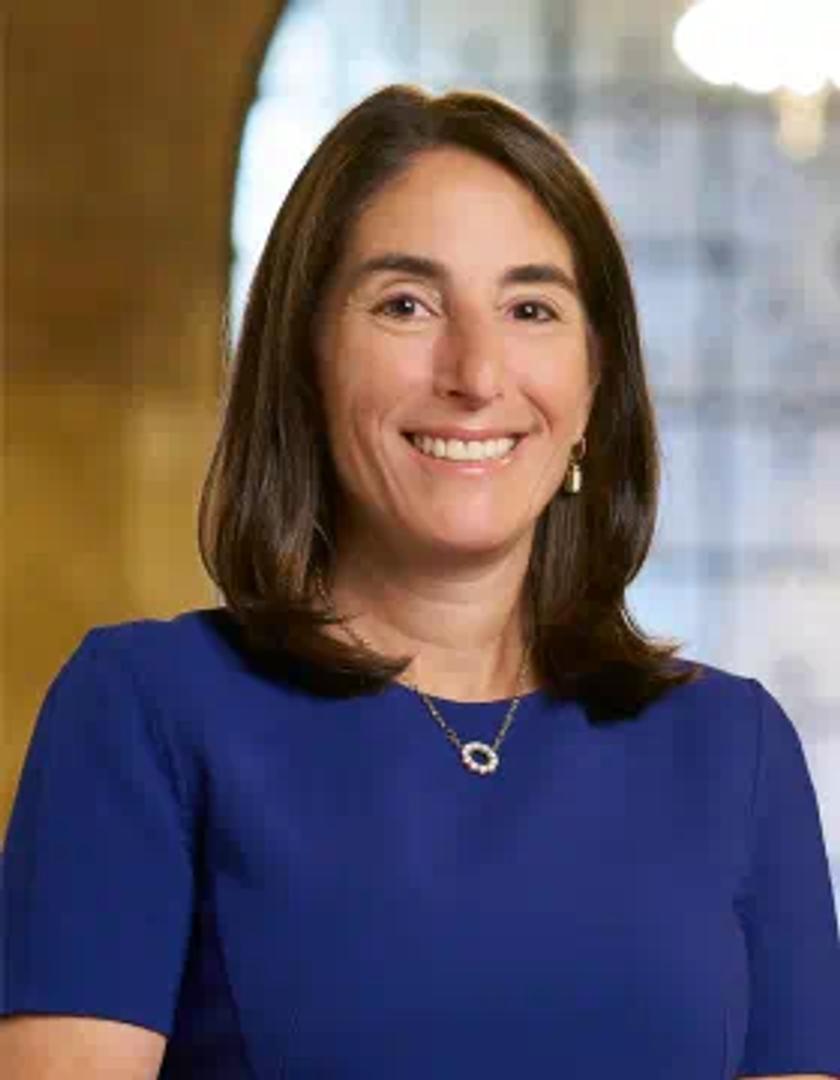
What you need to know: Beth Hammack, President of the Federal Reserve Bank of Cleveland, will become a voting member of the central bank's policy-making committee (FOMC) in 2026. She stated that interest rates need to remain unchanged for several months. She expressed dissatisfaction with last week's unexpectedly weak Consumer Price Index (CPI) report, pointing out that data collection was distorted by the government shutdown. All else being equal, bitcoin typically benefits from a more accommodative Federal Reserve monetary policy, but this has not been the case in 2025.
Since her appointment in 2024, Beth Hammack, President of the Federal Reserve Bank of Cleveland and former Goldman Sachs executive, has undoubtedly become one of the most hawkish members of the U.S. Federal Reserve System.
However, next year she will be in a more prominent position to advance these views. The Federal Open Market Committee (FOMC) of the Federal Reserve is responsible for setting interest rate policy. Of its twelve voting members, four are among the eleven regional Fed presidents, who rotate into one-year terms. In 2026, Hammack, President of the Federal Reserve Bank of Cleveland, will join this voting group.
“My baseline judgment is that we can hold here (on rates) for a while, until we get clearer evidence that inflation is either coming back down to target or that the employment situation is more clearly deteriorating,” Hammack told The Wall Street Journal over the weekend.
“I am cautious about this,” Hammack said regarding last week’s November consumer price report, which showed the overall inflation rate dropping sharply from 3.1% to 2.7%, with a similar decline in core inflation.
Hammack blamed the data distortion on last fall’s government shutdown, and her own calculations estimate the inflation rate at around 2.9% or 3.0%, which aligns with previous economists’ forecasts.
All else being equal, a more accommodative central bank monetary policy is considered favorable for risk assets such as stocks, commodities, and bitcoin BTC$87,997.00. While this has indeed been the case for stocks and commodities like gold and silver this year—they are all at or near all-time highs—bitcoin has struggled, beginning to decline shortly after the Fed’s first rate cut in September and moving away from its all-time high.
Major Disagreement with Waller
Among the candidates for the next Federal Reserve Chair under President Trump, current Fed Governor Chris Waller is one of them.
Three days ago, Waller stated that he believes the current federal funds rate range of 3.5%-3.75% is 50 to 100 basis points above the neutral level—meaning the Fed’s policy remains relatively tight.
However, Hammack told The Wall Street Journal that the current federal funds rate range is “slightly below” the neutral rate, meaning she believes the current policy is at least somewhat stimulative.
This is a significant difference between two key policymakers for 2026. Regardless of where rates go in 2026, dissenting votes often occur, though the results are usually unanimous or nearly so. Whoever ultimately becomes Fed Chair may find it difficult to secure the seven votes needed to set policy at each meeting.


