
SEC Grants Fuse No-Action Letter, Boosting Regulatory Clarity for Crypto Token Incentives

Quick Breakdown:
- The U.S. SEC issued a rare no-action letter granting regulatory protection for Fuse’s FUSE token.
- The no-action letter is contingent on the FUSE token being used strictly for network utility and distributed as an incentive for infrastructure maintenance, rather than sold for public speculation.
- The decision is seen as a sign of broader changes and increased openness to crypto projects under the new SEC Chairman.
SEC endorses Utility-Driven token models
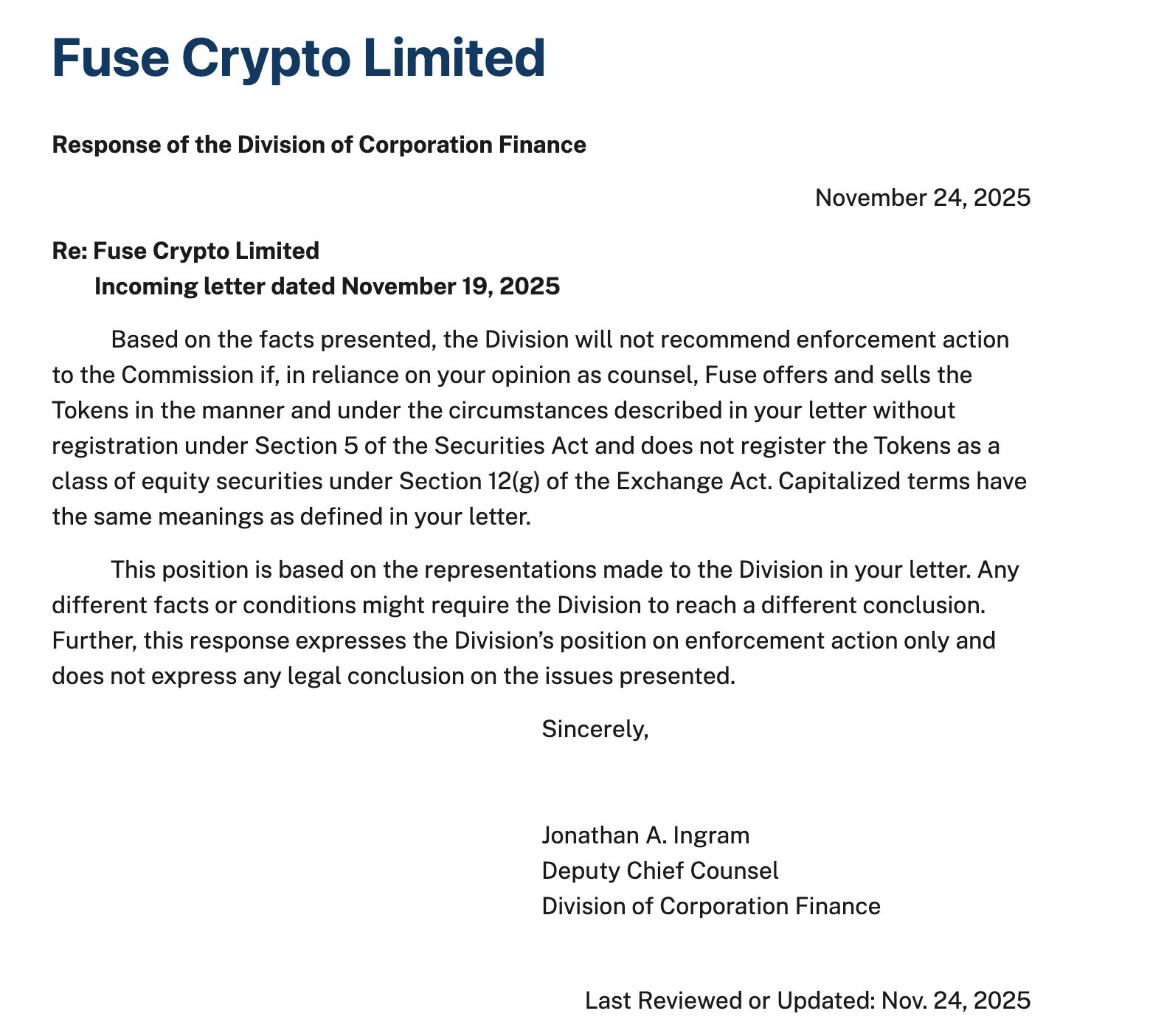
The U.S. Securities and Exchange Commission (SEC) has issued a rare no-action letter to the decentralized physical infrastructure network (DePIN) project Fuse, which operates on Solana. The SEC’s decision confirms that it will not pursue enforcement actions related to the project’s FUSE token so long as it is used strictly for network utility and distributed as an incentive for infrastructure maintenance, rather than sold to the public. This regulatory stance allows Fuse to proceed without fear of immediate legal challenge and offers a precedent for similar token-based ecosystem rewards.
 Source:
SEC
Source:
SEC
Fuse’s submission detailed how FUSE tokens are essential to network operations, consumed strictly for technical functions rather than speculation. According to the SEC, as long as Fuse continues to follow this model, network contributors can expect regulatory “cover,” marking a significant shift from earlier periods of regulatory uncertainty.
New SEC leadership signals greater openness to crypto
The no-action letter to Fuse comes amid broader changes at the SEC under new Chairman Paul Atkins, who took office in April. The leadership change has clearly shifted the SEC’s approach, leading to more open dialogue with crypto projects. In recent months, the agency has granted similar relief to DoubleZero , another DePIN project, as well as to crypto custodians that aren’t traditional banks, signalling a broader push toward clearer, more consistent guidance. Legal experts point out that the Fuse case was relatively straightforward from a regulatory standpoint, since the FUSE token is built for functional use within the network, similar to miner rewards in Proof-of-Work systems, rather than for passive investment.
Crypto lawyers and project teams have welcomed the SEC’s shifting stance, saying that no-action letters offer much-needed clarity and help cut down regulatory risk for blockchain startups. Industry observers emphasize that while these decisions do not establish sweeping precedents, they demonstrate a pragmatic shift and a baseline for what network-driven, utility-based tokens must meet to remain outside federal securities laws.
Take control of your crypto portfolio with MARKETS PRO, DeFi Planet’s suite of analytics tools.”
Disclaimer: The content of this article solely reflects the author's opinion and does not represent the platform in any capacity. This article is not intended to serve as a reference for making investment decisions.
You may also like
Deutsche Bank, Charles Schwab double down on crypto as Bitcoin gains on TradFi

VeChain Slides 8.3%: Is This a Healthy Correction or a Bigger Warning Sign?
Stablecoin supply has stalled in 2026, but payments rose by 45% to $480B: Report

The most dangerous divergence in U.S. stocks: ordinary stocks have already plummeted, how much longer can AI giants hold on?
Significantly tightened financial conditions are heavily impacting ordinary stocks in the US stock market, with the median S&P 500 constituent falling 15% from its peak and the equity risk premium dropping below zero. Rising US Treasury yields and oil prices have pushed the financial conditions index sharply higher, resulting in a severe deterioration in breadth beneath the apparent calm of the index. Market divergence is intensifying, raising the core uncertainty of whether ordinary stocks will catch up or the index will converge downward.

Crypto prices
More


