
ECB Says Stablecoin Risks in Euro Area Remain Low Despite Market Growth

Quick Breakdown
- ECB report finds stablecoin adoption in the eurozone remains low and mostly tied to crypto trading.
- Dollar-pegged stablecoins dominate globally but have limited links to euro financial markets.
- EU’s MiCA regulations expected to curb risks and prevent cross-border regulatory arbitrage.
ECB: stablecoin risks limited as use remains focused on crypto trading
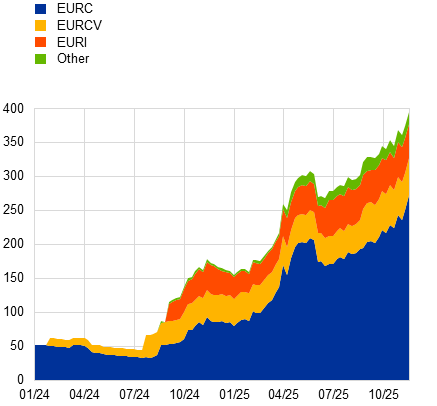
The European Central Bank (ECB) has downplayed concerns over stablecoin-related threats to Europe’s financial system, saying their limited adoption outside crypto markets keeps risks contained for now.
 Source:
ECB
Source:
ECB
In a pre-release of its latest financial stability review published on Monday, ECB analysts Senne Aerts, Claudia Lambert and Elisa Reinhold explained that stablecoins digital tokens pegged to fiat currencies or commodities are still primarily used within the crypto ecosystem rather than the broader economy.
Crypto trading still the main driver of stablecoin demand
The report identifies crypto trading as the dominant use case for stablecoins, despite years of claims that they could revolutionize payments. According to the ECB, other applications including cross-border payments have seen minimal traction.
The bank cited IMF research showing that while many stablecoin flows move across borders, there is no evidence that these transactions are meaningfully tied to remittances. Retail adoption is even smaller: Visa estimates that only around 0.5% of stablecoin activity involves small organic payments under $250.
US dollar stablecoins dominate, but EU exposure is limited
Although dollar-denominated stablecoins such as Tether’s USDT and Circle’s USDC control about 84% of the global market, their links to the eurozone financial system remain “limited,” the report noted. This lack of integration reduces the likelihood of spillover risks, even as the market continues expanding.
The ECB also highlighted Europe’s regulatory advantage. MiCA, the EU’s flagship crypto regulation, includes measures like banning interest payments on stablecoin holdings, which the bank says will help curb risky behaviour.
A policy shift ahead of the digital Euro
The report marks a shift in tone from earlier ECB comments suggesting that US stablecoins threaten Europe’s monetary sovereignty. Senior officials, including executive board member Piero Cipollone, have previously argued that dollar-backed tokens could undermine EU payment systems.
Now, the ECB appears more confident in its regulatory framework while pushing ahead with its own central bank digital currency (CBDC). The digital euro is expected to begin pilot tests in 2027, with the first possible issuance slated for 2029.
Take control of your crypto portfolio with MARKETS PRO, DeFi Planet’s suite of analytics tools.”
Disclaimer: The content of this article solely reflects the author's opinion and does not represent the platform in any capacity. This article is not intended to serve as a reference for making investment decisions.
You may also like
In July, Trump Disclosed Over 1,000 Securities Transactions: Sold Microsoft and Amazon, with Single Transaction Up to $25 Million
The total trading volume of the account under Trump's name in July ranged from $79 million to $270 million. On July 20th, the account sold Microsoft and Amazon, with each transaction amounting to between $5 million and $25 million, making them the largest trades of the month. The account also sold Oracle and purchased Intuit, Salesforce, Marvell, and Nvidia. On the same day, the account sold shares of defense giant Northrop Grumman, while Trump signed an executive order tightening supply chain requirements for defense contractors.
A Bold Claim from an Experienced CEO: “The Fed’s Interest Rate Hike Will Benefit Bitcoin”
Ripple’s XRP gains traction as banks accelerate On-Demand Liquidity adoption

Barrick, Equinox among TD Cowen’s best stock picks
Crypto prices
More


