
Trezor rolls out the first quantum-ready hardware wallet with transparent secure element

Trezor has launched the Safe 7, a next-generation hardware wallet featuring the world’s first transparent secure element and a quantum-ready architecture.
- Trezor Safe 7 offers a transparent secure element, dual-chip isolation, quantum-ready architecture, touchscreen confirmation, wireless charging, and broad crypto support.
- It arrives as quantum threats rise, future-proofing crypto against “Harvest-Now-Decrypt-Later” attacks.
In a press release shared with crypto.news, Trezor announced the launch of the Safe 7, a next-generation hardware wallet featuring two industry-first innovations: a fully auditable secure element and a quantum-ready architecture.
At the heart of the device is TROPIC01, the world’s first transparent secure element, allowing the crypto community to inspect and verify its design. This addresses a long-standing security challenge: trusting proprietary hardware without insight into how it works.
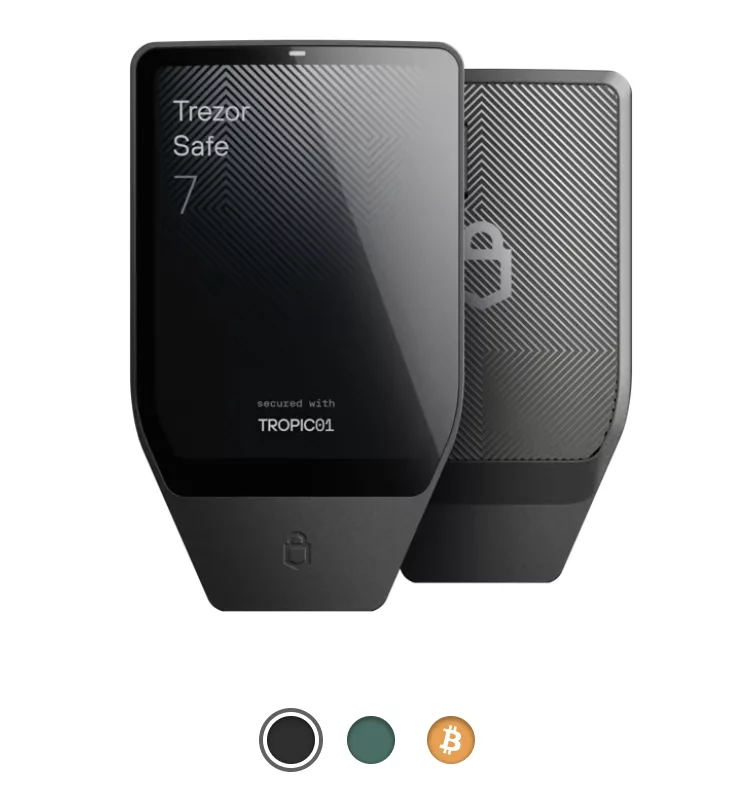 Trezor’s quantum-ready hardware wallet | Source: Safe 7 | trezor.io
Safe 7 is also built with quantum-ready architecture, ensuring the device can support post-quantum secure updates in the future. The wallet combines this future-proof security with a dual-chip design, keeping private keys isolated while requiring physical confirmation on a 2.5-inch high-resolution color touchscreen.
Other features include Bluetooth Low Energy connectivity, Qi2-compatible wireless charging, a durable aluminum unibody with Gorilla Glass protection, and IP54 resistance against dust and splashes. The device supports thousands of coins, staking, and third-party integrations via the Trezor Suite platform. The Safe 7 is available in Charcoal Black and Bitcoin-only editions for $249.
Trezor’s Safe 7 comes at a time when the crypto industry is increasingly worried about quantum computing threats . As advances in quantum technology accelerate, experts warn that current cryptographic algorithms protecting digital assets could eventually be broken, putting billions in digital wealth at risk.
“Harvest-Now-Decrypt-Later attacks are already underway. Hostile governments and cybercriminal groups are stockpiling encrypted data—medical files, financial transactions, classified intelligence, private communications—confident that quantum computers will eventually crack it,” said David Carvalho, Founder and CEO of Naoris Protocol, in a recent interview with crypto.news.
“Within the next decade, Bitcoin and other blockchains will have to move to post-quantum algorithms . It’s not a question of if, but when. That’s why we built a quantum-ready bootloader into Safe 7,” said Trezor CTO Tomáš Sušanka.
Other companies (e.g. Qastle ) are also beginning to explore quantum-resistant solutions, signaling a broader trend in the industry to anticipate next-generation threats before they materialize.
Disclaimer: The content of this article solely reflects the author's opinion and does not represent the platform in any capacity. This article is not intended to serve as a reference for making investment decisions.
You may also like
Societe Generale’s cost-cut plan targets €1.9B in savings by 2029
The "debt black hole" behind the AI boom: $1.2 trillion external financing may be needed in the next five years
The rapid surge of AI is creating an unprecedented "debt black hole": according to Bank of America estimates, total capital expenditure for building AI data centers between 2025 and 2030 will reach as much as $5 trillion, with external financing needs of core cloud giants alone reaching $1.2 trillion to $1.5 trillion. Free cash flow is already running low for giants such as Amazon and Meta, while Nvidia and Broadcom have quietly taken on the role of "implicit guarantors"—marking the beginning of a capital gamble that is set to reshape global credit markets.
Analyst Makes Bold Prediction: Micron (MU.US) Expected to Surpass Microsoft (MSFT.US) in Fiscal Year 2027 Profit; Memory Prices Are the Key Factor
Is Micron (MU.US) expected to earn a net profit of $35 billion in a quarter, surpassing Microsoft's (MSFT.US) profits?
Crypto prices
More


