
House of Doge Acquires Italian Soccer Team

House of Doge, the corporate arm of the Dogecoin Foundation, has acquired a majority stake in Italy’s soccer team US Triestina Calcio 1918, marking a milestone in the convergence of digital assets and traditional industries. The move comes as cryptocurrency firms seek tangible footholds in regulated sectors. By acquiring a century-old European football club, House
House of Doge, the corporate arm of the Dogecoin Foundation, has acquired a majority stake in Italy’s soccer team US Triestina Calcio 1918, marking a milestone in the convergence of digital assets and traditional industries.
The move comes as cryptocurrency firms seek tangible footholds in regulated sectors. By acquiring a century-old European football club, House of Doge is translating token-based enthusiasm into real-world ownership and signaling a shift in how crypto brands pursue legitimacy and growth.
Crypto and Football: A Growing Alliance
House of Doge becomes Triestina’s largest shareholder, bringing capital and blockchain plans. The club, based in Italy’s Serie C, will test cryptocurrency-based ticketing and merchandise payments.
The acquisition was executed in collaboration with Brag House Holdings, House of Doge’s publicly traded merger partner. Brag House provided the listed structure that enabled the purchase and continues to oversee governance and market access. Together, the firms are integrating Brag House’s gaming and fan ecosystem with House of Doge’s blockchain network, creating a single framework that connects digital communities with traditional sports audiences.
“Our investment is about proving that digital assets can drive real-world value, culture, and passion. Football provides the ideal stage to demonstrate how decentralized communities can create sustainable impact,” said Marco Margiotta, CEO of House of Doge.
It’s official! House of Doge is now the majority owner of U.S. Triestina 1918, one of Italy’s oldest professional football clubs!Dogecoin was founded on Community—and the world’s game is one of the biggest communities there is. We will support Triestina with immediate capital…
— House of Doge (@houseofdoge) October 20, 2025
Analysts note that crypto firms are converting on-chain communities into off-chain assets that generate revenue. By entering sports, gaming, and entertainment, companies like House of Doge aim to balance volatility with stable operations.
Expanding the Industry’s Legitimacy
The link between cryptocurrency and football is growing quickly. Clubs now use blockchain for sponsorships, fan-voting, and tokenized loyalty systems. For crypto firms, partnerships with trusted teams bring access to millions of fans and help reinforce credibility.
In 2025, Tether increased its stake to 10.7% in Juventus F.C., becoming the second-largest shareholder. The firm aims to expand fan-token integration and stablecoin payments in Serie A. Bitpanda also teamed with Arsenal F.C. and Paris Saint-Germain F.C. to enhance blockchain-based fan rewards. Socios continues its partnerships with FC Barcelona and Inter Milan to build global fan engagement.
The House of Doge deal aligns with its plan to go public via a reverse merger with Brag House Holdings (TBH). TBH also began trading in March at about $4.30 per share but has since fallen to $1.13, a drop of nearly 74%. This reflects the broader volatility among small-cap digital asset firms.
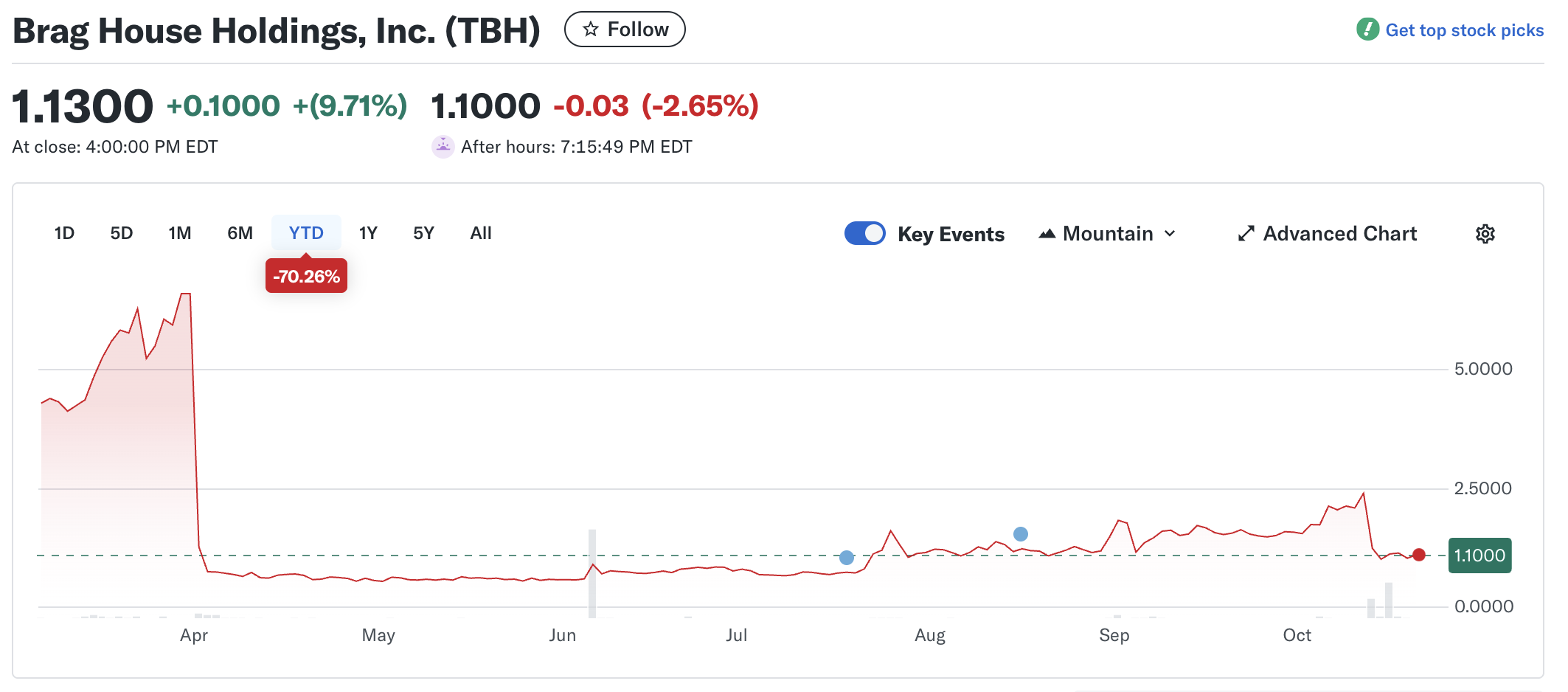 TBH Performance Since Launch /
Source:Yahoo
TBH Performance Since Launch /
Source:Yahoo
Dogecoin (DOGE) trades near $0.20—up 1.9% from yesterday but down 25% over the month. Its one-year high was $0.466, recorded on December 8 last year. At that time, optimism about a potential $1 breakout was strong, but the current price represents a decline of roughly 57% from that peak.
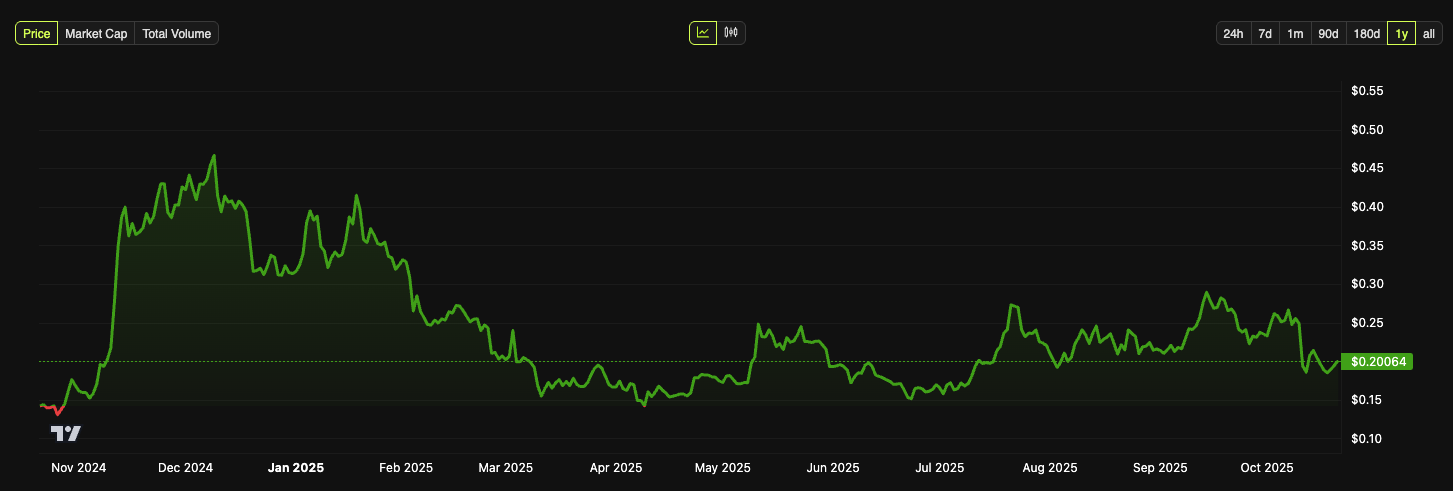 DOGE performance over the past year / Source: BeInCrypto
Disclaimer: The content of this article solely reflects the author's opinion and does not represent the platform in any capacity. This article is not intended to serve as a reference for making investment decisions.
You may also like
XRP Pundit: First Thing You Should Do When You Become a Crypto Millionaire
 VIPTradFi Focus: Where Does the RWA Market Stand Today?
1. Crypto outperformed traditional equity indexes following the rate hike, but elevated interest rates remain a key constraint on cross-asset allocation. From September 12 to 18, BTC, ETH, and SOL gained 4.83%, 3.84%, and 9.96%, respectively, while the S&P 500 edged down 0.08%. The U.S. Dollar Index rose 1.11%, and the 10-year U.S. Treasury yield closed at approximately 4.998%. Improving risk appetite is therefore coexisting with elevated discount rates, raising the bar for RWA allocation: investors need to compare not only returns on the underlying assets, but also on-chain liquidity and collateral efficiency. 2. Growth in tokenized equities is occurring even as the overall RWA market remains under pressure. As of September 18, Distributed Asset Value across RWAs stood at $38.503 billion, down 1.13% week over week, while tokenized equities reached $3.056 billion, up 6.03%. This week's data are better explained by capital reallocating across different RWA segments than by a broad-based expansion of the entire RWA market. 3. For exchanges, the opportunity lies in connecting spot holdings, collateral, and derivatives. Reality's distributed asset value stands at approximately $155 million, while eligible rTokens can already be used within Bitget's UTA margin framework. Across CoinGlass's verifiable sample of 177 TradFi instruments, open interest reached approximately $11.498 billion, up 2.06% week over week, even as weekly trading volume declined 7.60%. The medium-term opportunity remains intact, but deeper utilization will depend on liquidity, collateral use, and sustained trading activity. 4.Assets to watch: BTC, ETH, SOL, NEAR, ZEC, gold, tokenized U.S. equities, COST. 5.Key metrics to watch: rToken collateral utilization, the durability of TradFi open interest and trading volume, and next week's employment and consumer data.

Gold prices fall Rs 1,331/10 gram, silver dips Rs 1,600/kg as Mideast tensions outweigh oil fall: Key levels to track
Strategists Say Market's ‘Wall of Worry' Is Healthy, Not a Warning Sign
Crypto prices
More


