
Polymarket Cracks Down on Airdrop Farmers Ahead of Token Launch

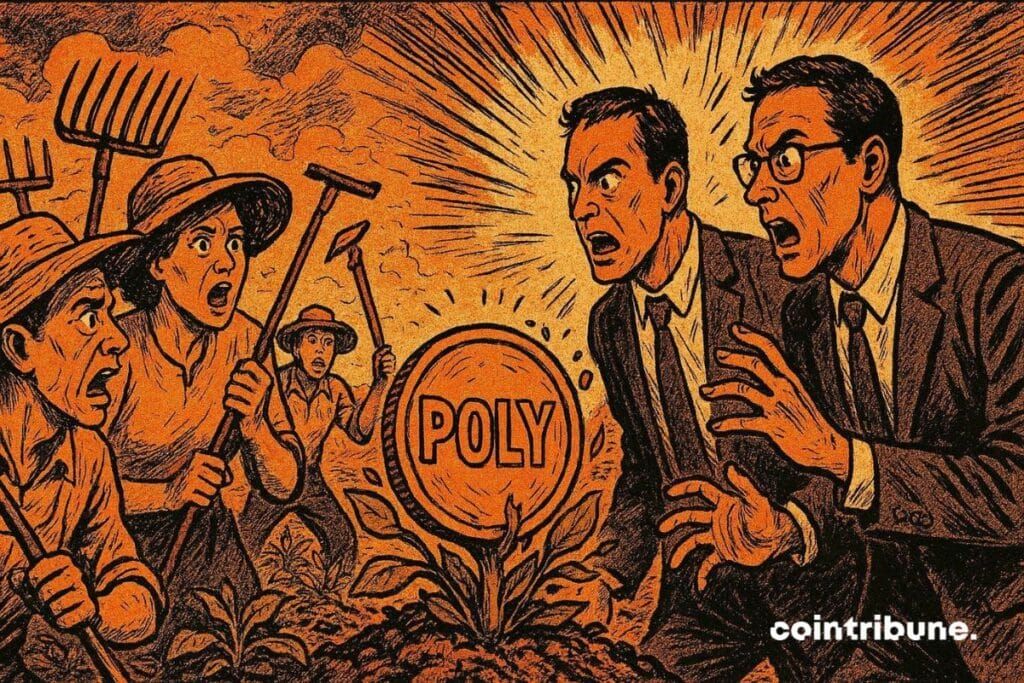
As the highly anticipated launch of its POLY token approaches, Polymarket sees its users redoubling their ingenuity to maximize their chances of getting a slice of the pie. Between sophisticated farming techniques and challenges for the platform, the crypto ecosystem is witnessing a new battle.
In brief
- Polymarket farmers are sophisticating their techniques to maximize their gains before the launch of the POLY token scheduled for 2026.
- Polymarket must innovate to distinguish real users from speculators, under penalty of controversies.
- POLY/ETH comparison: two opposing distribution models, with major implications for the future of crypto airdrops.
Polymarket facing the influx of farmers: a cat-and-mouse game that intensifies
Since 2024, Polymarket has been in the spotlight. The rapidly expanding prediction platform is actively developing its POLY token, scheduled for 2026. This prospect has triggered a rush towards crypto airdrops, those free token distributions aimed at rewarding the most active users.
Last year, farming techniques were still rudimentary: users made round trips on the same positions to artificially inflate their trading volumes. These practices, easy to spot, ended up saturating feeds and harming the experience of legitimate traders. In 2025, the landscape changed. Polymarket farmers have refined their methods , making their activities far more discreet.
Influential figures like Fhantom Bets and CSP Trading, experienced traders on Polymarket, confirm this evolution. According to them, obvious wash trading patterns have almost disappeared, replaced by subtler strategies. Users now optimize their activity to resemble ordinary crypto traders while maximizing their chances to be among the airdrop beneficiaries.
Crypto: a token in the crosshairs — Can Polymarket win the game?
Polymarket’s timeline is clear: the POLY token should not see the light of day before 2026. The platform first wants to consolidate its position in the United States, a strategic market after years of absence. This wait has not discouraged crypto farmers, quite the opposite. It simply pushed the platform to double down on vigilance.
The challenge is huge. Polymarket must identify real users among a crowd of increasingly organized farmers. Traditional detection methods, like spotting suspicious volumes, are no longer enough. The platform must innovate to preserve the fairness of its reward system without discouraging legitimate engagement from its crypto users.
A paradox emerges: the more farmers perfect their techniques, the more Polymarket must refine its detection tools. This technological arms race could well define the platform’s future. If it fails to separate the wheat from the chaff, the launch of POLY risks being marred by controversies, as has happened with other crypto projects.
POLY vs ETH: two opposing visions of token distribution
Ethereum made crypto history in 2014 with a successful token sale, without resorting to airdrops. ETH tokens were distributed via a public sale, reserving 60% of the funds for the foundation and early contributors. This approach allowed Ethereum to build a solid community focused on network utility:
- Smart contracts;
- DeFi;
- NFT.
Today, Ethereum is a safe bet, despite criticism on initial centralization.
Polymarket, on the other hand, is betting on an airdrop to reward its most active users. A risky strategy because it inevitably attracts farmers willing to do anything to maximize their gains. The challenge for POLY will be to prove its utility beyond speculation. Without clear governance or concrete advantages (fee reductions, access to exclusive features), the crypto token could struggle to establish itself.
The upcoming introduction of the POLY token promises to be a pivotal moment for Polymarket, which also wants to launch its own stablecoin . Between the ingenuity of farmers and the platform’s challenges, finding balance will be difficult. One thing is certain: if POLY wants to endure, it will have to offer much more than just a speculative reward. And you, do you think airdrops remain an effective tool for building crypto communities?
Disclaimer: The content of this article solely reflects the author's opinion and does not represent the platform in any capacity. This article is not intended to serve as a reference for making investment decisions.
You may also like
XRP Pundit: First Thing You Should Do When You Become a Crypto Millionaire
 VIPTradFi Focus: Where Does the RWA Market Stand Today?
1. Crypto outperformed traditional equity indexes following the rate hike, but elevated interest rates remain a key constraint on cross-asset allocation. From September 12 to 18, BTC, ETH, and SOL gained 4.83%, 3.84%, and 9.96%, respectively, while the S&P 500 edged down 0.08%. The U.S. Dollar Index rose 1.11%, and the 10-year U.S. Treasury yield closed at approximately 4.998%. Improving risk appetite is therefore coexisting with elevated discount rates, raising the bar for RWA allocation: investors need to compare not only returns on the underlying assets, but also on-chain liquidity and collateral efficiency. 2. Growth in tokenized equities is occurring even as the overall RWA market remains under pressure. As of September 18, Distributed Asset Value across RWAs stood at $38.503 billion, down 1.13% week over week, while tokenized equities reached $3.056 billion, up 6.03%. This week's data are better explained by capital reallocating across different RWA segments than by a broad-based expansion of the entire RWA market. 3. For exchanges, the opportunity lies in connecting spot holdings, collateral, and derivatives. Reality's distributed asset value stands at approximately $155 million, while eligible rTokens can already be used within Bitget's UTA margin framework. Across CoinGlass's verifiable sample of 177 TradFi instruments, open interest reached approximately $11.498 billion, up 2.06% week over week, even as weekly trading volume declined 7.60%. The medium-term opportunity remains intact, but deeper utilization will depend on liquidity, collateral use, and sustained trading activity. 4.Assets to watch: BTC, ETH, SOL, NEAR, ZEC, gold, tokenized U.S. equities, COST. 5.Key metrics to watch: rToken collateral utilization, the durability of TradFi open interest and trading volume, and next week's employment and consumer data.

Gold prices fall Rs 1,331/10 gram, silver dips Rs 1,600/kg as Mideast tensions outweigh oil fall: Key levels to track
Strategists Say Market's ‘Wall of Worry' Is Healthy, Not a Warning Sign

Crypto prices
More


