
Fake Pi Coins Appear on Prashu DEX Amid Unverified Stellar Integration Rumors

Fraudulent Pi token listings on the Prashu platform have fueled confusion amid unverified partnership rumors. While Pi Network and Stellar share some technical origins, they operate independently—making vigilance essential for users.
Fraudulent listings purporting to offer Pi Coins (PI) for trading on the Stellar (XLM) blockchain have emerged on a decentralized exchange (DEX), prompting warnings from users.
The scam surfaced amid rumors suggesting that Pi Network might leverage Stellar as a settlement layer for its upcoming decentralized applications (dApps).
Scam Warning: Fake PI Listings Appear on Prashu Platform
Screenshots circulating on X (formerly Twitter) showed an interface from the platform Prashu that included multiple “PI” assets supposedly available for trading. The listings included price and issuer details designed to mimic legitimate tokens, giving the impression of authenticity.
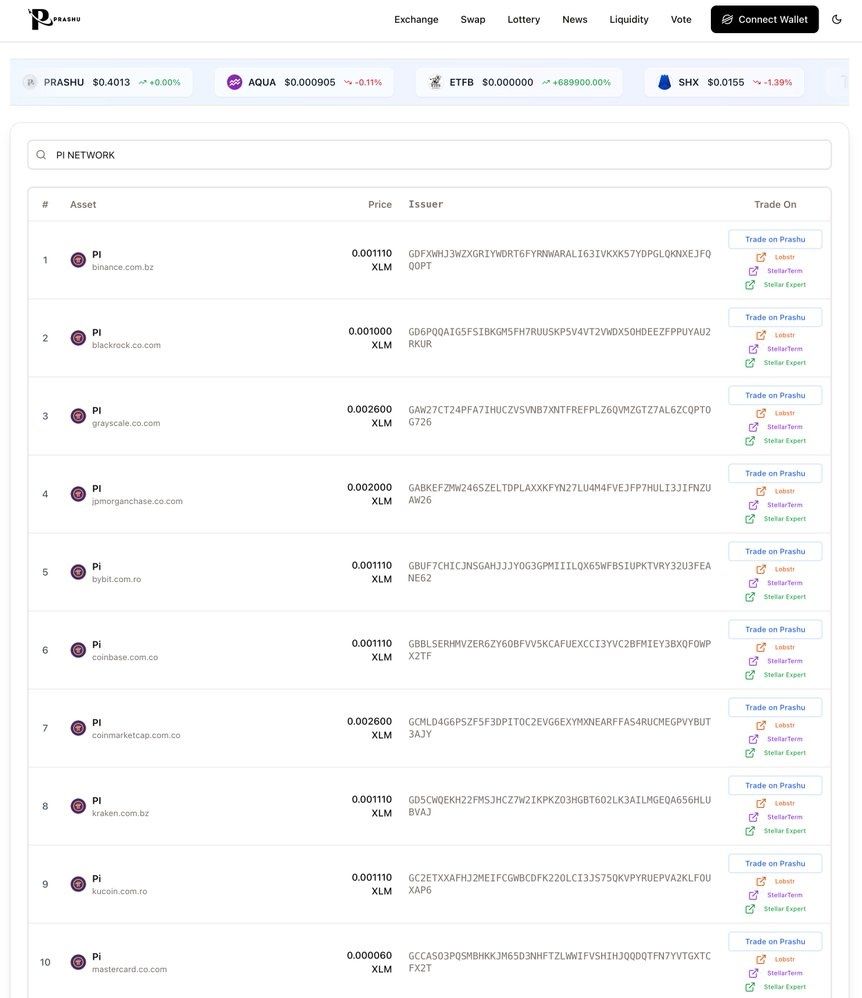 PI Network Scam On Parshu. Source:
However, prominent Pioneers quickly raised the alarm, labeling the listings as fake and urging users not to interact with the platform.
“This is a scam – do not buy PI on the Stellar network. For all we know Prashu is in on the scam. The addresses linked to the tokens are clearly fake,” a Pioneer stated.
🚨 PEOPLE ARE ASKING about $Pi Network token on the Stellar $XLM network.AT THE MOMENT, there is no verified Pi token on #Stellar.Always DYOR before buying anything.
— Lumexo | Stellar Wallet (@lumexodapp) October 18, 2025
Notably, Prashu, marketed as a Stellar-based DEX, has been suspended. It’s not the first time that the platform has been involved in such a controversy.
In August, a user publicly accused Prashu of theft following a rigged giveaway that lured participants into revealing private keys, resulting in the loss of crypto holdings.
“SCAM ALERT!!!! They stole my tokens. Someone organized a giveaway – 1000 XLM to win – you had to make any transaction on Prash. They provided a link to an exchange, and the only “Wallet Connect” option was a private key. You had to like the post, retweet it, and comment “done”. And I did it. The next day, USDC and TKG disappeared from my account,” the user explained.
Protocol Confusion: Pi Network’s Path Versus Stellar
The scam coincides with unverified reports of a Pi-Stellar partnership. One user claimed Pi Network will launch real-world asset trading dApps using Stellar as the settlement layer. The post stated,
“Pi Network is expected to launch dApps for RWA trading by early 2026, with XLM as the settlement layer. This is adding 60 million users to the Stellar XLM ecosystem with a single integration. Unlocking instant access to its full DeFi infrastructure. Parallel transactions & smart contracts enable trading of real-world assets.”
However, once again, the community was quick to question the credibility of these claims. Many Pioneers pointed out that Pi Network already operates on its own blockchain, so it doesn’t need Stellar.
“That doesn’t even make sense. Pi would use it’s own blockchain for settlement,” another user replied.
Furthermore, neither Pi Network’s Core Team nor the Stellar Development Foundation has made any official announcements confirming such a collaboration. The absence of official statements further emphasizes that the partnership narrative likely stems from community speculation rather than verified developments.
Meanwhile, Pi Network and Stellar have a long-standing and often confusing relationship. Although the Pi Network borrows from Stellar, the blockchains remain separate. Owning XLM provides no privileges in the Pi Network, and actual PI transactions do not interact with Stellar’s ledger.
Official documentation clarifies the distinction: Pi Network’s consensus mechanism is adapted from two key technologies: the Stellar Consensus Protocol (SCP) and the Federated Byzantine Agreement (FBA)
This enables energy-efficient validation via trust graphs, eschewing proof-of-work’s power demands. The separation was reiterated in Pi Network’s August announcement of its protocol upgrade from version 19 to 23.
“Pi Network is preparing an important upgrade: the move from protocol version 19 to version 23. The Pi protocol is adapted from Stellar protocol. This version is a custom Pi protocol built on a base pulling upgrades from Stellar protocol version 23 that enables new layers of functionality and control,” the team stated.
The latest fake token incident again highlights how quickly misinformation can spread in crypto communities—especially when rumors of high-profile partnerships gain traction. While Pi Network and Stellar share certain technical roots, they remain separate ecosystems.
Thus, users should remain cautious, verify information from trusted sources, and avoid engaging with unverified platforms claiming to list or trade Pi Coins.
Disclaimer: The content of this article solely reflects the author's opinion and does not represent the platform in any capacity. This article is not intended to serve as a reference for making investment decisions.
You may also like
XRP Pundit: First Thing You Should Do When You Become a Crypto Millionaire
 VIPTradFi Focus: Where Does the RWA Market Stand Today?
1. Crypto outperformed traditional equity indexes following the rate hike, but elevated interest rates remain a key constraint on cross-asset allocation. From September 12 to 18, BTC, ETH, and SOL gained 4.83%, 3.84%, and 9.96%, respectively, while the S&P 500 edged down 0.08%. The U.S. Dollar Index rose 1.11%, and the 10-year U.S. Treasury yield closed at approximately 4.998%. Improving risk appetite is therefore coexisting with elevated discount rates, raising the bar for RWA allocation: investors need to compare not only returns on the underlying assets, but also on-chain liquidity and collateral efficiency. 2. Growth in tokenized equities is occurring even as the overall RWA market remains under pressure. As of September 18, Distributed Asset Value across RWAs stood at $38.503 billion, down 1.13% week over week, while tokenized equities reached $3.056 billion, up 6.03%. This week's data are better explained by capital reallocating across different RWA segments than by a broad-based expansion of the entire RWA market. 3. For exchanges, the opportunity lies in connecting spot holdings, collateral, and derivatives. Reality's distributed asset value stands at approximately $155 million, while eligible rTokens can already be used within Bitget's UTA margin framework. Across CoinGlass's verifiable sample of 177 TradFi instruments, open interest reached approximately $11.498 billion, up 2.06% week over week, even as weekly trading volume declined 7.60%. The medium-term opportunity remains intact, but deeper utilization will depend on liquidity, collateral use, and sustained trading activity. 4.Assets to watch: BTC, ETH, SOL, NEAR, ZEC, gold, tokenized U.S. equities, COST. 5.Key metrics to watch: rToken collateral utilization, the durability of TradFi open interest and trading volume, and next week's employment and consumer data.

Gold prices fall Rs 1,331/10 gram, silver dips Rs 1,600/kg as Mideast tensions outweigh oil fall: Key levels to track
Strategists Say Market's ‘Wall of Worry' Is Healthy, Not a Warning Sign

Crypto prices
More


