
Bitcoin Under Pressure: ETFs See $536 Million in Outflows

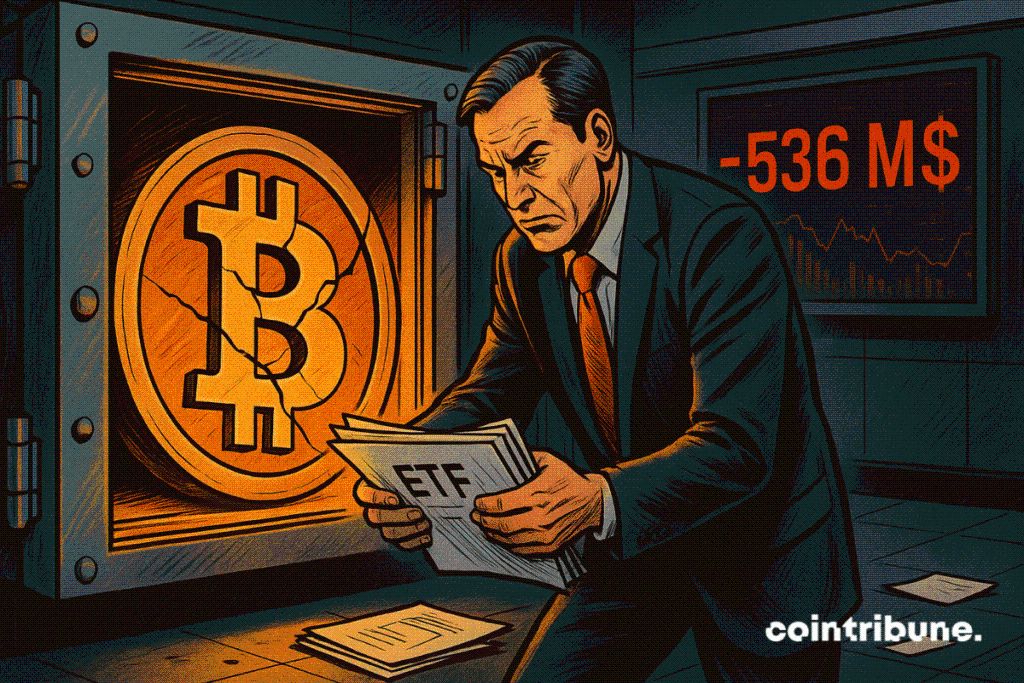
Spot Bitcoin ETFs have just experienced their largest daily outflow since August, in a context of a shaky market. This massive withdrawal of 536 million dollars reflects a sudden change in investor sentiment. A serious warning for institutional players, as bitcoin stalls below $110,000.
In brief
- Bitcoin ETFs record a record outflow of 536 million dollars in a single day.
- Bitcoin price stagnates below $110,000, affected by macro tensions and arbitrage.
Bitcoin ETFs endure their largest decline since summer
On October 16, Bitcoin ETFs saw $536 million of capital evaporate. This marks the largest net outflow in two months. These figures contrast with the record inflows recorded during the summer, a period when ETFs supported the crypto market boom.
This sudden turnaround reflects a loss of confidence from investors regarding bitcoin’s bullish momentum, whose price remains stuck below $110,000. Despite growing adoption through listed vehicles, institutional flows are now much more volatile. Investors now seem to be in an arbitrage phase.
A clear signal of institutional behavior facing macro risks
These massive withdrawals are not explained solely by bitcoin’s drop. They also reflect growing sensitivity to macroeconomic conditions. With rising interest rates, exposure to risk via volatile assets like BTC indeed raises questions (even among institutional players).
The mechanism of derivatives and speculative positions amplifies this phenomenon. The market becomes more technical and more linked to global movements than to the protocol fundamentals. The price consolidation around $110,000 seems to symbolize a temporary balance point, where risk appetite weakens.
In this context, Bitcoin ETFs no longer play their growth relay role. On the contrary, they become a thermometer of short-term sentiment, very reactive to volatility and macro expectations.
One thing is certain: bitcoin is at a turning point. ETFs that amplified its rise last summer now serve as an outlet amid uncertainty. If the digital asset wants to regain ground, it will have to convince beyond the charts and demonstrate resilience, even when macroeconomic winds turn. To be continued…
Disclaimer: The content of this article solely reflects the author's opinion and does not represent the platform in any capacity. This article is not intended to serve as a reference for making investment decisions.
You may also like
XRP Pundit: First Thing You Should Do When You Become a Crypto Millionaire
 VIPTradFi Focus: Where Does the RWA Market Stand Today?
1. Crypto outperformed traditional equity indexes following the rate hike, but elevated interest rates remain a key constraint on cross-asset allocation. From September 12 to 18, BTC, ETH, and SOL gained 4.83%, 3.84%, and 9.96%, respectively, while the S&P 500 edged down 0.08%. The U.S. Dollar Index rose 1.11%, and the 10-year U.S. Treasury yield closed at approximately 4.998%. Improving risk appetite is therefore coexisting with elevated discount rates, raising the bar for RWA allocation: investors need to compare not only returns on the underlying assets, but also on-chain liquidity and collateral efficiency. 2. Growth in tokenized equities is occurring even as the overall RWA market remains under pressure. As of September 18, Distributed Asset Value across RWAs stood at $38.503 billion, down 1.13% week over week, while tokenized equities reached $3.056 billion, up 6.03%. This week's data are better explained by capital reallocating across different RWA segments than by a broad-based expansion of the entire RWA market. 3. For exchanges, the opportunity lies in connecting spot holdings, collateral, and derivatives. Reality's distributed asset value stands at approximately $155 million, while eligible rTokens can already be used within Bitget's UTA margin framework. Across CoinGlass's verifiable sample of 177 TradFi instruments, open interest reached approximately $11.498 billion, up 2.06% week over week, even as weekly trading volume declined 7.60%. The medium-term opportunity remains intact, but deeper utilization will depend on liquidity, collateral use, and sustained trading activity. 4.Assets to watch: BTC, ETH, SOL, NEAR, ZEC, gold, tokenized U.S. equities, COST. 5.Key metrics to watch: rToken collateral utilization, the durability of TradFi open interest and trading volume, and next week's employment and consumer data.

Gold prices fall Rs 1,331/10 gram, silver dips Rs 1,600/kg as Mideast tensions outweigh oil fall: Key levels to track
Strategists Say Market's ‘Wall of Worry' Is Healthy, Not a Warning Sign

Crypto prices
More


