
Nasdaq Surges, Ondo Stalls: The Diverging Paths of Asset Tokenization

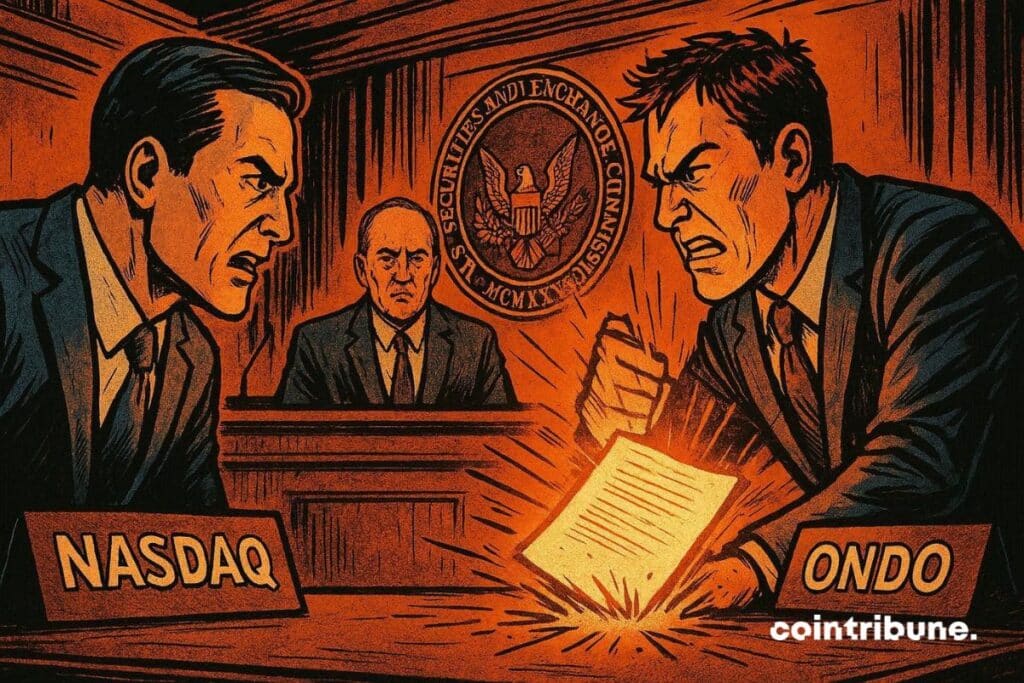
The tokenization of financial assets promises to disrupt traditional finance, but tensions between innovation and regulation are reaching a critical point. Nasdaq wants to accelerate the adoption of tokenized securities, while Ondo Finance, a giant in the sector, demands more transparency. Who is right in this fight for the future of crypto markets?
In brief
- Nasdaq proposes integrating tokenized securities to modernize markets, but its lack of details on the settlement process raises criticism.
- Ondo Finance demands more transparency from Nasdaq, denouncing an unfair competitive advantage and a risk of market centralization.
- The SEC’s decision could shape the future of tokenization, between accelerated adoption or stricter regulatory framework to protect investors.
Nasdaq’s Proposal for Tokenization of Securities
Nasdaq submitted a proposal to the SEC to integrate tokenized securities , a major step to modernize financial markets. The goal? Allow investors to trade stocks and ETFs in token form, reducing costs and speeding up transactions. According to Nasdaq, this innovation could democratize access to financial assets while maintaining traditional protections.
However, questions remain. The proposal relies on the Depository Trust Company (DTC) for transaction settlement, but technical details remain unclear. Some experts fear increased centralization, where a few players would dominate the market. In its letter to the SEC, Nasdaq assures that its approach complies with existing rules. But critics like Ondo Finance have doubts.
Ondo Finance Sounds the Alarm: Transparency and Fairness in Question
Ondo Finance, a leader in real asset tokenization, has sent a letter to the SEC to demand more clarity on Nasdaq’s proposal . According to Ondo, the lack of public details on DTC’s role creates an imbalance: only a few players would have access to crucial information, distorting competition. The company advocates for open collaboration and transparent standards before any approval.
 ONDO Finance writes to the SEC.
This opposition is not surprising. Ondo, which manages over 600 million dollars in tokenized assets, defends a decentralized and accessible ecosystem. For them, Nasdaq’s rush could harm the entire sector. Other players, like BlackRock and Fidelity, are watching closely, aware that this decision could influence their own tokenization projects.
Asset Tokenization: Toward a Stricter Regulatory Framework or a Financial Wild West?
The SEC plays a key role in this debate. Its approach will determine whether the tokenization of securities will be strictly regulated or left to private actors’ initiative. A too rapid approval could open the door to abuses, while a rejection would slow down innovation. While European regulators like the AMF in France adopt a cautious stance on tokenizing traditional assets by demanding strengthened guarantees, bitcoin reminds us that decentralization remains the only model resistant to any institutional interference.
Several scenarios are possible. If the SEC approves Nasdaq’s proposal, other exchanges could follow, accelerating global adoption. Conversely, a rejection or major modifications could slow the movement, favoring more decentralized solutions, like those promoted by Ondo Finance. Tokenization is inevitable, but its future will depend on the ability to find a balance between innovation and investor protection.
The confrontation between Ondo Finance and Nasdaq illustrates the challenges of tokenization: innovating without sacrificing transparency. However, one question remains: will tomorrow’s finance be more open or controlled by a handful of players? And you, would you be ready to invest in tokenized securities without clear guarantees?
Disclaimer: The content of this article solely reflects the author's opinion and does not represent the platform in any capacity. This article is not intended to serve as a reference for making investment decisions.
You may also like
XRP Pundit: First Thing You Should Do When You Become a Crypto Millionaire
 VIPTradFi Focus: Where Does the RWA Market Stand Today?
1. Crypto outperformed traditional equity indexes following the rate hike, but elevated interest rates remain a key constraint on cross-asset allocation. From September 12 to 18, BTC, ETH, and SOL gained 4.83%, 3.84%, and 9.96%, respectively, while the S&P 500 edged down 0.08%. The U.S. Dollar Index rose 1.11%, and the 10-year U.S. Treasury yield closed at approximately 4.998%. Improving risk appetite is therefore coexisting with elevated discount rates, raising the bar for RWA allocation: investors need to compare not only returns on the underlying assets, but also on-chain liquidity and collateral efficiency. 2. Growth in tokenized equities is occurring even as the overall RWA market remains under pressure. As of September 18, Distributed Asset Value across RWAs stood at $38.503 billion, down 1.13% week over week, while tokenized equities reached $3.056 billion, up 6.03%. This week's data are better explained by capital reallocating across different RWA segments than by a broad-based expansion of the entire RWA market. 3. For exchanges, the opportunity lies in connecting spot holdings, collateral, and derivatives. Reality's distributed asset value stands at approximately $155 million, while eligible rTokens can already be used within Bitget's UTA margin framework. Across CoinGlass's verifiable sample of 177 TradFi instruments, open interest reached approximately $11.498 billion, up 2.06% week over week, even as weekly trading volume declined 7.60%. The medium-term opportunity remains intact, but deeper utilization will depend on liquidity, collateral use, and sustained trading activity. 4.Assets to watch: BTC, ETH, SOL, NEAR, ZEC, gold, tokenized U.S. equities, COST. 5.Key metrics to watch: rToken collateral utilization, the durability of TradFi open interest and trading volume, and next week's employment and consumer data.

Gold prices fall Rs 1,331/10 gram, silver dips Rs 1,600/kg as Mideast tensions outweigh oil fall: Key levels to track
Strategists Say Market's ‘Wall of Worry' Is Healthy, Not a Warning Sign

Crypto prices
More


