
Here’s why Russia ranks highest in Europe for crypto adoption: Chainalysis

Crypto adoption in European countries like the United Kingdom and Germany is lagging behind Russia, according to the latest report from US blockchain analytics firm Chainalysis.
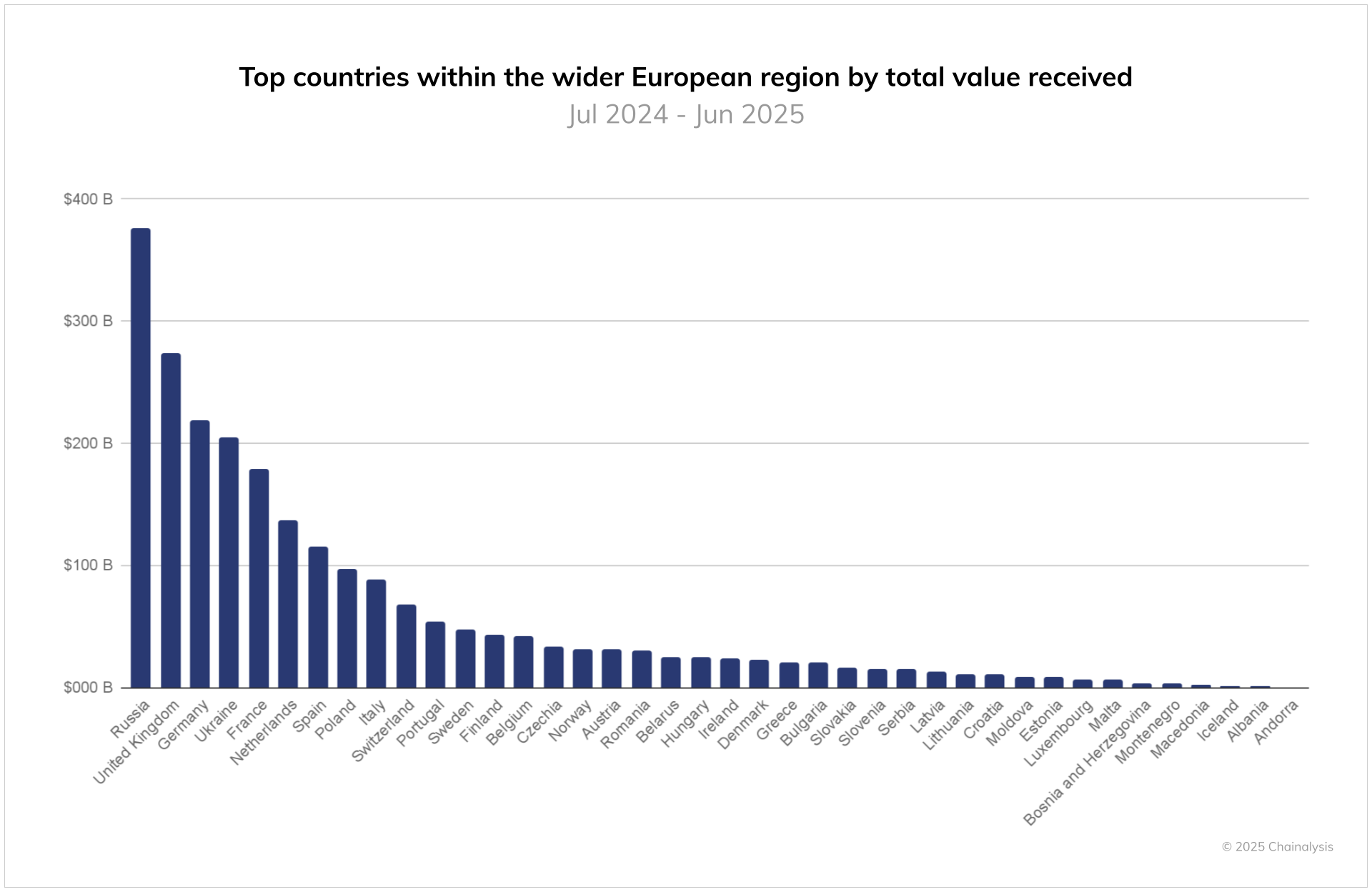
Russia emerged as the leading crypto market in Chainalysis’ latest European Crypto Adoption report, receiving $376.3 billion in crypto between July 2024 and June 2025.
Published Thursday, the report combines analyses of regions previously examined separately, covering Central, Northern, and Western Europe, as well as Eastern Europe as a whole.
“For this year’s analysis, we’ve reorganized our regional classifications to better reflect both current crypto activity and geopolitical realities,” Chainalysis said.
Russia’s volumes up almost 50% since last year
Russia’s received crypto volumes have increased 48% from last year’s $256.5 billion, widening its lead over major economies such as the UK, which recorded $273.2 billion in the past year, about 30% less.
Chainalysis attributed Russia’s surge in crypto adoption to two primary factors: a spike in large institutional transfers and the growing use of decentralized finance (DeFi).
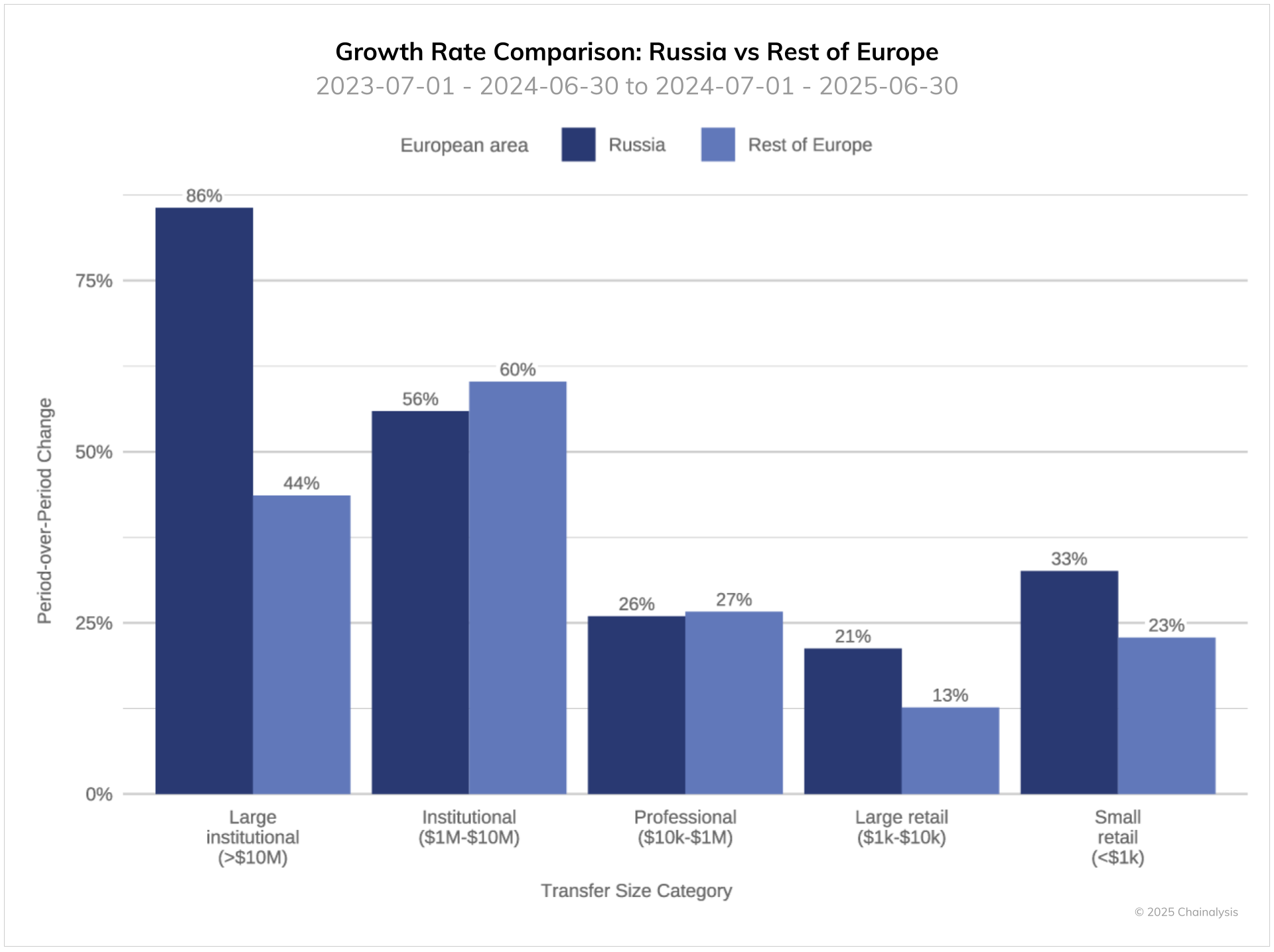
“The scale of institutional activity is particularly notable,” Chainalysis said, referring to large transfers — those exceeding $10 million — surging 86% year-over-year (YoY). The surge pace is nearly double the 44% growth observed in the rest of Europe, it added.
DeFi and retail among contributors
Beyond institutional activity, Russia also leads in both large and small retail segments, with YoY growth outpacing the rest of Europe by about 10%.
“DeFi adoption patterns reveal an even more dramatic shift,” Chainalysis said, referring to Russia’s DeFi activity surging eight times its previous levels in early 2025.
Russia’s rapid DeFi expansion and the increase in large-value transfers indicate growing adoption of crypto for financial services, Chainalysis concluded.
It also mentioned that A7A5 — a sanctioned ruble-pegged stablecoin issued in Kyrgyzstan — is a major example of this trend as it facilitates cross-border payments for both institutional and business users.
Launched in early 2025, A7A5 has emerged as the world’s largest non-US dollar stablecoin by market capitalization, despite facing multiple sanctions.
The stablecoin has been criticized by the European Union for being used as a tool for sanction evasion by Russia. The US government has also linked A7A5 to Grinex, the successor of Garantex, which was allegedly involved in money laundering and ransomware attacks with $100 million in transactions related to illicit activities.
Related: US rises to 2nd in crypto adoption as APAC sees most growth: Chainalysis
The ruble-pegged stablecoin reached $500 million in market cap in late September, overtaking major non–US dollar rivals such as Europe’s euro-pegged EURC, issued by Circle.
Chainalysis’s findings on Russia’s crypto market growth over the past year come amid mounting sanctions and an intensifying regulatory focus in the region. Notably, Russia was excluded from the Financial Stability Board’s peer review on cross-border regulation, also published Thursday.
Magazine: Binance shakes up Korea, Morgan Stanley’s security tokens in Japan: Asia Express
Disclaimer: The content of this article solely reflects the author's opinion and does not represent the platform in any capacity. This article is not intended to serve as a reference for making investment decisions.
You may also like
 VIPTradFi Focus: Where Does the RWA Market Stand Today?
1. Crypto outperformed traditional equity indexes following the rate hike, but elevated interest rates remain a key constraint on cross-asset allocation. From September 12 to 18, BTC, ETH, and SOL gained 4.83%, 3.84%, and 9.96%, respectively, while the S&P 500 edged down 0.08%. The U.S. Dollar Index rose 1.11%, and the 10-year U.S. Treasury yield closed at approximately 4.998%. Improving risk appetite is therefore coexisting with elevated discount rates, raising the bar for RWA allocation: investors need to compare not only returns on the underlying assets, but also on-chain liquidity and collateral efficiency. 2. Growth in tokenized equities is occurring even as the overall RWA market remains under pressure. As of September 18, Distributed Asset Value across RWAs stood at $38.503 billion, down 1.13% week over week, while tokenized equities reached $3.056 billion, up 6.03%. This week's data are better explained by capital reallocating across different RWA segments than by a broad-based expansion of the entire RWA market. 3. For exchanges, the opportunity lies in connecting spot holdings, collateral, and derivatives. Reality's distributed asset value stands at approximately $155 million, while eligible rTokens can already be used within Bitget's UTA margin framework. Across CoinGlass's verifiable sample of 177 TradFi instruments, open interest reached approximately $11.498 billion, up 2.06% week over week, even as weekly trading volume declined 7.60%. The medium-term opportunity remains intact, but deeper utilization will depend on liquidity, collateral use, and sustained trading activity. 4.Assets to watch: BTC, ETH, SOL, NEAR, ZEC, gold, tokenized U.S. equities, COST. 5.Key metrics to watch: rToken collateral utilization, the durability of TradFi open interest and trading volume, and next week's employment and consumer data.

Gold prices fall Rs 1,331/10 gram, silver dips Rs 1,600/kg as Mideast tensions outweigh oil fall: Key levels to track
Strategists Say Market's ‘Wall of Worry' Is Healthy, Not a Warning Sign

Canadian Dollar seems vulnerable near August 7 low amid sliding oil prices, trade tensions
Crypto prices
More


