
It's about Ethereum, something big is coming!

On October 6, asset management giant Grayscale officially announced the launch of the first spot crypto ETF product in the US that supports staking functionality—Grayscale Ethereum Trust (ETHE) and Grayscale Ethereum Mini Trust (ETH).
This means that investors can automatically receive staking rewards while holding Ethereum exposure through traditional brokerage accounts, without any on-chain operations. Grayscale also announced that its Solana product GSOL will also launch staking functionality, and will be converted to a formal ETF upon regulatory approval.
This move marks the official entry of the US market into the "stakeable crypto ETF era," representing a milestone in the process of yield generation for digital assets.
Key Breakthrough for ETH ETF: From Price Exposure to Yield Asset
Since the approval of spot Ethereum ETFs in the US in 2024, their appeal has consistently lagged behind BTC ETFs. The market generally points out that, compared to Bitcoin ETFs, they lack a core selling point—staking rewards.
In terms of ETF fund size, data from SoSoValue shows that the total net assets of Bitcoin ETFs currently stand at $164.5 billion, equivalent to 6.7% of its market cap. The net assets of Ethereum ETFs lag behind at $30.5 billion, accounting for 5.6% of the cryptocurrency's valuation.
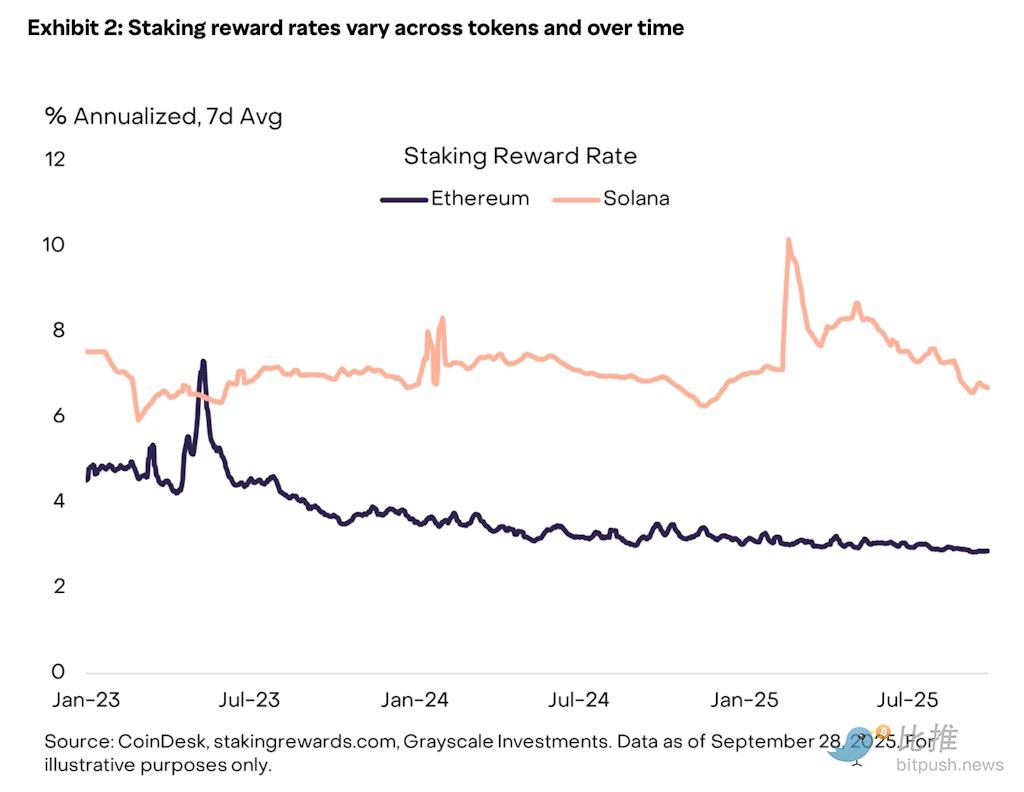
As a PoS mechanism network, Ethereum holders can earn an annualized 3% to 5% block reward through staking ETH, but previous ETFs only provided price tracking functionality and could not pass staking rewards to investors.
Grayscale's innovation precisely fills this gap.
According to the company announcement, ETHE will distribute staking rewards as monthly dividends, while ETH and GSOL will include the rewards in the net asset value (NAV) for compound growth. Grayscale's Head of Research, Zach Pandl, stated that this allows investors "to receive ETH network returns without any additional operations, while enhancing liquidity and security."
Against the backdrop of the Federal Reserve starting a rate-cutting cycle and declining returns on traditional fixed-income assets, the "yield attribute" of ETH staking ETFs stands out even more.
Institutional Capital May See a New Wave of Inflows
Grayscale currently manages over $8 billion in Ethereum assets, and the introduction of staking functionality is widely seen in the industry as a key variable to enhance ETH's attractiveness.
Bitcoin ETFs mainly provide price speculation and long-term allocation functions, while ETH staking ETFs additionally feature a "cash flow" logic, similar to stock dividends or bond coupons.
This means ETH is no longer just a "non-yielding asset," but is evolving into a new type of investment product with both yield and growth attributes.

Huobi co-founder Du Jun (@DujunX) commented on social media:
"This is super bullish for Ethereum! Reduced supply + increased demand, ETH staking adds a 'yield attribute' to ETFs, similar to stock dividends, which can attract more institutional and retail capital. Competitors like BlackRock will also follow suit, and it is expected that the net inflow of funds into various Ethereum ETFs should exceed $10 billion in the coming year."
This view represents the consensus of many industry observers.
Twinstake CEO Andrew Gibb previously stated at a Blockworks roundtable: "By (adding staking) functionality, you can turn it from a passive investment tool into a product that can generate income and yield. I think this makes it closer to similar traditional products—such as bond ETFs or dividend stocks."
Nate Geraci, President of NovaDius Wealth Management, said that while this is a positive development for those seeking to invest in ETH through traditional investment tools, unlocking staking does not necessarily lead to a significant increase in capital inflows. He believes: "In my view, the lack of a 2-3% yield is not the main obstacle for investors allocating to this asset class. Even so, this is still a significant milestone—it makes spot ETH ETFs more competitive than direct ETH ETFs."
As more institutions (such as BlackRock and Fidelity) are bound to launch ETFs with similar features, staking rewards will become the "standard" for future ETH fund competition. On the capital side, the lock-up effect of staking will further reduce circulating supply, while new capital inflows will drive up demand, providing structural support for ETH.
Long-term Impact on the Ethereum Ecosystem and Crypto Market
1. Strengthening ETH's "Digital Economy Bond" Attribute
The introduction of staking rewards transforms ETH from a "pure asset" into a "yield asset," which will change institutional pricing models. For traditional investors, ETH not only offers inflation hedging and network growth value, but also provides stable cash flow returns, making it easier to be included in portfolios such as pensions and sovereign wealth funds.
2. Enhancing Network Security and Decentralization
More capital participating in staking means an increase in the number of Ethereum network validator nodes, enhancing on-chain security. In the long run, the ETF staking mechanism will more closely bind institutional capital with the underlying operation of the blockchain, becoming a new channel for traditional finance to participate in decentralized network governance.
3. Promoting Divergence in Investment Logic Between ETH and BTC
The appeal of Bitcoin ETFs mainly stems from their "digital gold" attribute, while after the introduction of yield, ETH staking ETFs and BTC ETFs show clear divergence in investment logic: BTC leans toward a store of value asset, while ETH is more like a hybrid of "technology growth + yield asset." This will drive a reshaping of the valuation systems for the two major assets.
Potential Risks
Although the launch of staking ETFs is widely seen as positive, the market also needs to pay attention to several potential issues:
-
Liquidity risk: If a large amount of ETH is locked in staking, when redemption demand is concentrated, the fund may experience unlocking delays or discounts.
-
Node security and slashing risk: If validator node operations are mishandled and result in penalties (slashing), returns may be affected.
-
Centralization concerns: If ETF holdings are concentrated among a few large validator service providers, it may lead to excessive concentration of on-chain governance rights.
As of the time of writing, the trading price of ETH is $4,690, with a 156% increase over the past six months. As more institutions join the competition, staking ETFs are expected to become an important standard in the future crypto asset market. As yield attributes become the new core of pricing, the current price may just be a starting point.
Author: Seed.eth
Disclaimer: The content of this article solely reflects the author's opinion and does not represent the platform in any capacity. This article is not intended to serve as a reference for making investment decisions.
You may also like
Weekly U.S. Equities Macro Outlook (Sep 21–Sep 25):
Highlights of the U.S. Stock Market This Week: Intensive Speeches from Federal Reserve Officials, Middle East Situation and China-U.S. Summit Influence the Market
This week, U.S. stock market investors will focus on the trajectory of interest rates, tensions in the Middle East, the U.S.-China summit and technology-related topics, as well as calls to slow down the development of artificial intelligence (AI), while weighing whether major stock indexes can reach new historical highs.
Korean media reports that "Besant Mentor" Druckenmiller will visit Korea for the first time and will discuss investment with SK Hynix, Samsung Electronics, and Doosan.
This is Druckenmiller's first public visit to South Korea, focusing on the two main themes of AI and energy. He will be inspecting Samsung and SK Hynix, which hold key positions in AI supply chain bottlenecks such as HBM and semiconductor materials, as well as Doosan Enerbility, which is involved in nuclear power and gas turbines. It is worth noting that he has reduced his AI holdings to 20% of what they were six months ago; this visit is interpreted as a strategic shift from broad investments to the precise selection of core targets.
Crypto prices
More


