
"Depreciation trading" is booming! Bitcoin hits a new all-time high above $125,000

When a U.S. government shutdown triggers a dollar confidence crisis, both bitcoin and gold simultaneously reach new all-time highs. Standard Chartered Bank points out that $125,000 is not the end, and the year-end target price will be...
Driven by the broad-based rise in risk assets triggered by the U.S. government shutdown and the general optimism brought by the “Uptober” rally, the world’s largest cryptocurrency, bitcoin, hit a new high above $125,000 last weekend, surpassing the previous record set on August 14.
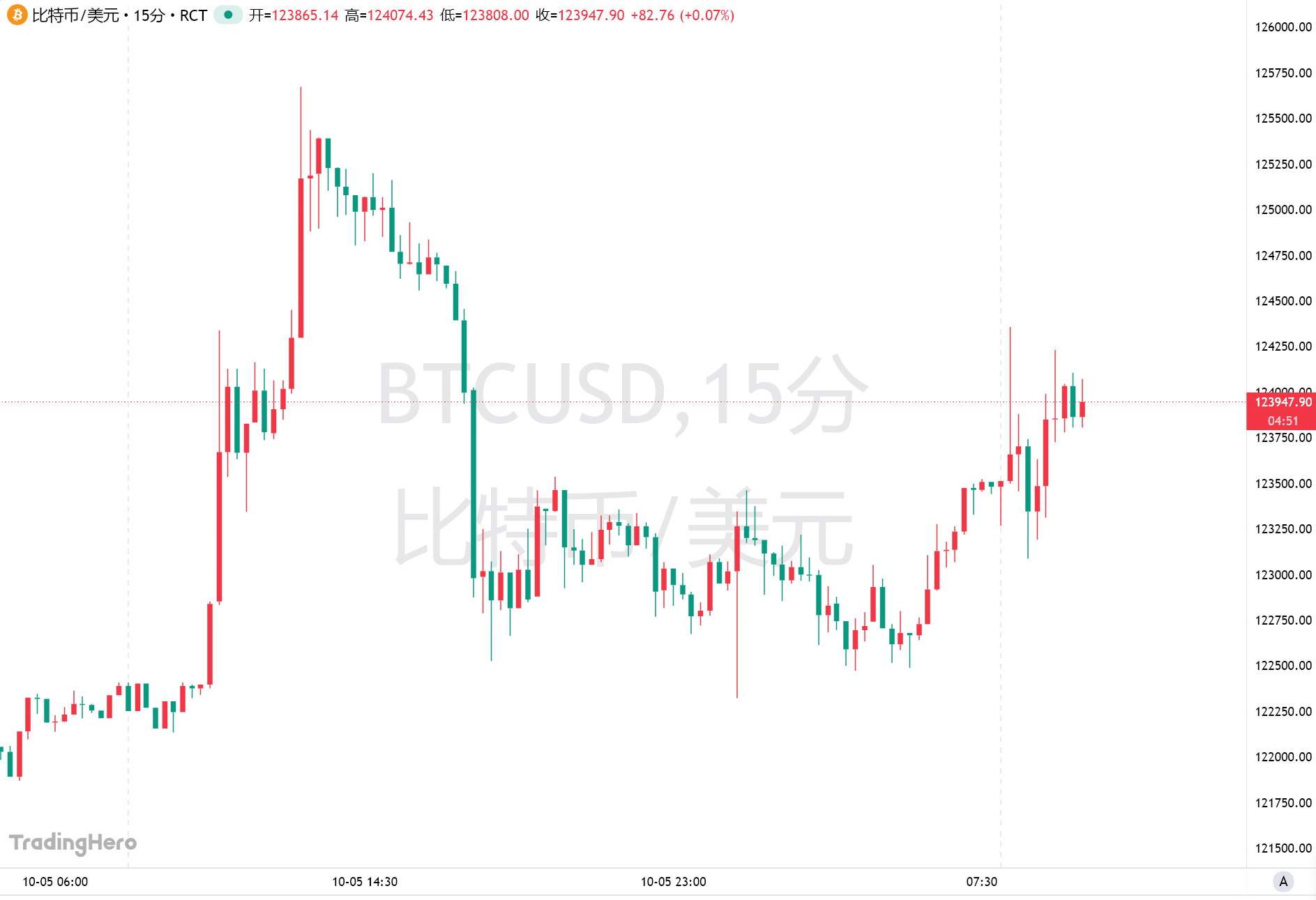
Bitcoin’s latest rally was supported by the rise in U.S. stocks and renewed inflows into bitcoin-related exchange-traded funds (ETFs). Investors speculate that the government shutdown, which began last Wednesday, will drive funds into safe-haven assets—a phenomenon market participants refer to as the “devaluation trade.”
The core of the “devaluation trade” is to hedge against the decline in fiat currency purchasing power. It refers to investors proactively moving funds out of dollar assets and into assets considered to have greater value-preserving potential—such as gold, stocks, and cryptocurrencies—when the market expects a currency (especially the U.S. dollar) to weaken, in order to avoid the risk of shrinking purchasing power.
Uptober is a term unique to the cryptocurrency market to describe the October rally, a portmanteau of “Up” and “October,” specifically referring to the seasonal rise in cryptocurrencies during October. Bitcoin has risen in 9 out of the past 10 Octobers.
Joshua Lim, Co-Head of Markets at crypto institutional brokerage FalconX, said: “Right now, many assets—including stocks, gold, and even Pokémon cards—are hitting all-time highs. It’s no surprise that bitcoin is benefiting from the dollar devaluation narrative.”
As the largest digital asset by market capitalization, bitcoin has risen more than 30% so far this year.
For most of the past year, bitcoin’s price has steadily climbed, thanks to the friendly legislative environment in Washington under President Trump’s administration. Publicly listed companies led by Michael Saylor’s Strategy company have adopted the increasingly popular “bitcoin hoarding” corporate strategy, boosting demand for the currency. This strategy has also spread to smaller competing coins such as ether, driving a broad rise across the digital asset sector.
In the week ending October 3, spot bitcoin ETFs saw a cumulative net inflow of $3.24 billions, the largest weekly inflow so far in 2025 and the second largest weekly inflow since their launch in January 2024.
Last Friday, despite the possibility of a prolonged U.S. government shutdown and weak business activity data, a new wave of large-scale AI deals and partnerships pushed U.S. stocks to record highs, while U.S. Treasuries and the dollar exchange rate fell. Meanwhile, with U.S. interest rates declining and ongoing inflation concerns, central bank gold purchases worldwide are set to drive gold to a seventh consecutive weekly gain.
Geoff Kendrick, Global Head of Digital Asset Research at Standard Chartered Plc, said: “This government shutdown is significant,” adding that he expects bitcoin to rise during this period. He noted that during the last government shutdown from 2018 to 2019, bitcoin was in a “different situation”—at that time, its price movement was less correlated with traditional risk assets.
He added: “This year, bitcoin trading carries ‘U.S. government risk,’ which is best reflected in its relationship with the U.S. Treasury term premium.”
Kendrick said that new ETF inflows and the U.S. government shutdown could further push up cryptocurrency prices in the coming weeks. In a report to clients, he stated that bitcoin is expected to break through its all-time high within days and could reach $135,000 in the coming weeks, slightly later than his previous forecast. He also reiterated his year-end target of $200,000 for bitcoin.
Disclaimer: The content of this article solely reflects the author's opinion and does not represent the platform in any capacity. This article is not intended to serve as a reference for making investment decisions.
You may also like
Highlights of the U.S. Stock Market This Week: Intensive Speeches from Federal Reserve Officials, Middle East Situation and China-U.S. Summit Influence the Market
This week, U.S. stock market investors will focus on the trajectory of interest rates, tensions in the Middle East, the U.S.-China summit and technology-related topics, as well as calls to slow down the development of artificial intelligence (AI), while weighing whether major stock indexes can reach new historical highs.
Korean media reports that "Besant Mentor" Druckenmiller will visit Korea for the first time and will discuss investment with SK Hynix, Samsung Electronics, and Doosan.
This is Druckenmiller's first public visit to South Korea, focusing on the two main themes of AI and energy. He will be inspecting Samsung and SK Hynix, which hold key positions in AI supply chain bottlenecks such as HBM and semiconductor materials, as well as Doosan Enerbility, which is involved in nuclear power and gas turbines. It is worth noting that he has reduced his AI holdings to 20% of what they were six months ago; this visit is interpreted as a strategic shift from broad investments to the precise selection of core targets.
Applovin CEO: The "Darkest Hour" of a 92% Stock Price Crash and "Self-Salvation"
AppLovin's CEO reviewed the company's history: when its stock price plummeted by 92% in 2022 and its market value shrank to $3.8 billion, he stopped roadshows, initiated a $6 billion buyback, and quietly completed a technological upgrade from regression models to deep learning. Afterwards, the stock price rose from $9 to $750, and the market value peaked at $250 billion. He also revealed that the company expects to generate about $6 billion in cash this year, with an EBITDA profit margin of 84%.
Crypto prices
More


