
US Government Shutdown Drives Record $6 Billion Crypto Inflows

Institutional investors poured nearly $6 billion into crypto last week as Fed rate cuts and US political turmoil drove record inflows led by Bitcoin, Ethereum, and Solana.
After last week’s macro-driven outflows, investors returned in force amid Fed easing and political uncertainty, pushing crypto inflows toward the $6 billion mark.
The US government shutdown, among other macro concerns, drew investor interest back to risk-on assets amid fiat uncertainty.
Crypto Inflows Reached $5.9 Billion Last Week
According to the latest CoinShares report, digital asset investment products saw a dramatic turnaround last week, recording record inflows of $5.95 billion.
The surge follows a sharp $812 million outflow the previous week, reflecting how swiftly sentiment has shifted.
According to James Butterfill, head of research at CoinShares, it came as investors responded to weak US employment data, a recent Fed rate cut, and mounting concerns over US government stability after the shutdown.
The rebound marks the largest weekly inflow on record for digital assets, pushing total assets under management (AuM) to an all-time high of $254 billion.
Butterfill described the movement as a delayed response to the FOMC’s dovish pivot, amplified by softer economic indicators and a loss of confidence in US fiscal governance.
“Investors appear to be rotating back into digital assets as a hedge against policy uncertainty,” the report noted.
Bitcoin and Ethereum Lead the Charge As Sentiment Shifts From Panic to Positioning
Just one week earlier, digital asset products experienced their sharpest pullback in months, $812 million in outflows, led by $719 million from Bitcoin and $409 million from Ethereum, after stronger-than-expected macro data temporarily revived fears of a more hawkish Federal Reserve.
At the time, US-based investors drove over $1 billion in withdrawals, signaling widespread caution. That caution has now flipped decisively to optimism. The US led last week’s inflows with a record $5.0 billion, while Switzerland ($563 million) and Germany ($312 million) also posted historic highs.
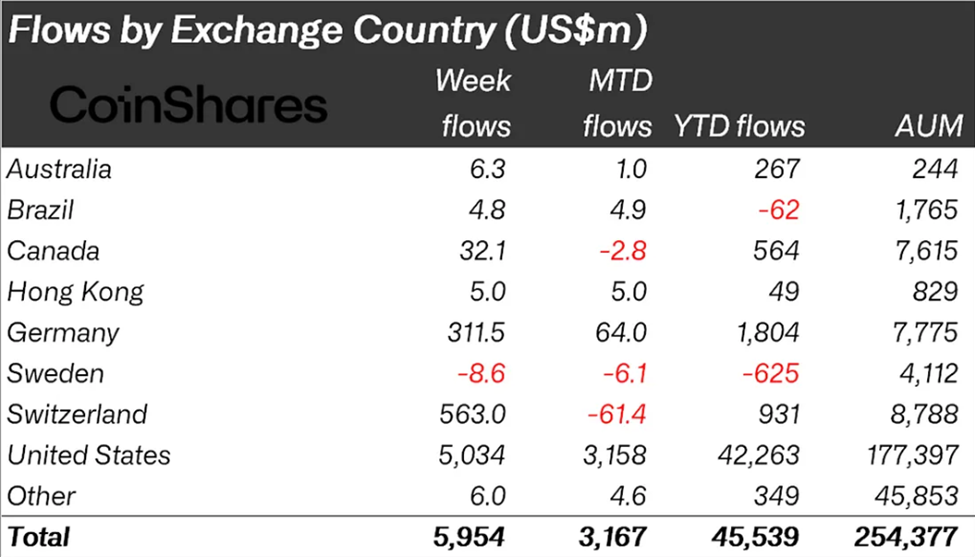 Crypto Inflows by Asset Metrics. Source:
CoinShares Report
Crypto Inflows by Asset Metrics. Source:
CoinShares Report
The CoinShares executive attributes the rebound to fading inflation fears, dovish rate expectations, and a political risk premium tied to the government shutdown. Together, these have reignited demand for alternative, non-sovereign assets like Bitcoin.
Bitcoin attracted $3.55 billion in inflows, its largest on record, as prices approached all-time highs. Despite these gains, investors notably avoided short-Bitcoin products, suggesting strong conviction that the rally could extend.
Ethereum also enjoyed a stellar week, pulling in $1.48 billion, bringing its year-to-date (YTD) inflows to $13.7 billion, nearly triple its 2024 total.
Solana continued to assert its position as a key institutional favorite, drawing $706.5 million, another all-time weekly record that brought its YTD total to $2.58 billion.
XRP followed with $219.4 million, reflecting renewed appetite for select large-cap altcoins even as smaller tokens saw little interest.
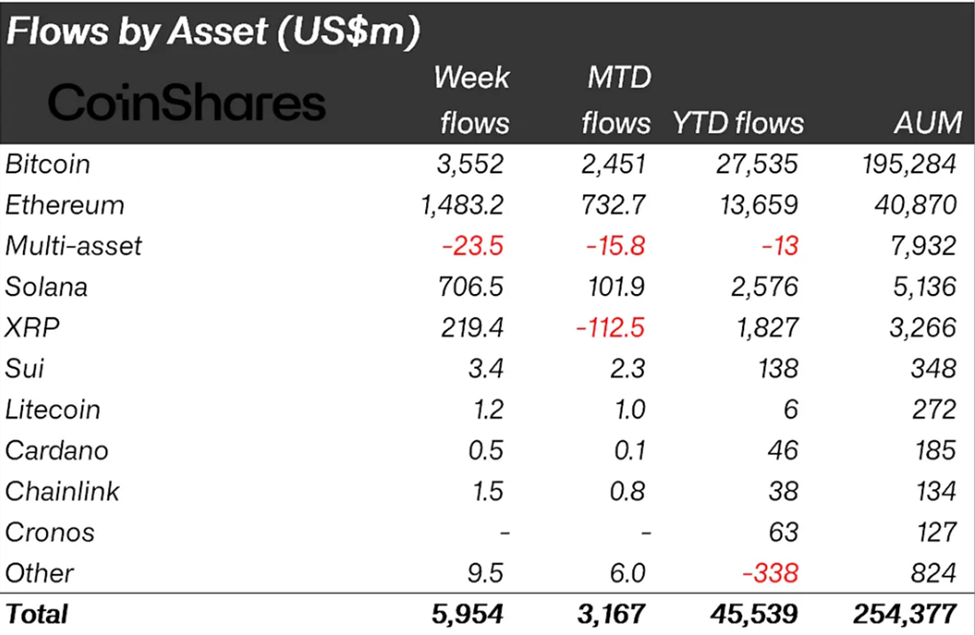 Crypto Inflows by Asset Metrics. Source: CoinShares Report
The swing from a billion-dollar outflow to a near $6 billion inflow in the space of two weeks highlights the crypto market’s heightened sensitivity to macroeconomic and political cues.
With the US government shutdown casting doubts over fiscal management and the Fed signaling a more accommodative stance, digital assets appear to be reasserting their role as risk-on bets and macro hedges.
CoinShares suggests institutional capital could remain sticky if the current momentum persists, especially as investors seek yield and diversification amid volatile traditional markets.
Disclaimer: The content of this article solely reflects the author's opinion and does not represent the platform in any capacity. This article is not intended to serve as a reference for making investment decisions.
You may also like
Highlights of the U.S. Stock Market This Week: Intensive Speeches from Federal Reserve Officials, Middle East Situation and China-U.S. Summit Influence the Market
This week, U.S. stock market investors will focus on the trajectory of interest rates, tensions in the Middle East, the U.S.-China summit and technology-related topics, as well as calls to slow down the development of artificial intelligence (AI), while weighing whether major stock indexes can reach new historical highs.
Korean media reports that "Besant Mentor" Druckenmiller will visit Korea for the first time and will discuss investment with SK Hynix, Samsung Electronics, and Doosan.
This is Druckenmiller's first public visit to South Korea, focusing on the two main themes of AI and energy. He will be inspecting Samsung and SK Hynix, which hold key positions in AI supply chain bottlenecks such as HBM and semiconductor materials, as well as Doosan Enerbility, which is involved in nuclear power and gas turbines. It is worth noting that he has reduced his AI holdings to 20% of what they were six months ago; this visit is interpreted as a strategic shift from broad investments to the precise selection of core targets.
Applovin CEO: The "Darkest Hour" of a 92% Stock Price Crash and "Self-Salvation"
AppLovin's CEO reviewed the company's history: when its stock price plummeted by 92% in 2022 and its market value shrank to $3.8 billion, he stopped roadshows, initiated a $6 billion buyback, and quietly completed a technological upgrade from regression models to deep learning. Afterwards, the stock price rose from $9 to $750, and the market value peaked at $250 billion. He also revealed that the company expects to generate about $6 billion in cash this year, with an EBITDA profit margin of 84%.
Crypto prices
More


