
Vitalik backs Ethereum treasury firms, but warns of overleverage

Ethereum co-founder Vitalik Buterin threw his support behind Ether
ETH$3,890treasury companies, but warned that the trend could spiral into an “overleveraged game” if not handled responsibly.
In an interview with the Bankless podcast released on Thursday, Buterin said the growing number of public companies buying and holding Ether was valuable because it exposes the token to a broader range of investors.
“There’s definitely valuable services that are being provided there,” Buterin said. He added that companies buying into ETH treasury firms instead of holding the token directly gives people “more options,” especially those with “different financial circumstances.”
So-called crypto treasury companies have become a hot trend on Wall Street, garnering billions of dollars to buy up and hold swaths of cryptocurrencies, with the most popular plays being Bitcoin and Ether.
Leverage must not lead to ETH’s “downfall”
Buterin tempered his support with caution, stressing that ETH’s future must not come at the cost of excessive leverage.
“If you woke me up three years from now and told me that treasuries led to the downfall of ETH, then, of course, my guess for why would basically be that somehow they turned it into an overleveraged game.”
He outlined a worst-case chain reaction where a drop in ETH’s price turned into forced liquidations that cascaded and drove the token’s price down, also causing a loss of credibility.

However, Buterin is confident that ETH investors have enough discipline to steer clear of such a collapse.
“These are not Do Kwon followers that we’re talking about,” he said, mentioning the co-founder of the Terra blockchain that collapsed in 2022.
ETH treasury firms now hold nearly $12 billion
The market for public companies that hold Ether has ballooned to $11.77 billion, led by BitMine Immersion Technologies and SharpLink Gaming .
BitMine holds 833,100 ETH worth $3.2 billion — the fourth-largest holdings among public companies that hold any cryptocurrency.
SharpLink and The Ether Machine hold $2 billion and $1.34 billion worth of ETH, respectively, while the Ethereum Foundation and PulseChain round out the top five.
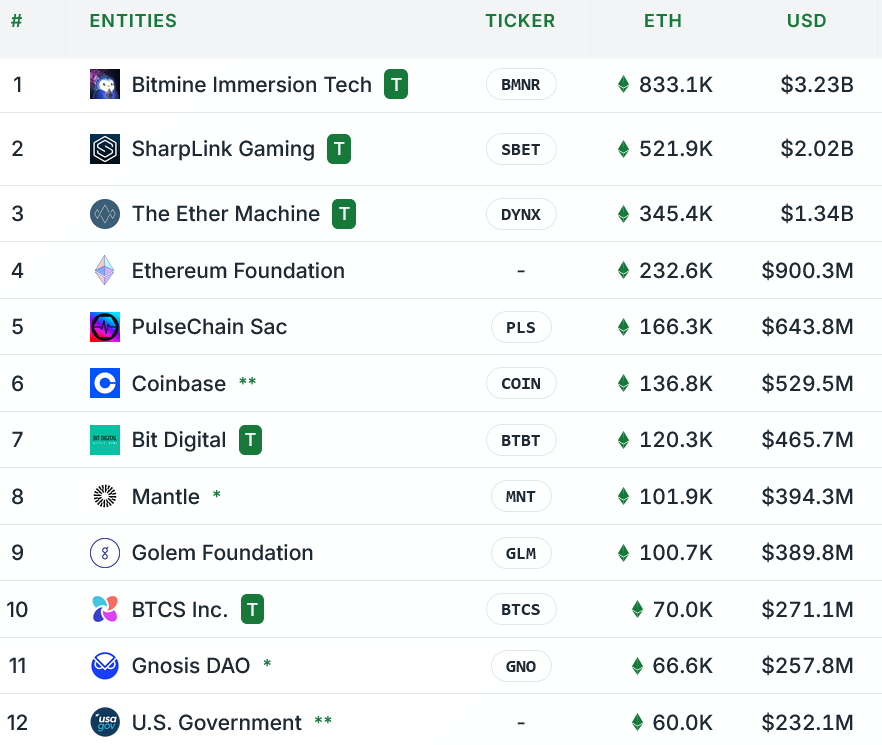
The 12 largest ETH treasury holders. Source: StrategicETHReserve.xyz
ETH making a comeback
ETH has seen a mixed year so far, falling from around $3,685 in January to a low of $1,470 on April 9, before rallying more than 163% to its current price of $3,870 .
The trend of ETH treasury firms has been a notable catalyst behind the token’s resurgence. Its price rally has helped ETH close the gap on Bitcoin and Solana , which have led the current bull cycle.
Disclaimer: The content of this article solely reflects the author's opinion and does not represent the platform in any capacity. This article is not intended to serve as a reference for making investment decisions.
You may also like
BUILDon rallies as holders hit record 87,320 – Can B extend its gains?
Goldman Sachs Hedge Fund Chief: "Zero-Day Options" Suppress U.S. Stock Volatility, Technology and Energy Remain the Best Choices
The S&P 500 has experienced intraday fluctuations of less than 1% for 27 consecutive trading days, marking the longest period of low volatility since the pandemic. Goldman Sachs warns that this "calm" is the result of zero-day options strategies forcibly locking in the market, and once a catalyst emerges, the compressed volatility energy will be released all at once. Meanwhile, expectations for a rate hike in September are rising, market sentiment has dropped to its lowest point of the year, and fiscal sustainability risks loom large—is this pot of heating water going to boil for much longer?
Balancer eyes wind-down after restructuring fails to revive revenue
Is a new wave of sell-offs approaching? The ultimate rival of the AI bull market emerges—The "global anchor of asset pricing" breaks through the 5% super threshold
After the 10-year US Treasury yield breaks back above the critical 5% mark, it is more likely to usher in a period of high-level tug-of-war and accelerated asset differentiation. Especially before energy shocks and the significantly eased large-scale expansion of the US fiscal deficit, the conditions to quickly replicate the sharp yield decline seen at the end of 2023 are not yet fully in place.

Crypto prices
More


