
Ethereum Treasury Companies Are a Better Buy Than US Spot Ether ETFs, Standard Chartered Says

Why Ethereum Treasury Holdings Beat Spot ETFs, According to Standard Chartered
Geoffrey Kendrick, head of digital assets research at London-based Standard Chartered Bank, delivered a nugget of alpha that many may have missed last week, ether treasury companies are probably a better buy than spot ether ETFs. The reason, which may be obvious to some, is that spot ETH funds don’t currently offer staking rewards, but treasury companies do.
Kendrick and his team published a research note last Tuesday, showing how ether treasury companies such as Sharplink , have purchased the cryptocurrency at double the rate of spot ETFs. In a follow-up note yesterday, Kendrick said that since June, both treasury firms and ETFs each bought roughly 1.6% of all ether in circulation.
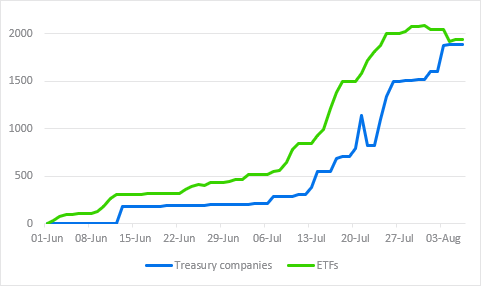
( ETH holding companies and ETFs are neck-and-neck when it comes to amount of ETHbought since June / Standard Chartered Research)
And now, given the already rapid pace of acquisition shown by treasury entities, the additional benefit of compounded staking rewards, and the fact that holding companies face fewer regulatory hurdles than ether ETFs, Kendrick and team see ETH treasury firms as having more growth potential than their fund counterparts or even their bitcoin treasury cousins.
“We think ETH treasury companies have even more growth potential than BTC ones from a regulatory arbitrage perspective,” Kendrick and team explain. “We think they may eventually end up owning 10% of all ETH , a 10x increase from current holdings.”
The team also expects ether treasury companies to help buoy the cryptocurrency past the $4,000 threshold. Ether, which floundered in the first quarter of 2025, reached its all-time high of $4,891.70 nearly four years ago in November 2021. The digital asset was trading at $3,816.40 at the time of reporting, up 3.81% over 24 hours, according to Coinmarketcap.
“If the flows can continue, ETH may be able to break above the key USD 4,000 level (our current end-2025 forecast),” Kendrick and team said.
Disclaimer: The content of this article solely reflects the author's opinion and does not represent the platform in any capacity. This article is not intended to serve as a reference for making investment decisions.
You may also like
BUILDon rallies as holders hit record 87,320 – Can B extend its gains?
Goldman Sachs Hedge Fund Chief: "Zero-Day Options" Suppress U.S. Stock Volatility, Technology and Energy Remain the Best Choices
The S&P 500 has experienced intraday fluctuations of less than 1% for 27 consecutive trading days, marking the longest period of low volatility since the pandemic. Goldman Sachs warns that this "calm" is the result of zero-day options strategies forcibly locking in the market, and once a catalyst emerges, the compressed volatility energy will be released all at once. Meanwhile, expectations for a rate hike in September are rising, market sentiment has dropped to its lowest point of the year, and fiscal sustainability risks loom large—is this pot of heating water going to boil for much longer?
Balancer eyes wind-down after restructuring fails to revive revenue
Is a new wave of sell-offs approaching? The ultimate rival of the AI bull market emerges—The "global anchor of asset pricing" breaks through the 5% super threshold
After the 10-year US Treasury yield breaks back above the critical 5% mark, it is more likely to usher in a period of high-level tug-of-war and accelerated asset differentiation. Especially before energy shocks and the significantly eased large-scale expansion of the US fiscal deficit, the conditions to quickly replicate the sharp yield decline seen at the end of 2023 are not yet fully in place.

Crypto prices
More


