

Key Notes
- A Qubic core developer, CFB, has an ongoing campaign disclosed as an intention to dominate Monero’s hashrate, active since May 2025.
- Respected names from the Monero community have called it a “PR stunt” to bring fear, uncertainty, and doubt related to XMR, arguing there are no real risks.
- Orphan blocks are normal occurrences for proof-of-work blockchains, but the five recently spotted events display atypical signs.
Between Aug. 6 and 7, the Monero network had five orphan blocks in approximately 24 hours, measured within the last 720 blocks. This event raised some alerts after a post by Qubic’s core developer, CFB, indirectly claimed responsibility for these occurrences. Monero XMR $265.9 24h volatility: 6.3% Market cap: $4.90 B Vol. 24h: $193.12 M is one of the leading privacy-focused cryptocurrencies in the market.
Orphan blocks happen when two or more miners mine and broadcast the same valid block height. This causes a local chain split where the network will follow the block with the largest proof-of-work (or hashrate) attached to it, orphaning the other, which becomes invalid.
According to Monero Research Labs, as seen in its blockchain visualization tool , orphan blocks will often appear, and they are natural to proof-of-work chains.
“They [orphan blocks] occur naturally when two miners mine different valid blocks almost simultaneously. A high rate of orphaned blocks can indicate a problem in network-wide connection latency or even malicious behavior by one or more entities with a large hashpower share. If a malicious entity with a high share of network hashpower attempted a selfish mining strategy to raise its share of block rewards, the rate of orphaned blocks could increase. The malicious entity would cause the blocks of other pools to become orphaned.”
What seems atypical in this recent case was that an “unknown” miner was involved in four out of the five occurrences, winning the proof-of-work race against consolidated and properly identified mining pools in a short period. In particular, the blocks 3471456, 3472098, 3472148, and 3472176 follow this same pattern.
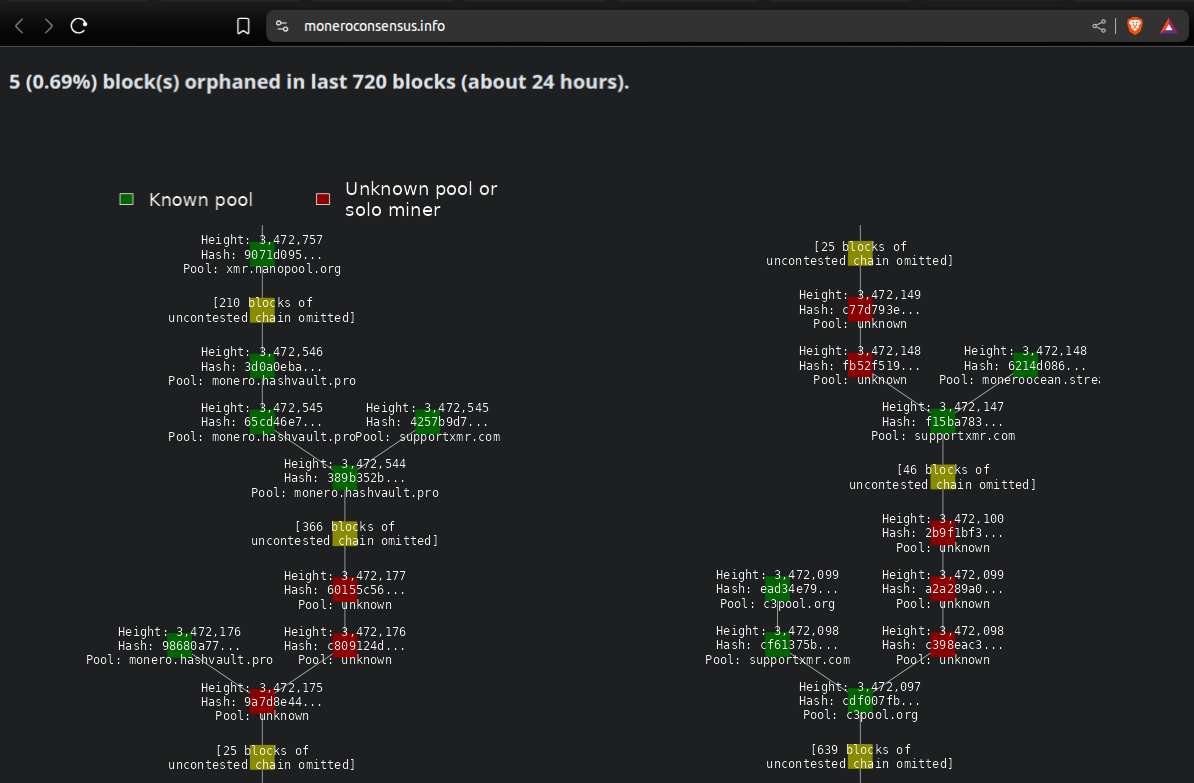
Monero Orphan Blocks Visualization | Source: moneroconsensus.info
In an ongoing discussion on X, the Monero expert and renowned contributor known as ‘ untraceable ‘ (locked account for non-followers) explained that this is likely a “selfish mining strategy” employed by the Qubic mining pool, which is less profitable than an “honest mining strategy,” unless the pool has more than 33% of the network’s hashrate.
Other commentators have noticed that Qubic’s pool has gone “silent” by hiding its hashrate from the other nodes, which increased the block-discovery share of “unknown” miners from 2% to 8%. This aligns with ongoing public communication by CFB, who claimed to have gone “silent” (mining-wise) to protect against an ongoing DDoS attack by other Monero miners and enthusiasts.
Unknown was around 2% before Pubic went into hiding.
— Victor (@VictorMoneroXMR) August 7, 2025
Is Monero at Risk?
CFB has been talking about Qubic’s “Monero domination” plan actively since May 2025, facing resistance online. On July 26, for example, the developer made a provocative post warning “exchanges and the other relevant entities” to expect orphan blocks on Monero from Aug. 2 to Aug. 31 as a result of Qubic’s activities.
Dear $XMR holders, the #Qubic team is unable to contact every single service accepting #Monero coins, please, inform the exchanges and the other relevant entities that from the 2nd of August, 12:00 UTC to the 31st of August, 12:00 UTC it is STRONGLY recommended to accept $XMR …
— Come-from-Beyond (@c___f___b) July 26, 2025
CFB was one of the core developers of Bytecoin, a cryptocurrency project that preceded Monero and has raised doubts in the past due to a premine of 82% of the coins. Therefore, all posts by CFB should be considered with caution, which explains the skepticism from many XMR supporters.
Ricardo Spagni, one of the most prominent figures in Monero’s history, commented on this recent event of five orphan blocks.
“I don’t think it’s so much higher than normal so as to be an outlier – it’s within normal distribution. If it happens for 3 days consecutively I might consider it outside of Poisson distribution, but even then it may just be an outlier.”
As things develop, Monero enthusiasts, holders, developers, and miners continue to watch the Qubic-XMR mining war with a mixture of curiosity, skepticism, fear, and opportunity, depending on different factors. So far, the risks of undesired consequences appear to be minimal, but savvy contributors will remain vigilant until more is known.
next


