
Who Is Stephen Miran? Trump’s Crypto-Friendly Pick for Fed Governor

President Trump's nomination of Stephen Miran to the Federal Reserve Board could reinforce crypto policy in the U.S. With his pro-crypto stance and backing for financial deregulation, Miran's appointment may drive favorable conditions for digital assets amid calls for lower interest rates
President Trump has nominated Stephen Miran, current chair of the Council of Economic Advisers, to the Federal Reserve Board of Governors. The crypto-friendly economist will replace Adriana Kugler in a temporary role through January 2026. This move signals potential shifts toward lower rates and crypto-supportive monetary policy.
Miran’s Strong Pro-Crypto Stance
Miran has been vocal about the economic potential of crypto. In his interview with The Bitcoin Layer, he stated:
“I think that Financial deregulation is going to be a powerful part of that. I think that crypto has a big role potentially to play in innovation and ushering in another Trump Administration economic boom.”
His appointment signals Trump’s commitment to crypto-friendly economic policy. Miran’s background includes experience in Treasury and expertise on Wall Street at Hudson Bay Capital.
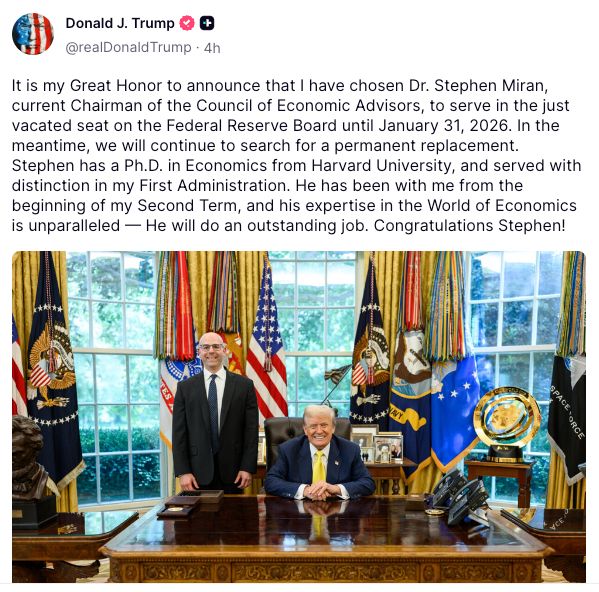 Source: TruthSocial
Miran previously criticized the Fed’s aggressive COVID-19 stimulus actions as inflationary. However, he now aligns with Trump’s calls for lower interest rates. His appointment comes as Trump seeks a “shadow chair” to challenge Jerome Powell’s policies.
The nomination requires Senate confirmation when Congress reconvenes in September. If confirmed, Miran would vote at the Fed’s mid-September rate-setting meeting. Markets expect his presence could support arguments for rate cuts.
Two Trump-appointed governors already dissented at last week’s meeting. This marked the first time multiple governors voted against a rate decision in over 30 years.
Crypto Market Catalyst
Miran’s Fed appointment could significantly impact cryptocurrency markets. His pro-crypto stance, combined with support for loose monetary policy, creates favorable conditions for digital assets. Bitcoin and Ethereum typically perform well in low-rate, high-liquidity environments.
In particular, Miran has raised the need to streamline cryptocurrency regulations, noting in a November 2023 post on the social media platform X:
“I never cease to marvel at what fraction of ‘innovation’ in recent decades is simply due to circumventing regulations. Uber, crypto, Airbnb…”.
In response to news of Binance CEO Changpeng Zhao’s resignation, he also posted:
“And while binance did some evil shit (helping finance Iran, Hamas), maybe we should actually streamline a lot of regulations.”
Miran’s views, coupled with the fact that cryptocurrencies have traditionally performed well in low-interest-rate and high-liquidity environments, could be a significant catalyst for assets like Bitcoin and Ethereum.
Additionally, Miran has experience as a senior strategist at Hudson Bay Capital, an investment firm that has traded claims in the FTX bankruptcy, which filed in late 2022. His nomination clearly shows the administration’s intent to place a figure more aligned with the rapidly evolving digital asset landscape into a key regulatory role.
After Miran’s nomination, the Bitcoin price rose around 2%, crossing $117,000.
Disclaimer: The content of this article solely reflects the author's opinion and does not represent the platform in any capacity. This article is not intended to serve as a reference for making investment decisions.
You may also like
Is a new wave of sell-offs approaching? The ultimate rival of the AI bull market emerges—The "global anchor of asset pricing" breaks through the 5% super threshold
After the 10-year US Treasury yield breaks back above the critical 5% mark, it is more likely to usher in a period of high-level tug-of-war and accelerated asset differentiation. Especially before energy shocks and the significantly eased large-scale expansion of the US fiscal deficit, the conditions to quickly replicate the sharp yield decline seen at the end of 2023 are not yet fully in place.

Anthropic releases another article: What will the economy look like in the AI era?
Anthropic's economics team has released an AI economic scenario model, centered around three scenarios: moderate and gradual growth, transformative changes with GDP doubling, and an extreme situation with 15% annual growth but massive job losses among knowledge workers. The model treats work as "bundles of tasks" and analyzes AI’s enhancement and substitution effects on different types of tasks. Anthropic emphasizes that the economic outlook for 2030 is not predetermined; the key lies in how the dividends from AI are widely shared.
"New Federal Reserve News Agency": Waller's Rate Hike "Has No Way Back", Trump's "Trust" Faces Test
Nick Timiraos believes that after the higher-than-expected August CPI, the probability of the Federal Reserve raising interest rates this week has surged, while Waller’s hawkish stance on inflation has left himself almost "no leeway." With seven weeks before the election, whether or not Waller raises rates will directly test how long Trump's “trust” in him can last. Previously, Waller maintained a balance between the White House and the Federal Reserve by “talking less and avoiding provocation,” but after this meeting, silence will no longer serve as his shield.
Trump Opposes AI "Guardrails": Congress Pushes Legislation for Restrictions, Deepening Bipartisan Divide
U.S. President Trump opposes setting guardrails for artificial intelligence (AI), putting him at odds with a growing number of bipartisan lawmakers. As the midterm elections approach, voters' concerns about AI safety have intensified their doubts about this technology.

Crypto prices
More


