
BIG Chainlink News: $1M Reserve Launched

Chainlink just dropped a game-changing update: it's building a reserve funded by real revenue —both onchain and offchain. With over $1 million in LINK already stacked, the market just got a reason to pay attention. Is this the fuel LINK price needs to break past $20 again?
Chainlink News: What Is the Chainlink Reserve and Why It Matters?
Chainlink just rolled out a strategic LINK reserve , aimed at long-term sustainability. It’s not just a marketing term. The Chainlink reserve is already backed by over $1 million worth of LINK, accumulated through both onchain service fees and offchain enterprise payments. Think Swift, Mastercard, UBS — not just your typical DeFi projects.
This isn’t a short-term liquidity pool or a rainy-day fund. Chainlink says it won’t touch the reserve for years. The goal is to funnel institutional adoption and revenue into LINK accumulation, strengthening its token economy without relying on inflationary emissions.
The model is smart. Enterprises can pay in stablecoins or fiat, and Chainlink will programmatically convert that revenue into LINK via DEXs. Over time, as adoption grows, this could create consistent buy pressure on LINK from real revenue.
Chainlink News: What the Daily Chart Is Saying Right Now
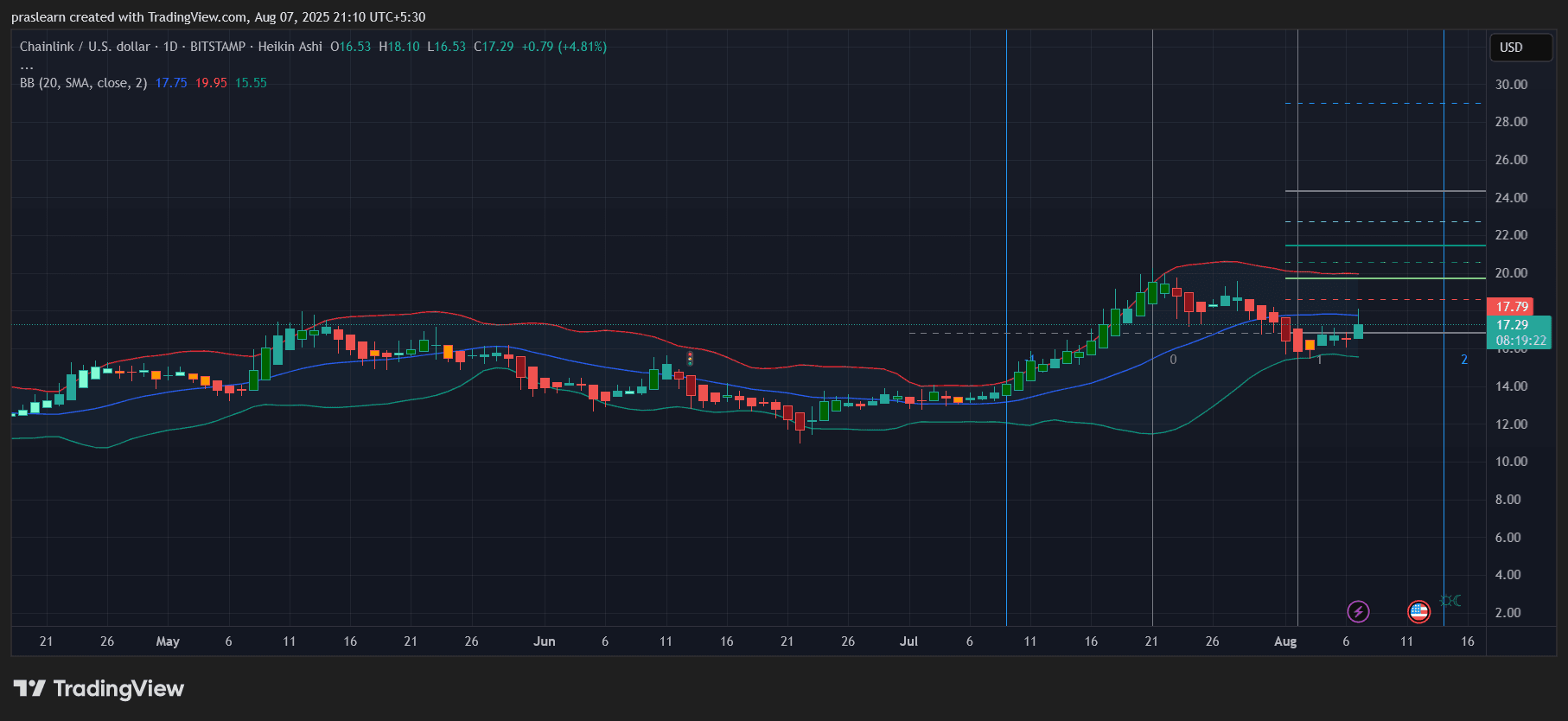 LINK/USD Daily Chart- TradingView
Looking at the daily chart, LINK price closed at $17.29 with a 4.81 percent gain on the day. The candle broke above the 20-day moving average (blue midline on Bollinger Bands), signaling a potential trend reversal after a recent correction.
The Chainlink price is now attempting to reclaim the upper Bollinger Band area. The last strong rally peaked near $22, and the red upper band is now sitting around $19.95. A move past that would confirm bullish momentum returning.
What really stands out is the Heikin Ashi candle structure. After several days of bearish or indecisive candles, today’s strong green close shows increasing momentum and reduced selling pressure. This aligns with the psychological impact of the reserve news — long-term support from institutional flows gives investors confidence to hold or buy more.
Can the Chainlink Reserve News Actually Move the Market?
The launch of the reserve doesn’t immediately inject capital into LINK’s trading volume. But what it does do is shift sentiment. When traders see that Chainlink is building a sustainable treasury from real revenue — not just grants or VC funds — it reframes the token's utility. LINK isn’t just a gas token for oracles anymore. It becomes a revenue-backed digital asset.
In the short term, the announcement gives bulls a reason to return. In the medium to long term, it sets the foundation for stronger tokenomics. More revenue means more LINK accumulated into the reserve. If market supply stays fixed or limited, this becomes a basic supply and demand equation.
Key Levels to Watch
- Support: $15.55 and $17.75 (lower and middle Bollinger Bands)
- Resistance: $19.95 (upper band) and $22.00 (previous local high)
If LINK price can close above $18.50 in the next two sessions, a push to test $20 seems likely. On the flip side, a failure to hold above $17 could drag it back into the $15.50–$16.50 consolidation zone.
Final Thoughts
The reserve launch changes the narrative. Instead of just another Oracle project, Chainlink is positioning LINK as a token backed by real enterprise use and actual revenue flows. That won’t pump the price overnight, but it does lay the groundwork for more sustainable growth.
The chart reflects that optimism. Chainlink price is trying to recover from its dip, and today’s breakout candle adds fuel. If momentum holds and volume picks up, $20 could come back into play sooner than expected.
Disclaimer: The content of this article solely reflects the author's opinion and does not represent the platform in any capacity. This article is not intended to serve as a reference for making investment decisions.
You may also like
Is a new wave of sell-offs approaching? The ultimate rival of the AI bull market emerges—The "global anchor of asset pricing" breaks through the 5% super threshold
After the 10-year US Treasury yield breaks back above the critical 5% mark, it is more likely to usher in a period of high-level tug-of-war and accelerated asset differentiation. Especially before energy shocks and the significantly eased large-scale expansion of the US fiscal deficit, the conditions to quickly replicate the sharp yield decline seen at the end of 2023 are not yet fully in place.

Anthropic releases another article: What will the economy look like in the AI era?
Anthropic's economics team has released an AI economic scenario model, centered around three scenarios: moderate and gradual growth, transformative changes with GDP doubling, and an extreme situation with 15% annual growth but massive job losses among knowledge workers. The model treats work as "bundles of tasks" and analyzes AI’s enhancement and substitution effects on different types of tasks. Anthropic emphasizes that the economic outlook for 2030 is not predetermined; the key lies in how the dividends from AI are widely shared.
"New Federal Reserve News Agency": Waller's Rate Hike "Has No Way Back", Trump's "Trust" Faces Test
Nick Timiraos believes that after the higher-than-expected August CPI, the probability of the Federal Reserve raising interest rates this week has surged, while Waller’s hawkish stance on inflation has left himself almost "no leeway." With seven weeks before the election, whether or not Waller raises rates will directly test how long Trump's “trust” in him can last. Previously, Waller maintained a balance between the White House and the Federal Reserve by “talking less and avoiding provocation,” but after this meeting, silence will no longer serve as his shield.
Trump Opposes AI "Guardrails": Congress Pushes Legislation for Restrictions, Deepening Bipartisan Divide
U.S. President Trump opposes setting guardrails for artificial intelligence (AI), putting him at odds with a growing number of bipartisan lawmakers. As the midterm elections approach, voters' concerns about AI safety have intensified their doubts about this technology.

Crypto prices
More


