

Germany’s industrial output dropped in June to its lowest level since 2020, the year when the coronavirus pandemic swept the planet, paralyzing the global economy.
The decline in German production, which comes amid weak demand and slow growth abroad, coincided with a continued decrease in industrial orders.
The trend sets in as the country’s export-oriented economy prepares for the impact of U.S. tariffs and stiffer competition from Chinese manufacturing.
Industrial production in Germany returns to pandemic volumes
German industrial output fell 1.9% in June over the previous month, the Federal Statistical Office announced Thursday, quoted by Reuters. The figure exceeds the 0.5% drop expected by polled analysts, the news agency pointed out.
With the monthly decline, production in the Bundesrepublik reached its lowest point since May 2020, the time when the economy was shrinking under the burden of measures introduced to limit the spread of the raging Covid-19 virus.
Provisional data suggesting a 1.2% increase in May was also revised by Destatis to a negative 0.1%, compared to April, as a result of corrections in the numbers coming from Germany ’s massive automotive industry.
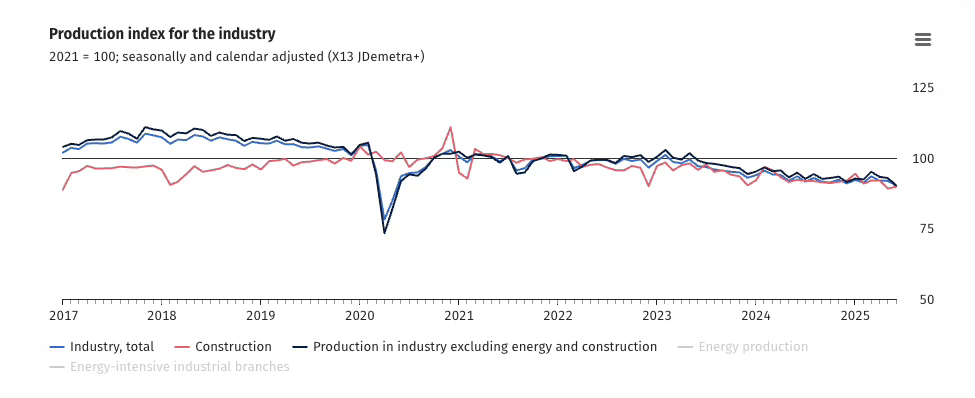 Production index for German industry. Source: Statistisches Bundesamt ( Destatis )
The indicator was down in quarterly terms as well, by 1.0% in Q2, returning to levels last registered during the first half of the same pandemic year, the official stats revealed. That’s despite earlier signs that German production might be recovering from last year’s sharp drop.
Carsten Brzeski, global head of macro for ING Research, expressed concern that the latest figures may result in a downward revision of the estimated 0.1% contraction of Germany’s gross domestic product (GDP) in Q2, 2025. He commented for Reuters:
“Our previous view that the German economy would at least experience a cyclical rebound has come under enormous pressure. At face value, industry remains stuck in a very long bottoming out.”
Industrial orders surprised analysts, too, falling by 1% in June. They are moving in that direction for a second month in a row. The unexpected decrease has been largely attributed to weaker foreign demand for German products.
Germany’s exports rise mainly due to EU deliveries
At the same time, however, German exports rose 0.8% month-on-month, surpassing the forecasted 0.5% and 2.4% over June 2024, reaching €130.5 billion (almost $152 billion), according to the country’s statistical office.
Shipments to other member states of the European Union increased by 2.4%, while those to non-EU countries registered a 1.2% decrease.
Exports to the United States fell by 2.1% compared with the previous month. This is the third consecutive monthly drop, and the figures are at their lowest level since early 2022.
Weaker U.S. demand came after months of strong purchases in anticipation of President Donald Trump’s tariffs . Germany’s export-dependent economy is likely to suffer under his policies as the United States is Berlin’s biggest trading partner.
Meanwhile, imports increased by 4.2% over May, to €115.6 billion euros ($134.5 billion), and the Federal Republic’s foreign trade surplus shrank to under €15 billion (around $17.4 billion) from May’s €18.5 billion and last June’s €20.3 billion ($23.6 billion).
“The medium-term outlook for German industry remains poor as weak growth in both Europe and China, and rising competition from Chinese producers is likely to weigh heavily on demand for German industrial goods,” concluded Franziska Palmas, senior Europe economist at the Capital Economics research group.
Want your project in front of crypto’s top minds? Feature it in our next industry report, where data meets impact.


