Bitget App
Trade smarter
Buy cryptoMarketsTradeFuturesEarnAISquareMore
Ethereum’s Supply Decline Suggests Potential for Price Rally Amid Market Strength

Ethereum’s Supply Decline Suggests Potential for Price Rally Amid Market Strength

CoinotagCoinotag2025/08/07 16:20
By:Marisol Navaro


  • Ethereum’s reserves on Binance fell by 496,984 ETH in one month.

  • USDT holdings increased by over 258 million, showcasing a contrasting trend.

  • Ethereum’s price has breached resistance, currently trading above $3,700.

Ethereum’s supply has decreased significantly, indicating strong market dynamics and potential for price increases. Learn more about this trend.

Ethereum Supply Declines

The recent report from Binance revealed a significant drop in Ethereum reserves, which fell by almost 10%. Currently, Binance holds approximately 4.55 million ETH, down from 5.05 million ETH a month ago. This withdrawal contrasts sharply with other assets, where USDT and Bitcoin reserves saw increases.
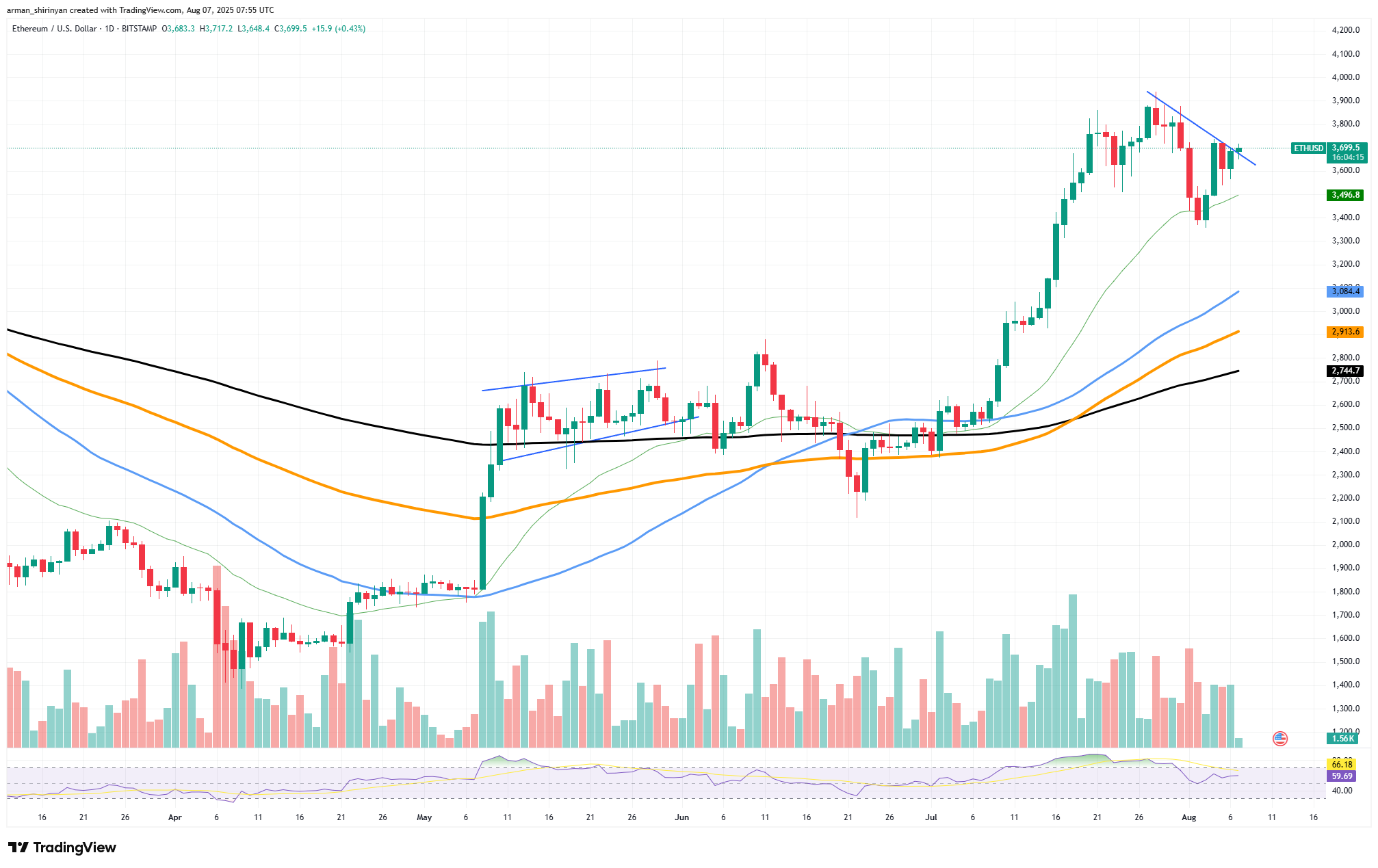
Ethereum’s Supply Decline Suggests Potential for Price Rally Amid Market Strength image 0

Such a large outflow of Ethereum is noteworthy. If demand remains stable or increases, the declining supply could lead to higher prices, reflecting fundamental economic principles. The ETH/USD chart supports this notion, indicating potential bullish trends.

Ethereum’s Market Strength

After a brief dip towards the $3,500-$3,600 range, Ethereum is showing signs of recovery. The price has breached a descending trendline, signaling a bullish breakout. The 26 EMA support remains intact, and the RSI is currently around 66, suggesting room for growth without immediate overbought risks.

With nearly half a million ETH removed from circulation, it is likely that these coins have been transferred to cold wallets or utilized in DeFi applications. This behavior is positive for Ethereum’s price outlook, as it may indicate long-term holding or staking.

Ethereum is now trading above $3,700, benefiting from the recent supply shortage. This abrupt decline in reserves could ignite a rally, especially if new capital inflows follow.


Frequently Asked Questions

What factors are influencing Ethereum’s market strength?

Ethereum’s market strength is influenced by a significant reduction in supply, positive technical indicators, and increased demand in decentralized finance (DeFi) applications.

How does Ethereum’s supply impact its price?

A decrease in Ethereum’s supply can lead to price increases, especially if demand stays constant or rises, as the fundamental law of supply and demand dictates.

Key Takeaways

  • Supply Decline: Ethereum’s reserves on Binance have decreased significantly.
  • Market Indicators: Technical analysis shows bullish trends for Ethereum.
  • Future Outlook: A potential rally could occur if new capital inflows are observed.

Conclusion

In summary, Ethereum’s recent supply decline and market strength suggest a positive outlook for its price. As demand remains stable, the potential for a rally increases, making it a critical time for investors to watch the market closely.


In Case You Missed It: Bitcoin's 2025 Performance Highlights Potential Missed Opportunities for Berkshire Hathaway as a Growth Asset
0
0

Disclaimer: The content of this article solely reflects the author's opinion and does not represent the platform in any capacity. This article is not intended to serve as a reference for making investment decisions.

Understand the market, then trade.
Bitget offers one-stop trading for cryptocurrencies, stocks, and gold.
Trade now!

You may also like

Is a new wave of sell-offs approaching? The ultimate rival of the AI bull market emerges—The "global anchor of asset pricing" breaks through the 5% super threshold

After the 10-year US Treasury yield breaks back above the critical 5% mark, it is more likely to usher in a period of high-level tug-of-war and accelerated asset differentiation. Especially before energy shocks and the significantly eased large-scale expansion of the US fiscal deficit, the conditions to quickly replicate the sharp yield decline seen at the end of 2023 are not yet fully in place.

智通财经2026/09/15 03:26
Is a new wave of sell-offs approaching? The ultimate rival of the AI bull market emerges—The "global anchor of asset pricing" breaks through the 5% super threshold

Anthropic releases another article: What will the economy look like in the AI era?

Anthropic's economics team has released an AI economic scenario model, centered around three scenarios: moderate and gradual growth, transformative changes with GDP doubling, and an extreme situation with 15% annual growth but massive job losses among knowledge workers. The model treats work as "bundles of tasks" and analyzes AI’s enhancement and substitution effects on different types of tasks. Anthropic emphasizes that the economic outlook for 2030 is not predetermined; the key lies in how the dividends from AI are widely shared.

华尔街见闻2026/09/15 03:26

"New Federal Reserve News Agency": Waller's Rate Hike "Has No Way Back", Trump's "Trust" Faces Test

Nick Timiraos believes that after the higher-than-expected August CPI, the probability of the Federal Reserve raising interest rates this week has surged, while Waller’s hawkish stance on inflation has left himself almost "no leeway." With seven weeks before the election, whether or not Waller raises rates will directly test how long Trump's “trust” in him can last. Previously, Waller maintained a balance between the White House and the Federal Reserve by “talking less and avoiding provocation,” but after this meeting, silence will no longer serve as his shield.

华尔街见闻2026/09/15 03:26

Trump Opposes AI "Guardrails": Congress Pushes Legislation for Restrictions, Deepening Bipartisan Divide

U.S. President Trump opposes setting guardrails for artificial intelligence (AI), putting him at odds with a growing number of bipartisan lawmakers. As the midterm elections approach, voters' concerns about AI safety have intensified their doubts about this technology.

智通财经2026/09/15 02:46
Trump Opposes AI "Guardrails": Congress Pushes Legislation for Restrictions, Deepening Bipartisan Divide