
Ethereum’s Institutional Accumulation Deepens; Retail Investors Still on the Sidelines


- Institutions dominate ETH’s market in 2025, aggressively accumulating ETH and driving growth.
- Retail investors remain defensive amid macro uncertainty, focused on capital preservation.
- Institutional-backed Ethereum ETFs see record inflows, contrasting with retail hesitation.
Ethereum’s market performance in 2025 underscores a growing gap between institutional and retail investors. Institutions are aggressively building Ethereum treasuries and embracing sophisticated DeFi strategies, while retail investors remain cautious amid macroeconomic uncertainty. The widening divide reflects differing investment mindsets and market approaches. The shift in sentiment is becoming more evident, especially as institutional confidence shapes market leadership.
Ethereum has emerged as the preferred choice among institutional investors, whose growing support is reshaping the market. Firms like Bitminer now hold over 833,000 ETH, worth nearly $3 billion, highlighting confidence in its long-term value.
Retail Caution vs. Institutional Confidence: ETH’s Market Divergence
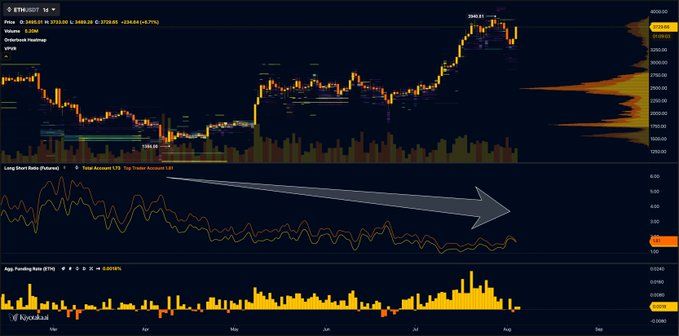
Meanwhile, retail investors are hesitant to jump in, mainly due to ongoing economic uncertainty and limited access to information. Crypto market intelligence platform Kiyotaka revealed a drop in the ETH Long Short Ratio(Futures) since April, signaling a defensive posture. Retail traders are holding back, focused on preserving capital rather than engaging in the volatile market.
 Source:
X
Source:
X
This cautious sentiment is further reflected in broader Ethereum market activity. The latest ETH Dump Alert indicates a $418.8 million net taker volume in a single day, highlighting the stark contrast between market participants. Taker sellers offloaded 115.4K more ETH than buyers were willing to absorb, creating the second-largest daily sell-side imbalance ever recorded in Ethereum’s history.
— Maartunn (@JA_Maartun) August 6, 2025
ETH Dump Alert: -$418.8M Net Taker Volume (daily)
Taker sellers offloaded 115.4K more $ETH than buyers were willing to absorb.
This is the 2nd largest daily sell-side imbalance ever. pic.twitter.com/XDw9cmDbKS
Ethereum ETFs Soar as Institutional Demand Grows
Ethereum’s rise in institutional-backed Ethereum ETFs further reflects the growing divide. By July 31, Ethereum ETFs reached a record $21.52 billion in net assets. While BlackRock’s ETHA led the charge, inflows were also observed in ETFs such as VanEck’s ETHV and 21Shares’s CETH.
Emma Shi, the Head of HashKey OTC, reveals the main distinction between the groups. Ethereum is considered by institutions as a hedge against macro-risks, whereas retail investors use a more defensive position.
Participants in retail aim to replenish lost funds rather than make new investments. In contrast, institutional players tend to use market dips not to exit or cautiously accumulate, but to establish larger, strategic positions.
Related: Ether Machine Buys 15,000 ETH, Solidifies Role in ETH Treasury Race
Conditions such as a reduction in arbitrage opportunities have left retail investors on the defensive. In the absence of such benefits, retail traders have been at a disadvantage in terms of equal access to DeFi opportunities.
Even though the market of Ethereum is dominated by institutions, volatility is relatively high, and the reluctance among retail investors creates a large gap. The most influential variable in retail attitude is the macroeconomic environment, and only once this factor finds its footing will the retail investors probably rejoin the market.
Institutions are becoming more important in defining the market behavior of Ethereum. Amidst the uncertainty among retail investors, institutions are accumulating Ethereum, potentially changing the market’s future. This disparity is an indication of a new phase in digital asset investment, as capital, information, and strategic vision will dictate market leadership.
The post Ethereum’s Institutional Accumulation Deepens; Retail Investors Still on the Sidelines appeared first on Cryptotale.
Disclaimer: The content of this article solely reflects the author's opinion and does not represent the platform in any capacity. This article is not intended to serve as a reference for making investment decisions.
You may also like
BTC, ETH, XRP, ZEC consolidate near highs as breakout levels approach
As chip stocks plummet, "cybersecurity software" surges across the board, CrowdStrike and Palo Alto Networks hit new highs
CrowdStrike surged 13.8% in a single day to a record high, while Palo Alto Networks soared 13%. The software ETF outperformed the semiconductor ETF by more than 10 percentage points in a single day, marking the largest gap in history. Analysts believe that regardless of the pace of AI development, security demand will only continue to rise. Capital is accelerating its rotation from computing hardware to security software, with segments such as identity management and data governance expected to benefit first.
Altman can afford to wait, but Masayoshi Son can't: OpenAI will not go public this year, exposing a $20 billion gap and a credit weakness for SoftBank.
OpenAI has postponed its public listing, putting its largest external shareholder, SoftBank, in a liquidity crisis. This week, SoftBank is conducting a roadshow in New York, seeking to issue $10-20 billion in bonds to repay the $40 billion bridge loan previously borrowed to increase its investment in OpenAI. According to Bloomberg estimates, SoftBank faces a funding gap of at least $20 billion, and the yield on its existing U.S. dollar bonds has already exceeded 8.5%, with pricing approaching junk status.
Meeting postponed, gold price drops rapidly
Crypto prices
More


