
Stablecoin market hits ATH as non-USD stables quietly surpass $1B in market cap: report

In July, the stablecoin market hit a record $261 billion, with non-USD stablecoins quietly surpassing $1B in total market cap. However, CBDC developments showed a mixed picture, with some countries advancing pilots while others pushing back.
- Stablecoins hit a new ATH market cap in July though their market dominance dipped as broader crypto assets rallied.
- Falcon Finance’s USDf surged 121% to enter the top 10 stablecoins.
- Non-USD stablecoins surpassed $1B in market cap, though they still represent less than 1% of the sector.
- CBDC projects saw mixed progress globally.
As reported in the latest Stablecoins & CBDCs Report by Coindesk , the stablecoin market continued its upward trajectory in July, marking its 22nd consecutive month of growth and reaching a new all-time high of $261 billion in total market cap, following a 4.87% monthly increase.
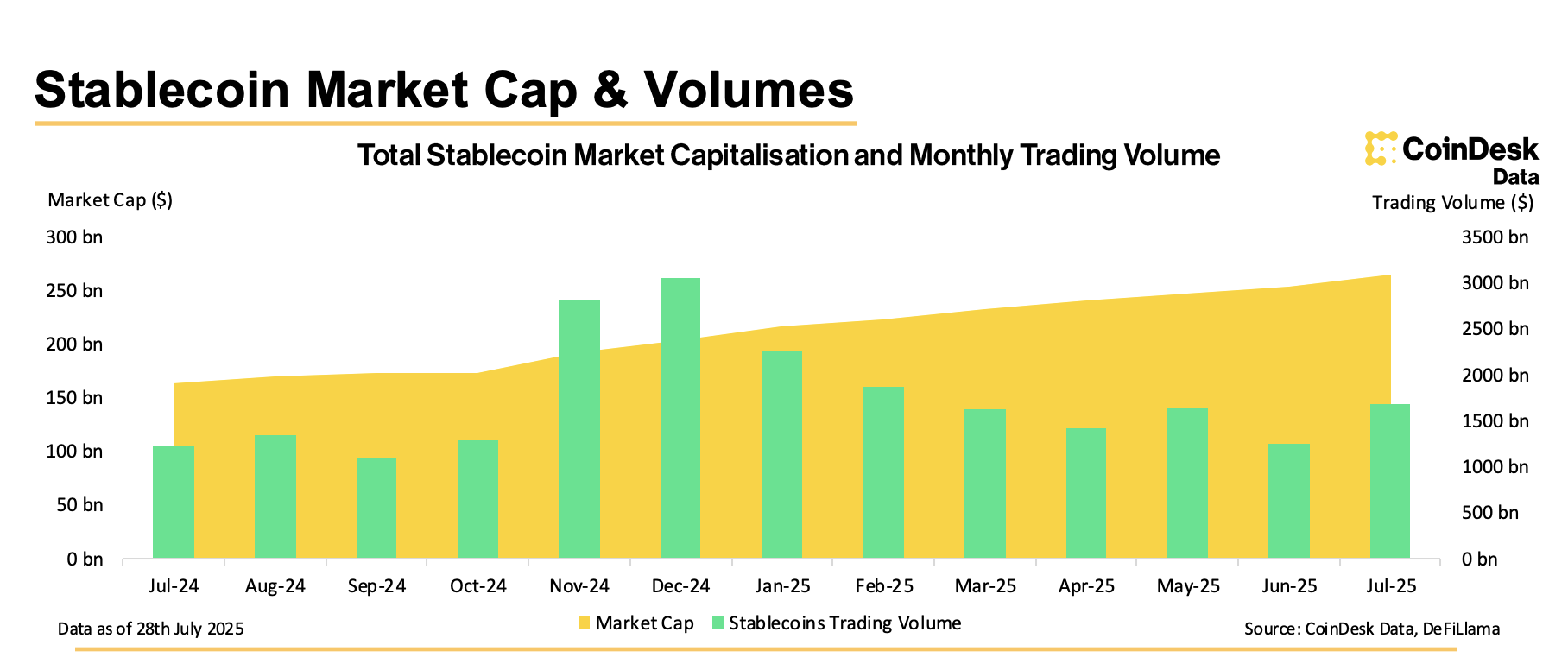 Source: Non-USD Stablecoins: Market Cap and Trading Volumes | Coindesk Stablecoins &CBDCs Report July 2025
However, the market dominance of stablecoins has slightly declined to 6.64% because the broader crypto market has been rallying, with major assets like Bitcoin ( BTC ) and Ethereum ( ETH ) posting larger percentage gains. As capital flows into risk-on assets during bullish periods, stablecoins typically grow at a slower rate, causing their share of the total market to shrink — even if their absolute value continues to rise.
On the market side, CEX volumes for crypto-fiat pairs climbed to a record $41.7 billion in July.
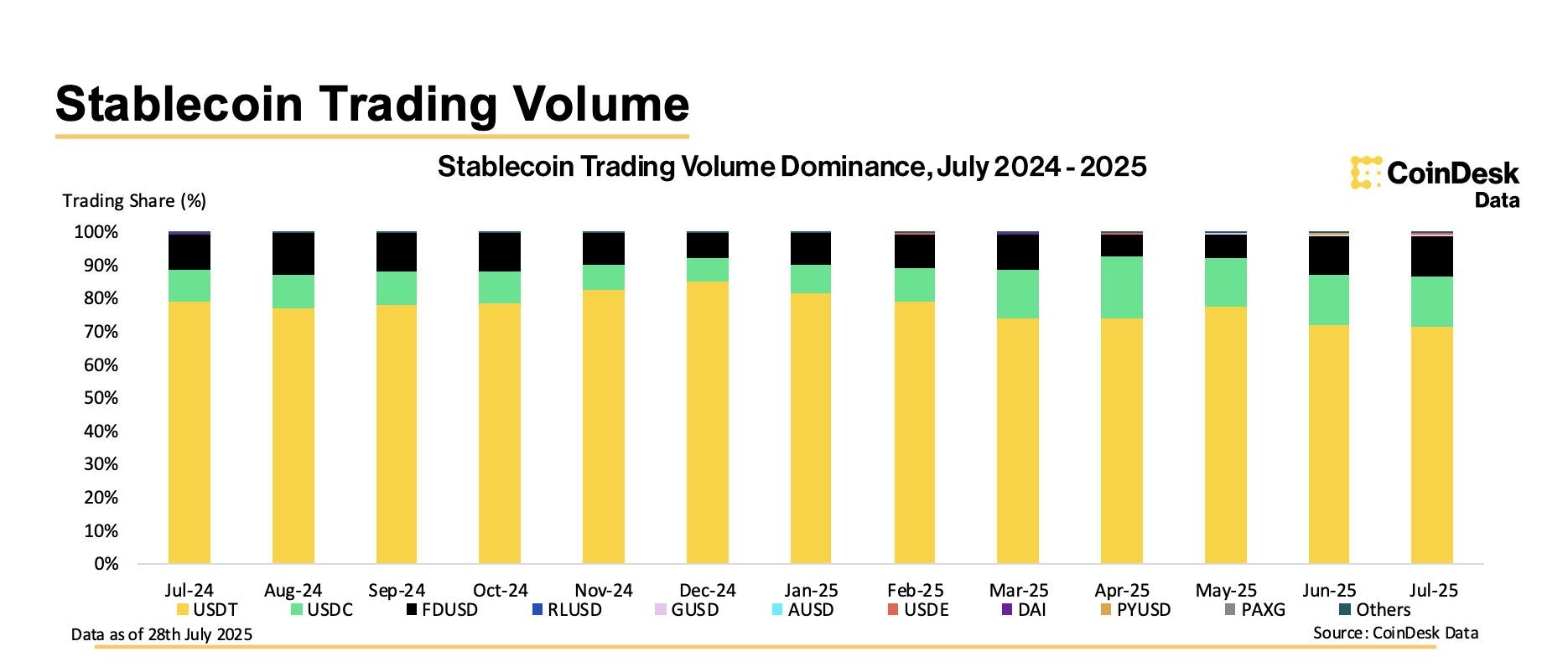 Source: Non-USD Stablecoins: Market Cap and Trading Volumes | Coindesk Stablecoins &CBDCs Report July 2025
The sector’s steady growth comes alongside clearer regulatory signals. Most notably, the GENIUS Act became law when President Trump signed it on July 18. This legislation sets the first federal framework regulating “payment stablecoins,” requiring that they be fully backed on a 1:1 basis by cash or liquid U.S. Treasuries, while also enforcing monthly disclosure and auditing of reserves.
Stablecoin market highlights from July
Falcon Finance ’s USDf grew 121% in market cap to $1.07 billion, entering the 10th spot. USDf’s growth is driven by its on-chain yield model, which helps users earn stable returns. Falcon Finance also announced plans to introduce gold redemptions and add real-world asset collateral over the next two years.
Ethena Labs’ USDe rose 43.5% to $7.6 billion. The company is expanding through a $260 million ENA token buyback, increased institutional involvement, and support for StablecoinX, which is preparing for a public listing.
Over on the Tron ( TRX ) network, the ecosystem saw its stablecoin market cap surge to $81.9 billion, with Tether ( USDT ) on Tron now representing over 50% of the total USDT supply for the first time since August last year. The network also welcomed the launch of A7A5, a RUB-pegged stablecoin that has already amassed a market cap of $467 million since its debut in June.
Euro and other non-USD stablecoins quietly cross $1B milestone
While USD-pegged stablecoins still dominate the market , non-USD-pegged alternatives are steadily gaining traction. In July, the total market cap of non-USD stablecoins, including euro and ruble-backed tokens, exceeded $1 billion for the first time.
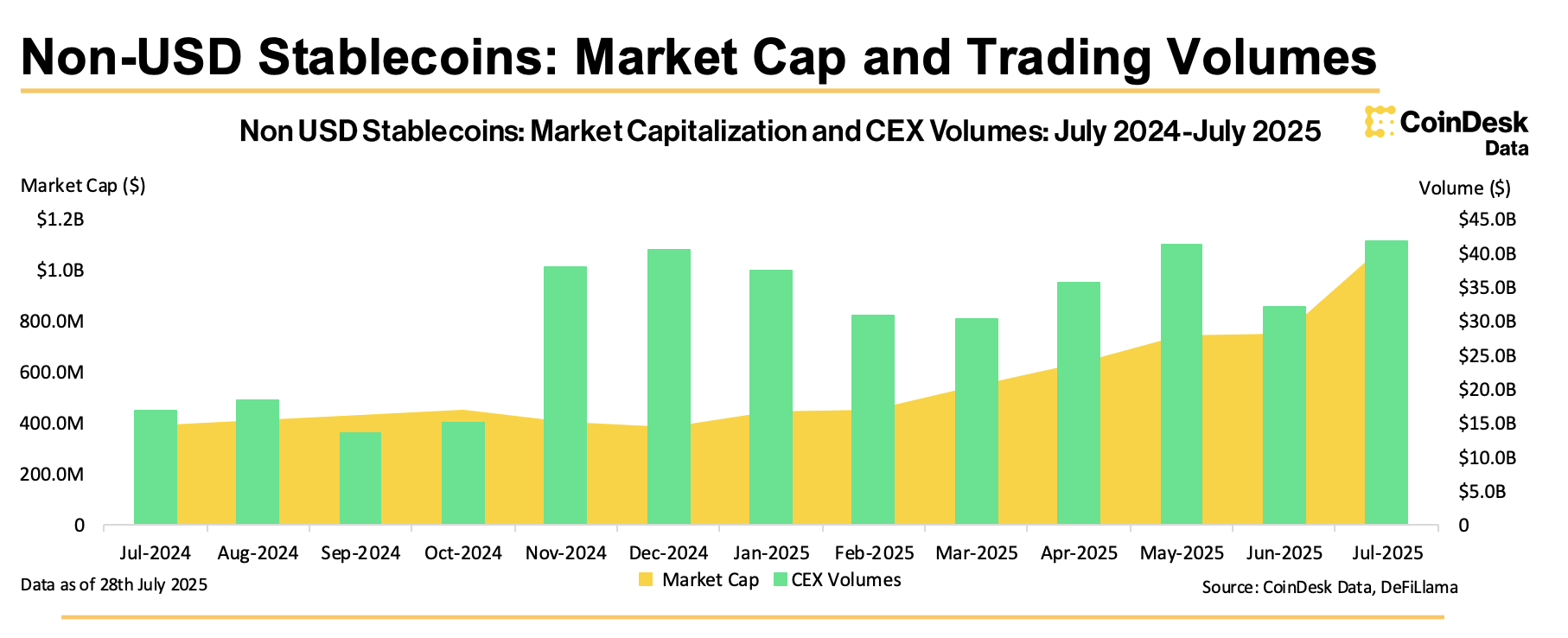 Source: Non-USD Stablecoins: Market Cap and Trading Volumes | Coindesk Stablecoins &CBDCs Report July 2025
However, their market share remains small, accounting for less than 1% of the total stablecoin sector. Yet their momentum is noteworthy, especially amid rising crypto-fiat volumes and a shift in focus toward real-world use cases and regional liquidity needs.
CBDC Developments in July
Central Bank Digital Currency activity in July was marked by both progress and pushback across key jurisdictions.
On July 4, China expanded the use of its digital yuan to additional free trade zones, reinforcing its strategy of incremental geographic rollouts. The same day, the Bank of Canada released a comprehensive research paper outlining the technical path for a retail CBDC.
Meanwhile, the European Central Bank continued to prepare for the introduction of the digital euro, with President Christine Lagarde publicly defending the project ahead of its planned October 2025 pilot.
However, not all developments were expansionary.
In the U.S., Representative Tom Emmer reintroduced the CBDC Anti-Surveillance State Act on June 29, aiming to limit the Federal Reserve’s authority to issue a digital dollar, citing privacy and overreach concerns.
Across the Atlantic, the Bank of England was reported on June 22 to be reconsidering its “Britcoin” project altogether, with political uncertainty and slow retail CBDC adoption globally weighing on the decision.
Disclaimer: The content of this article solely reflects the author's opinion and does not represent the platform in any capacity. This article is not intended to serve as a reference for making investment decisions.
You may also like
Altman can afford to wait, but Masayoshi Son can't: OpenAI will not go public this year, exposing a $20 billion gap and a credit weakness for SoftBank.
OpenAI has postponed its public listing, putting its largest external shareholder, SoftBank, in a liquidity crisis. This week, SoftBank is conducting a roadshow in New York, seeking to issue $10-20 billion in bonds to repay the $40 billion bridge loan previously borrowed to increase its investment in OpenAI. According to Bloomberg estimates, SoftBank faces a funding gap of at least $20 billion, and the yield on its existing U.S. dollar bonds has already exceeded 8.5%, with pricing approaching junk status.
Meeting postponed, gold price drops rapidly
The "first metaverse stock" bets on "AI-powered game creation"! Roblox (RBLX.US) competes for creator economy dividends, shares surge nearly 13%
On September 11, after Roblox announced new tools for game developers and features for players at its developer conference, the company's stock price rose by more than 12% on Monday.

Trump publicly calls Jensen Huang: The "AI danger theory" is a fraud, data center importance surpasses the internet
During his speech at the All-In Summit in Los Angeles, Nvidia CEO Jensen Huang received a call from Trump and put it on speaker. Trump dismissed the dangers of AI as a "scam" and compared data centers to "the oil of the next twenty or thirty years," claiming their importance "exceeds that of the internet." Jensen Huang immediately expressed agreement, stating that he "won't let (an AI slowdown) happen." However, these strong statements failed to boost the market, as Nvidia's stock fell by 3.4% that day, with tech stocks overall trending lower.
Crypto prices
More


