
Bitcoin Volatility Drops Below 40 as ETFs Reshape Market


- Bitcoin’s volatility fell from over 60 to under 40 after ETF trading began in January 2024.
- Gold volatility rose slightly while Bitcoin’s dropped, bringing the gap under 2x for the first time.
- The gold-to-BTC ratio shows a brief bullish signal as the price nears the 0.03054 resistance
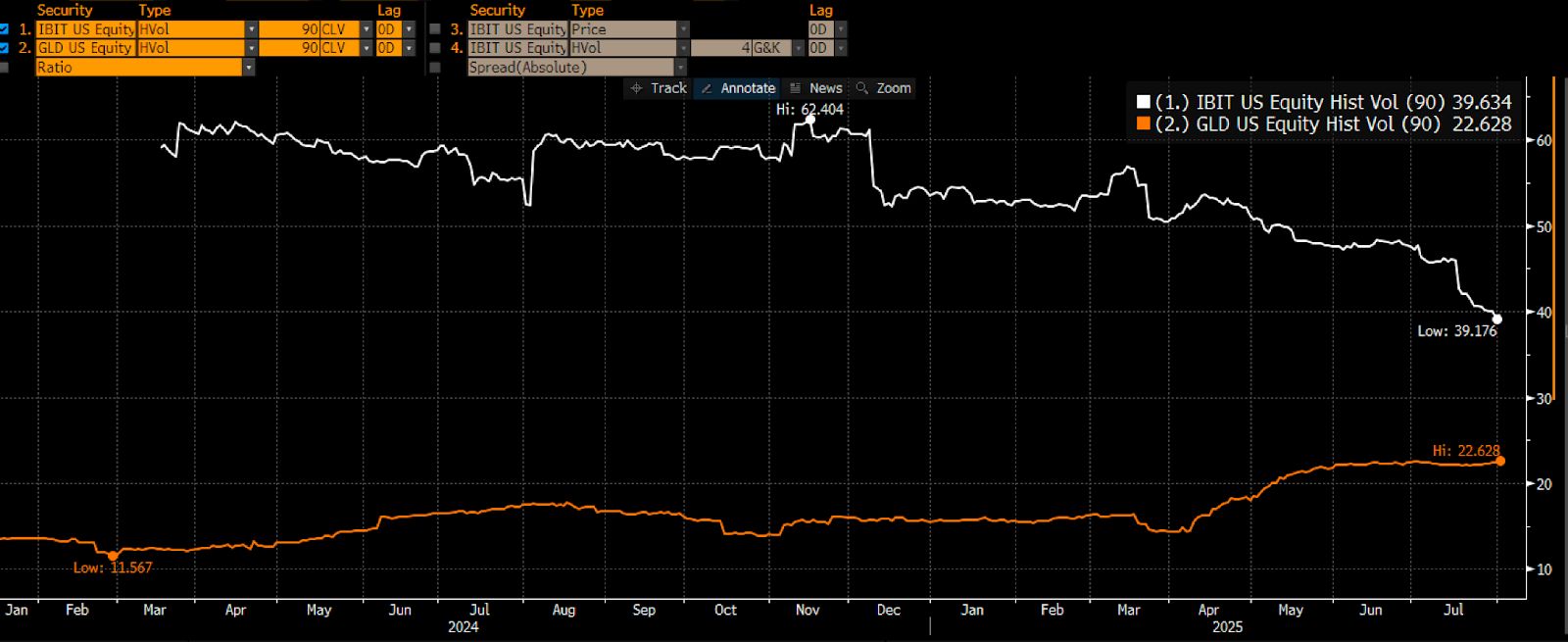
Since the launch of spot Bitcoin ETFs in January 2024, Bitcoin’s 90-day rolling volatility has sharply declined, marking a significant structural change in its trading profile. According to Bloomberg ETF analyst Eric Balchunas, the 90-day volatility of BlackRock’s IBIT ETF has dropped from over 60 to just under 40, setting a record low. GLD, the SPDR Gold Shares ETF, long considered a volatility benchmark for stability, now reports a rolling volatility of 22.628. Previously, Bitcoin was over three times more volatile than gold. Today, it’s less than double.
 Source:
X
Source:
X
From Wild Swings to Institutional Calm
The chart shared by Balchunas tracks historical volatility for IBIT and GLD from early 2024 to August 2025. At the start of the ETF launch cycle, IBIT volatility peaked at 62.404, while GLD recorded a low at 11.567. Over the months, Bitcoin’s volatility trended down steadily. Meanwhile, gold’s volatility showed a slow but consistent rise, topping at 22.628.
As of early August 2025, IBIT’s volatility has fallen to 39.176. The narrowing spread—now just over 17 points—represents the closest point of convergence between Bitcoin and gold volatility since ETFs began trading. Balchunas remarked that this compression had never occurred before, noting it used to exceed a 3x ratio.
One of the reasons for this convergence of volatility can be attributed to ETF-related mechanisms designed to stabilize price fluctuations. Tools such as covered call strategies and in-kind redemptions have allowed for yield generation while controlling large price swings. These regulated mechanisms provide a buffer against volatility, allowing larger funds to manage exposure more efficiently.
This has been boosted by huge institutional inflows. The total cumulative net inflows that IBIT alone has amassed are over $52 billion. In the past, volatility in Bitcoin pushed away a great number of institutional investors. Today, its more stable risk profile is drawing interest from pensions, endowments, and other large funds seeking exposure without the extreme price swings.
Related: Dalio’s 15% Portfolio Allocation: Gold and Bitcoin’s Role in a Financial Crisis
A Structural Shift or Temporary Calm?
Amidst these developments, there lies a big question: is the decline in volatility of Bitcoin a long-term structural shift or just a temporary phase? According to some analysts, such as Balchunas, it could be an indication of market maturity. Nevertheless, the macroeconomic and regulatory uncertainty is still one of the variables.
Beyond technical and economic shifts, philosophical concerns are also gaining ground. Some say Bitcoin is drifting away from its decentralized structure. The rise of ETFs, dominated by centralized asset managers, has raised concerns among Bitcoin purists who fear the asset is becoming too entangled with Wall Street. The early years were dominated by retail traders and mining pools. Currently, however, in this cycle, decisions and flows are more and more being dictated by institutional strategies.
Gold/BTC Ratio Signals Trend Reversal?
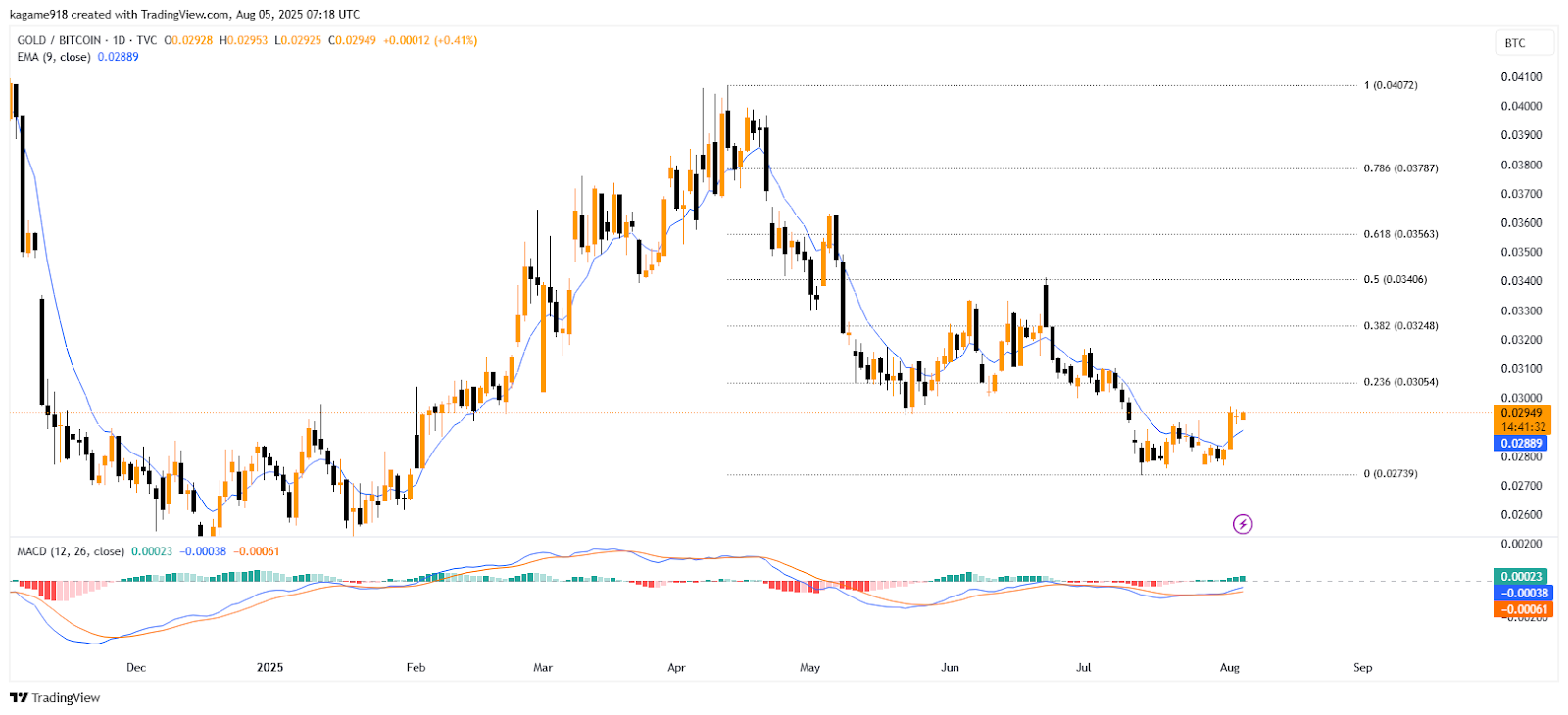
At press time, data on TradingView indicates that the Gold-to-Bitcoin ratio currently stands at 0.02949. The price has reached the 0.03000 level and is ready to touch the 0.236 Fibonacci resistance at 0.03054. This can be an indication of a short-term reversal in favor of gold, and in case this is breached, it may act as a short-term reversal in favor of Bitcoin.
 Source:
TradingView
Source:
TradingView
The 9-day EMA is at 0.02889, supporting price action. A bullish crossover has just taken place, with green histograms indicating rising buying interest. Currently, MACD stands at -0.00038, crossing above the signal line at -0.00061.
The GOLD/BTC had been in a bearish trend since April; however, recent price action suggests bullishness. On a clear break above 0.03054, expect 0.03248 and 0.03406 to be the following targets. Should the EMA support not hold, the pair could tumble back to 0.02739.
The current movement in GOLD/BTC offers further insight into how gold is reclaiming strength relative to Bitcoin amid this volatility compression. As the gap in volatility narrows, traditional correlations may start to shift.
The post Bitcoin Volatility Drops Below 40 as ETFs Reshape Market appeared first on Cryptotale.
Disclaimer: The content of this article solely reflects the author's opinion and does not represent the platform in any capacity. This article is not intended to serve as a reference for making investment decisions.
You may also like
Meeting postponed, gold price drops rapidly
The "first metaverse stock" bets on "AI-powered game creation"! Roblox (RBLX.US) competes for creator economy dividends, shares surge nearly 13%
On September 11, after Roblox announced new tools for game developers and features for players at its developer conference, the company's stock price rose by more than 12% on Monday.

Trump publicly calls Jensen Huang: The "AI danger theory" is a fraud, data center importance surpasses the internet
During his speech at the All-In Summit in Los Angeles, Nvidia CEO Jensen Huang received a call from Trump and put it on speaker. Trump dismissed the dangers of AI as a "scam" and compared data centers to "the oil of the next twenty or thirty years," claiming their importance "exceeds that of the internet." Jensen Huang immediately expressed agreement, stating that he "won't let (an AI slowdown) happen." However, these strong statements failed to boost the market, as Nvidia's stock fell by 3.4% that day, with tech stocks overall trending lower.
Claude AI Predicts Bitcoin Price as Strive Adds Another 469 BTC
Crypto prices
More


