
Pi Network Price Crashes 35% To Reach All-Time Low Amid Market Downturn

Pi Network’s price crash to $0.40 signals a significant downturn, but a recovery is possible if investors capitalize on the low price. Watch for key support levels at $0.51 and $0.45.
Pi Network’s price took a massive hit today, crashing 35% to reach an all-time low of $0.40. Despite a quick rebound, this sharp decline has left many investors in the red.
The market conditions, along with the erratic behavior of investors, have significantly impacted the altcoin’s price action.
Pi Network Is Exhibiting Negative Signals
The MACD indicator shows a strengthening bearish momentum, with the potential for a positive crossover delayed by the recent market downturn. The momentum was previously close to flipping bullish but has since been extended due to worsening market conditions. This delay in the crossover makes it difficult for Pi Network’s price to stage a recovery anytime soon.
Investor sentiment remains weak, with the MACD reinforcing the overall bearish outlook. The recent drop in price suggests that altcoin is facing a challenging road ahead. For a recovery to take hold, the MACD would need to flip bullish again, but this would require improved market conditions and investor confidence, which seem lacking at the moment.
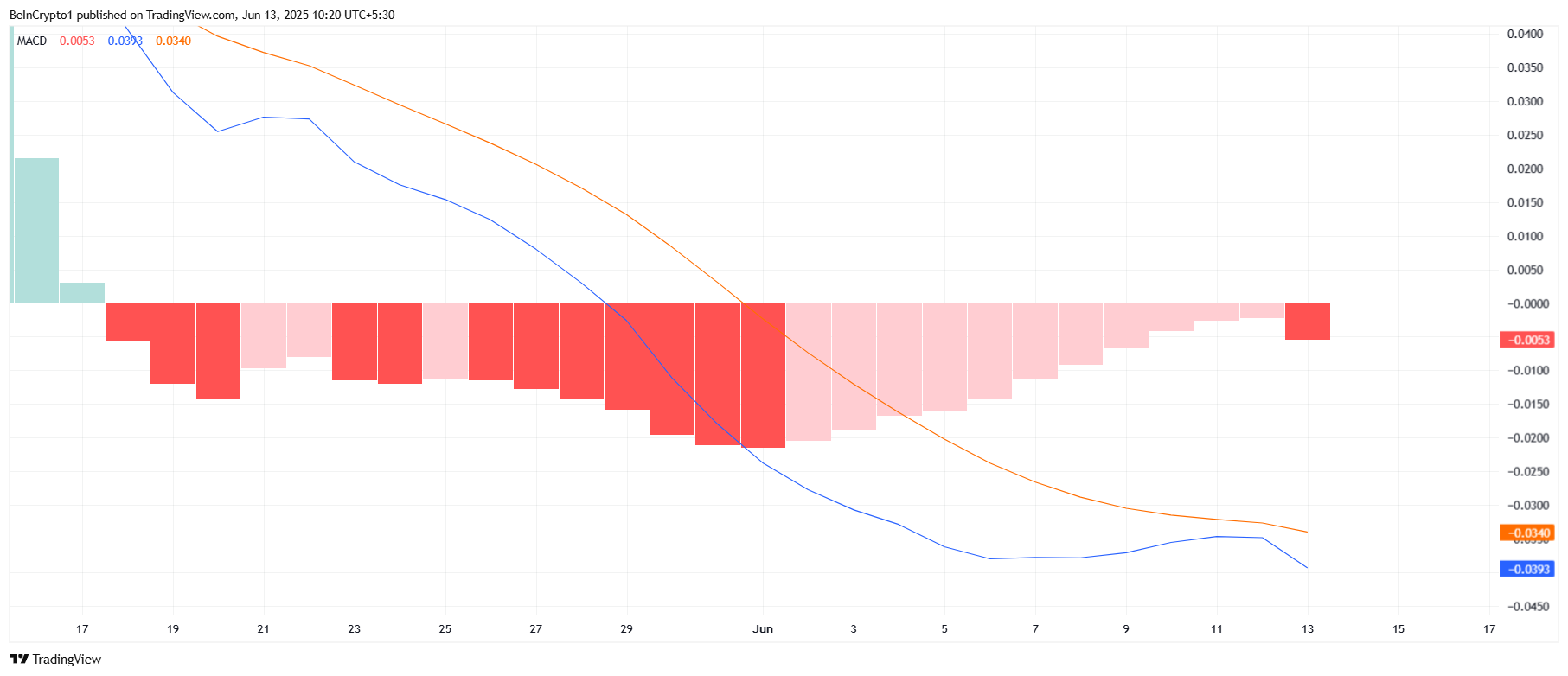 Pi Network MACD. Source:
TradingView
Pi Network MACD. Source:
TradingView
The broader market sentiment for Pi Network has also been significantly negative throughout this month. The weighted sentiment shows a decline in confidence from Pi holders, contributing to the ongoing downtrend. This lack of investor optimism could weigh heavily on Pi Network’s price as it continues to struggle with securing support levels.
The ongoing bearish sentiment from investors signals a lack of belief in the altcoin’s short-term recovery. This hesitation to hold or accumulate Pi further compounds the downward pressure.
 Pi Network Weighted Sentiment. Source:
Santiment
Pi Network Weighted Sentiment. Source:
Santiment
PI Price Saved From New Lows
At the time of writing, Pi Network’s price stands at $0.55, marking a 9.7% drop today. While this decline is notable, the intra-day low of $0.40 has caused the most concern. This drop represents a 35% fall and brought the price to its lowest point in the altcoin’s history.
The $0.40 all-time low was recorded in April. Despite some recovery, this dramatic drop triggered panic among investors. Pi is now facing further declines, with potential support at $0.51 and a worst-case scenario where the price could drop to $0.45, deepening the losses.
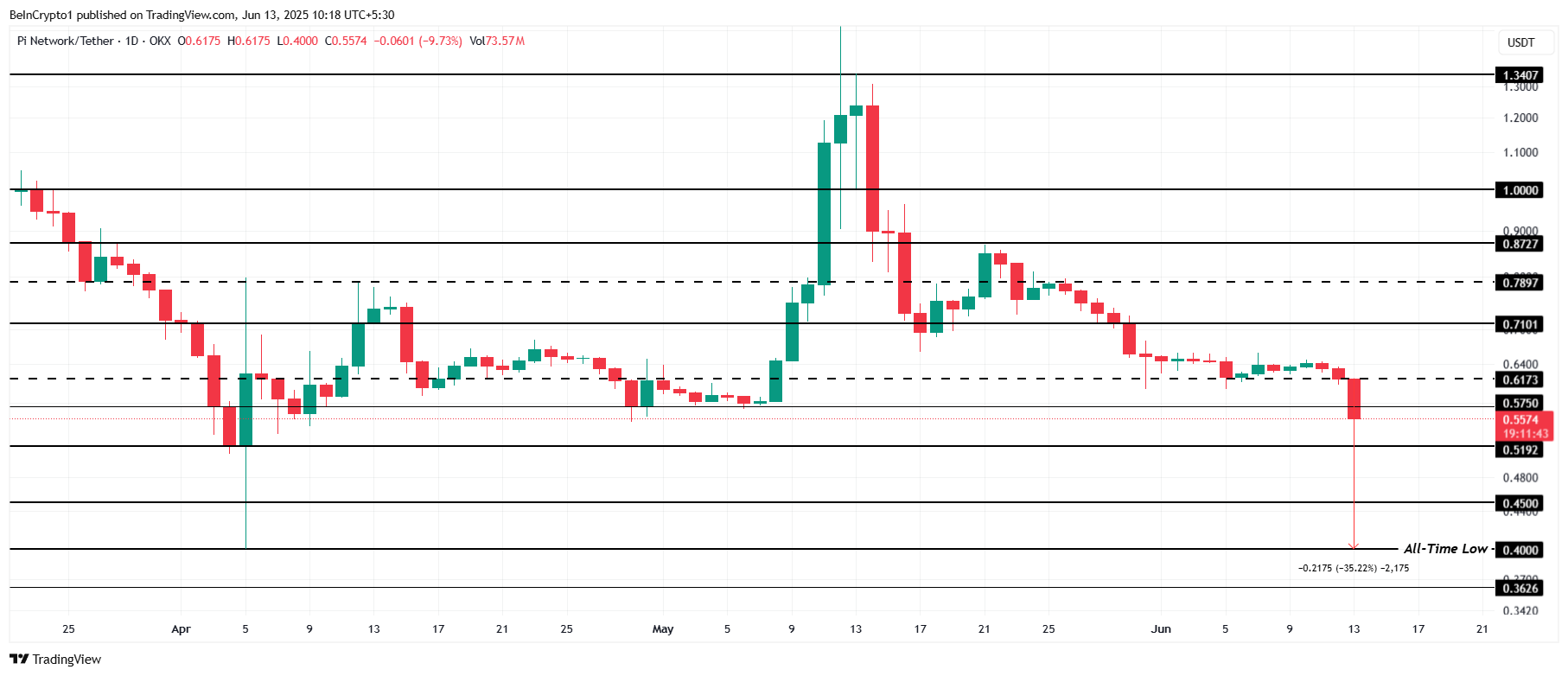 Pi Network Price Analysis. Source:
TradingView
Pi Network Price Analysis. Source:
TradingView
However, if investors decide to capitalize on the low price and accumulate PI, the altcoin may experience a price rebound. A successful bounce from current levels could push Pi back to $0.57 and eventually $0.61, effectively invalidating the bearish outlook and marking a potential shift in momentum.
Disclaimer: The content of this article solely reflects the author's opinion and does not represent the platform in any capacity. This article is not intended to serve as a reference for making investment decisions.
You may also like
Jensen Huang: Nvidia chip sales will double next year compared to this year, AI cannot be regulated like social media
Jensen Huang opposes applying social media regulations directly to AI, arguing that social media is a product, while AI is an underlying technology that supports other technologies and products. He believes regulation should target products, not the technology itself. He emphasizes rigorous testing and states that products should be withheld from release if they are not safe enough. "AI safety is of utmost importance."
What to buy after the Federal Reserve raises interest rates? Historically, US energy and technology stocks outperform while real estate lags. Goldman Sachs: The pace of rate hikes determines the US stock market.
U.S. stock performance in the 12 months after the first Federal Reserve rate hike: According to Jefferies, the energy sector led with an average return of 22.4%, followed by information technology at 15.4%. According to Charles Schwab, real estate underperformed the S&P 500 by 4.3%, making it the worst of the 11 sectors. Goldman Sachs states that the pace of rate hikes is the core variable affecting U.S. stocks; currently, if the 10-year U.S. Treasury yield rises by 50 basis points within a month, it will create "rapid rate hike" pressure.
Bank of America Ripple Report Fuels XRP Debate
Gold surges over 2%, US dollar retraces gains after Federal Reserve decision
Crypto prices
More


