
Huma Finance Unveils Tokenomics, Allocates 5% Airdrop

Huma Finance steps into the PayFi spotlight with bold tokenomics and a 5% HUMA token airdrop, despite mixed community reactions. Backed by major VC funding, the protocol targets real-world impact in crypto payments.
Huma Protocol, a platform in the emerging PayFi sector, has officially announced its tokenomics and Season 1 airdrop plan for the HUMA token.
The project has attracted attention from numerous venture capital firms, as the PayFi sector is considered highly promising. However, the current market context shows that retail investors pay less attention to traditional airdrop formats.
Huma Finance Airdrops 5% to Users
PayFi combines instant payments with decentralized finance (DeFi), using blockchain technology to enable fast, efficient, and cost-effective financial transactions.
Huma Protocol aims to lead this trend by integrating DeFi with real-world assets (RWA). The team designed the HUMA token to serve both utility and governance purposes, and encourage community participation to ensure long-term benefits for stakeholders, including users, liquidity providers (LPs), partners, and developers.
Huma Protocol revealed its Season 1 airdrop plan, allocating 5% of the total HUMA supply (500 million tokens) to loyal users. However, many have commented that this allocation seems quite low.
“5% for season 1 airdrop is too less,” Investor CryptoStalker said.
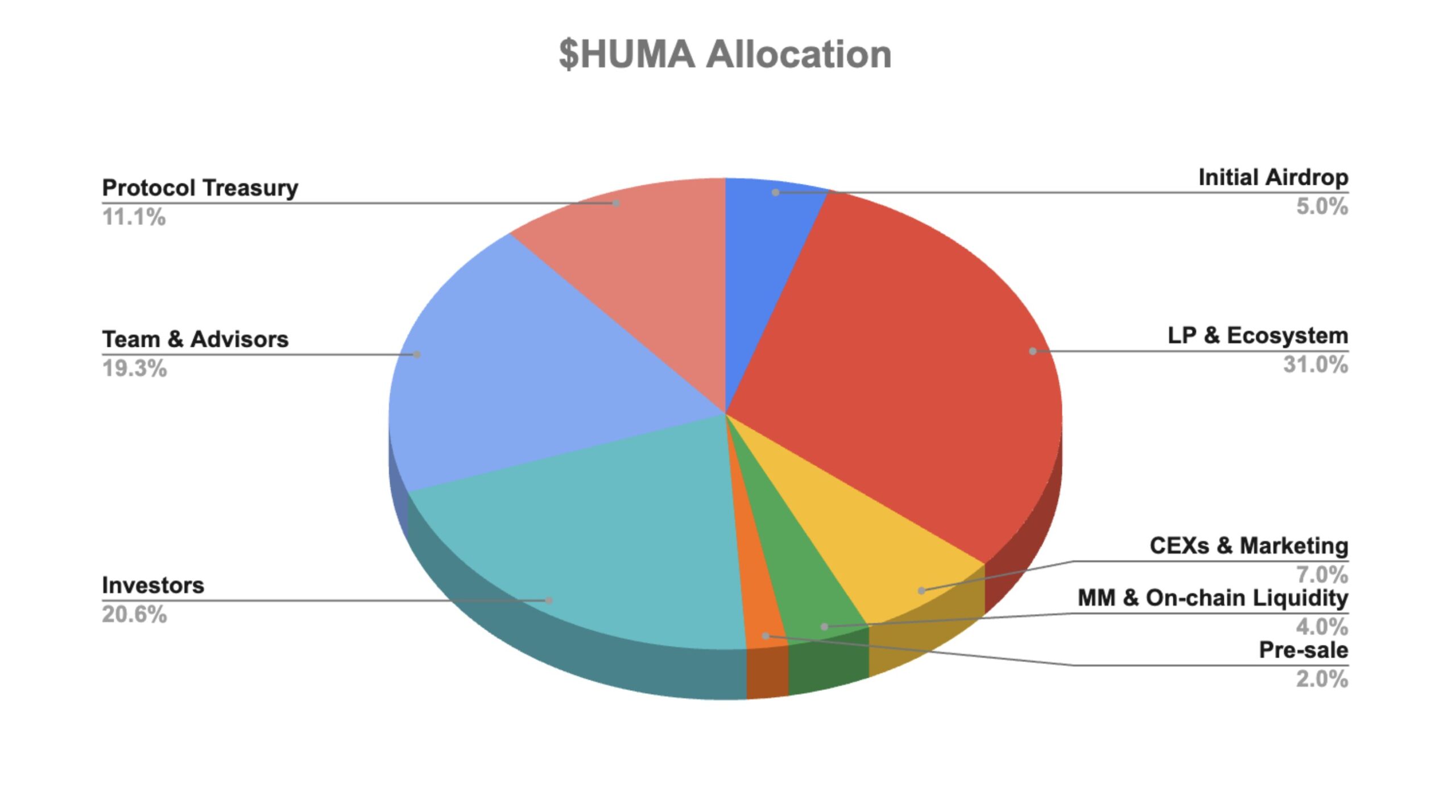 Huma Finance’s Tokenomics. Source:
Huma Finance.
Huma Finance’s Tokenomics. Source:
Huma Finance.
Despite the criticism, the Huma Foundation emphasized that this is just the beginning. The Foundation has planned a second airdrop, allocating 2.1% of the total supply, roughly three months after the token generation event (TGE).
Additionally, the total HUMA supply is capped at 10 billion tokens, and the initial circulating supply will be 17.33%.
Token distribution includes:
- 31% for liquidity providers and the ecosystem,
- 20.6% for investors,
- 19.3% for the team and advisors,
- 11.1% for the protocol treasury.
Furthermore, the release schedule will continue until the end of 2029. Tokens assigned to the team and investors will be locked for 12 months, followed by a three-year vesting period.
 HUMA Token Release Schedule. Source:
Huma Finance.
HUMA Token Release Schedule. Source:
Huma Finance.
Allocations for LPs and the ecosystem will decrease by 7% each quarter. These rates may be adjusted through protocol governance.
Huma Finance Faces Both Potential and Challenges
Huma Protocol is expanding as PayFi gains traction. As governments develop crypto- and stablecoin-friendly policies, crypto-based payments could emerge as a mainstream alternative to traditional systems.
“Web2 has a lot of problems, and a centralized payment network is one of them. Slow transactions, high charges, and no user control. But now there’s a solution. Huma Finance is the first PayFi network, which aims to accelerate global payments with instant access to liquidity anywhere and anytime.” Investor Niels remarked.
According to a Coingecko report referencing research from Mordor Intelligence, the global payment funding market is anticipated to reach $2.85 trillion in 2024 and grow to $4.78 trillion by 2029.
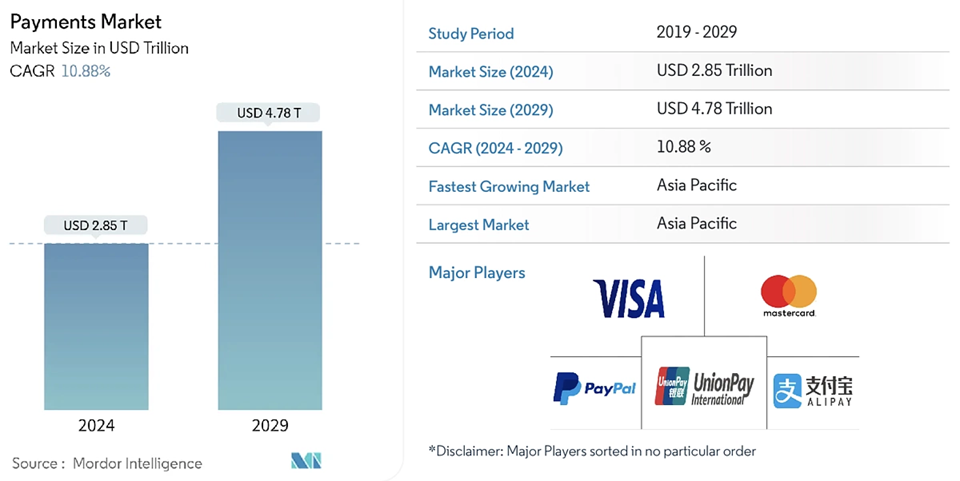 Payment Market Size Prediction. Source:
Mordor Intelligence
Payment Market Size Prediction. Source:
Mordor Intelligence
“This massive growth highlights the urgent need for scalable, efficient, and accessible financial infrastructure—exactly what PayFi aims to deliver,” the report noted.
Because of this, first movers like Huma Protocol enjoy a competitive advantage. The project has raised over $46 million from investors such as Haskey Capital and Circle.
However, current market conditions have failed to give Huma strong initial momentum. Low airdrop allocations and shifting user interest, driven by newer models like Binance Alpha, have made traditional airdrops less appealing.
Disclaimer: The content of this article solely reflects the author's opinion and does not represent the platform in any capacity. This article is not intended to serve as a reference for making investment decisions.
You may also like
Bending Spoons to Acquire Miro in $1.36 Billion Enterprise Deal
With the US midterm elections approaching, Wall Street bets on a divided Congress—will markets see a mild respite?
As the U.S. midterm elections approach, Wall Street is generally betting on a "divided Congress" scenario, with the Democratic Party taking back the House of Representatives and the Republican Party retaining the Senate. This is expected to limit radical policies and reduce uncertainty. Historical data shows that since 1950, when a divided Congress occurred under a Republican president, the average annual gain of U.S. stocks was 13.7%, higher than the 8.3% and 4.9% gains when either the Republican or Democratic Party controlled Congress alone. If the election results deviate from expectations, the market may still experience significant volatility.
Dogecoin falls 4% to $0.086 as leveraged long positions unwind
Famous US stock investor Eric Jackson joins Shanda Technology (SDA.US) Advisory Board to support the company's internationalization strategy and investor relations development
Eric Jackson, founder of EMJ Capital and renowned technology investor, has officially joined the company's advisory board.

Crypto prices
More


