
US Loses Perfect Credit Rating – How Will It Impact Bitcoin Price?

Bitcoin gains long-term bullish tailwinds from Moody’s historic U.S. downgrade, but short-term charts show indecision and key price resistance ahead.
Bitcoin (BTC) is facing a mix of bullish signals and short-term uncertainty. Moody’s recent downgrade of the US credit rating has heightened long-term bullish sentiment around BTC, reinforcing its role as a hedge against rising debt and fiscal uncertainty.
Meanwhile, on-chain data shows a declining supply of Bitcoin on exchanges, suggesting investors are leaning toward holding rather than selling. Despite these bullish fundamentals, BTC remains in a short-term consolidation phase, with price action needing fresh momentum to break higher.
Moody’s Downgrade Ends US Century-Long Perfect Credit Rating Streak
Moody’s has downgraded the US credit rating from Aaa to Aa1, removing the country’s last perfect score among major credit agencies.
It’s the first time in over a century that the US lacks a top-tier rating from all three, following downgrades by S&P in 2011 and Fitch in 2023. Rising deficits, mounting interest costs, and the absence of credible fiscal reforms drove the decision.
 US Total Public Debt. Source:
FRED.
US Total Public Debt. Source:
FRED.
Markets reacted quickly—Treasury yields climbed, and equity futures slipped. The White House dismissed the downgrade as politically driven, with lawmakers still negotiating a $3.8 trillion tax and spending package.
Moody’s also warned that extending Trump-era tax cuts could deepen deficits, pushing them toward 9% of GDP by 2035—a scenario that may strengthen the appeal of crypto, especially Bitcoin, as a hedge against long-term fiscal instability.
Bitcoin Consolidates: Falling Exchange Supply Meets Ichimoku Indecision
After briefly rising from 1.42 million to 1.43 million between May 2 and May 7, Bitcoin’s supply on exchanges is falling once again.
This short uptick followed a more significant decline between April 17 and May 2, when the exchange supply dropped from 1.47 million to 1.42 million. Now, the metric has resumed its downward trend, currently sitting at 1.41 million BTC.
The supply of Bitcoin on exchanges is a key market indicator. When more BTC is held on exchanges, it often signals potential selling pressure, which can be bearish.
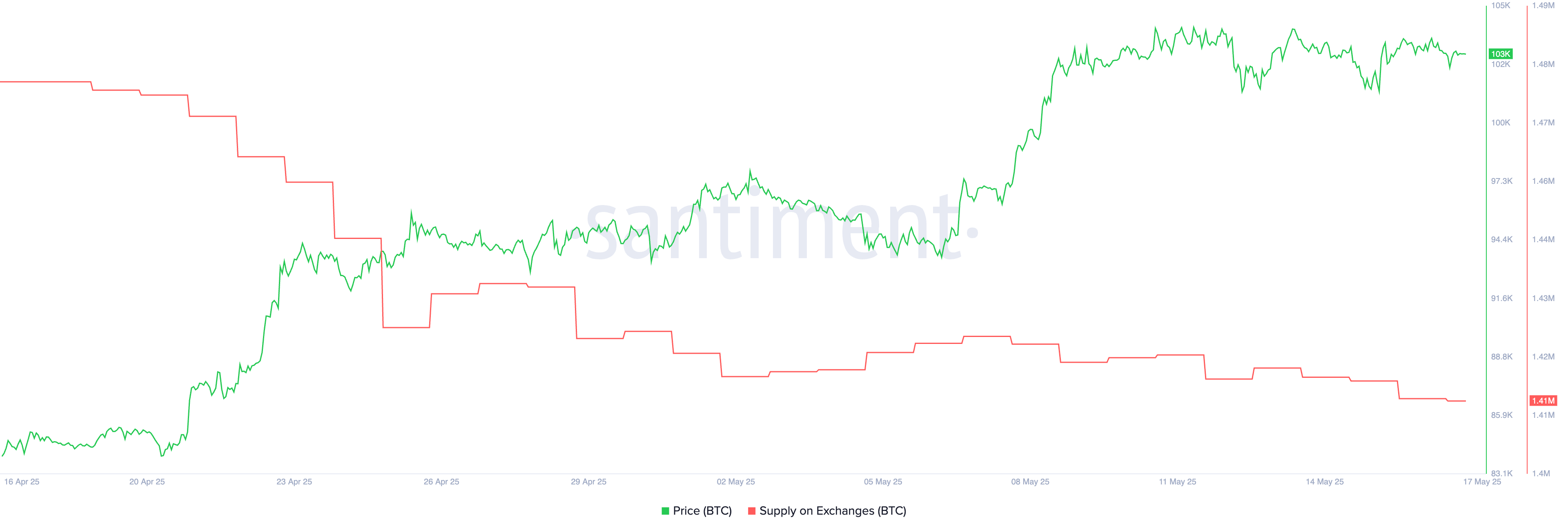 BTC Supply on Exchanges. Source:
Santiment.
BTC Supply on Exchanges. Source:
Santiment.
Conversely, a decline in exchange balances suggests holders are moving their coins to cold storage, reducing near-term sell pressure—a bullish signal. The current drop reinforces the idea that investors may be preparing to hold rather than sell.
The Ichimoku Cloud chart for Bitcoin shows a period of consolidation with neutral-to-slightly-bearish signals. The price is currently sitting right around the flat Kijun-sen (red line), indicating a lack of strong momentum in either direction.
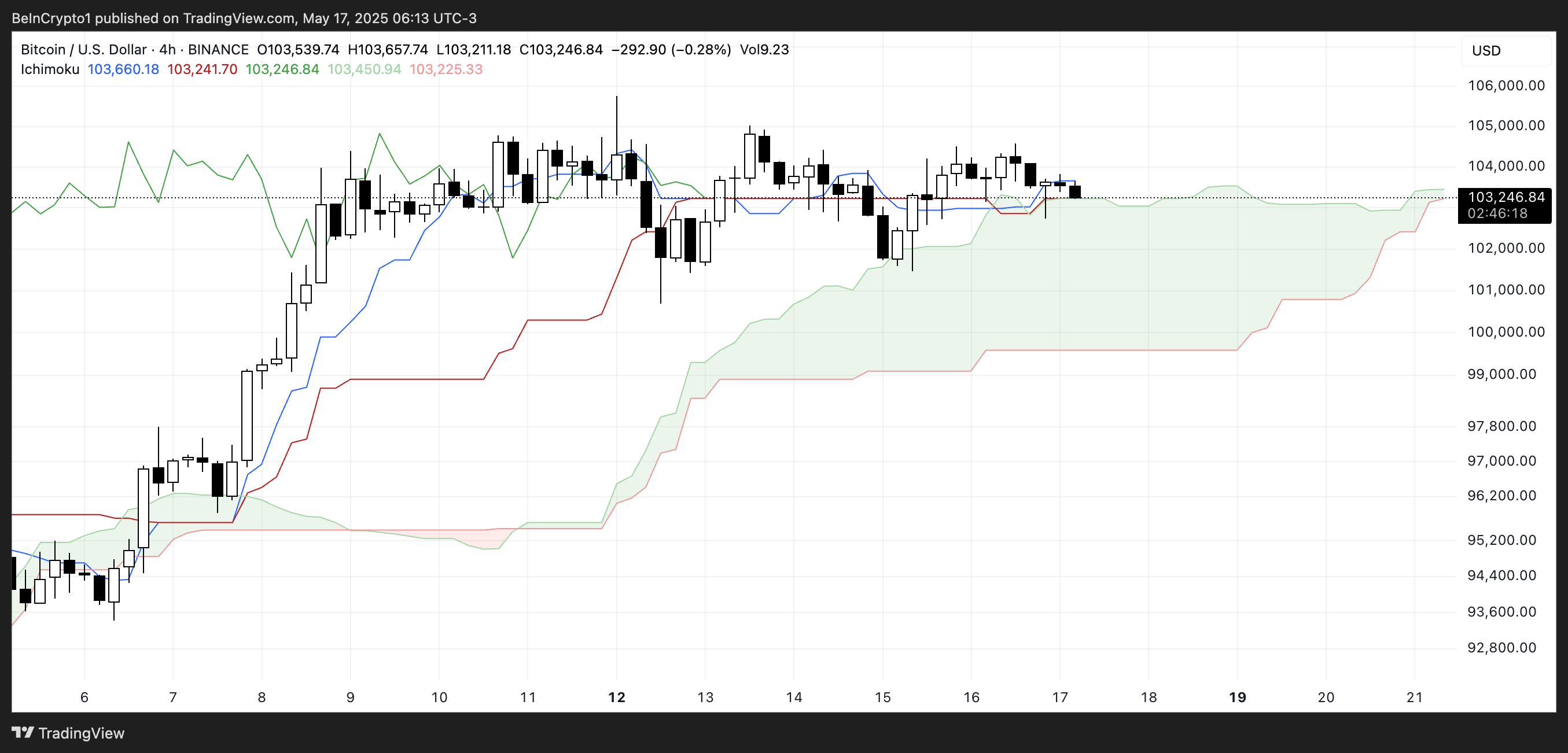 BTC Ichimoku Cloud. Source:
TradingView.
BTC Ichimoku Cloud. Source:
TradingView.
The Tenkan-sen (blue line) is also flat and closely tracking the price, reinforcing this sideways movement and short-term indecision.
The Senkou Span A and B lines (which form the green cloud) are also relatively flat, suggesting equilibrium in the market. The price is moving near the top edge of the cloud, which typically acts as support. However, since the cloud is not expanding and has a flat structure, there is no strong trend confirmation at the moment.
The Chikou Span (green lagging line) is slightly above the price candles, hinting at mild bullish bias, but overall, the chart signals indecision and the need for a breakout to confirm the next direction.
Moody’s Downgrade Strengthens Bitcoin’s Long-Term Bull Case Amid Short-Term Consolidation
The U.S. losing its last perfect credit rating after Moody’s downgrade could be a major long-term catalyst for Bitcoin.
While it may not trigger immediate price action, the downgrade reinforces the narrative of growing fiscal instability and debt concerns—conditions that strengthen Bitcoin’s appeal as a decentralized, hard-capped asset.
In the medium to long term, more investors may turn to BTC as a hedge against sovereign risk and weakening trust in traditional financial systems.
 BTC Price Analysis. Source:
TradingView.
BTC Price Analysis. Source:
TradingView.
In the short term, however, Bitcoin price remains in a consolidation phase after breaking above $100,000. Its EMA lines are still bullish, with shorter-term averages above longer-term ones, but they are flattening out.
For bullish momentum to resume, BTC would need to push past the $105,755 resistance.
On the downside, holding above the $100,694 support is crucial—losing it could open the door for declines toward $98,002 and potentially $93,422.
Disclaimer: The content of this article solely reflects the author's opinion and does not represent the platform in any capacity. This article is not intended to serve as a reference for making investment decisions.
You may also like
Arthur Hayes forecasts $1 million Bitcoin by 2030, links target to AI debt risks
AI valuation divergence intensifies! Anthropic IPO: Enthusiastic Silicon Valley bids $2 trillion, while a cautious Wall Street only recognizes $1.5 trillion
The valuation debate surrounding Anthropic’s IPO is exposing a pricing gap between Silicon Valley and Wall Street. Silicon Valley venture capitalists are still betting heavily on AI growth at high valuations, with some investment banks discussing an early valuation of around $2 trillion. Meanwhile, Wall Street public market institutions are focusing on high interest rates, capital expenditure on computing power, and ongoing financing pressures, and are leaning toward a $1.5 trillion valuation.
Micron (MU.US) Q4 earnings call: Management declares "No sign of supply-demand balance," 75% of shipments for next year already locked in; 2028 expected to be tighter than 2027
Micron Technology (MU.US) management expressed optimism during the Q4 earnings call, stating that AI-driven memory demand remains strong and that supply and demand will remain tight in 2027 and 2028.
After experiencing Muse, I cleared out my Airbnb holdings
A senior analyst heavily invested in Airbnb decided to sell all his Airbnb holdings just 10 days after experiencing Meta AI's Muse app. He believes that Muse not only understands his preferences but also helps him bypass Airbnb to book accommodations directly, at 60% lower prices. As AI agents begin to compare prices, cancel, and rebook on your behalf, the "traffic moat" that internet platforms depend on is under threat, and the era of "proactive e-commerce" may be dawning.
Crypto prices
More


