
Investors Pour Into Bitcoin ETFs for 8th Straight Day | ETF News

Institutional investors continued their bullish streak with eight consecutive days of inflows into Bitcoin ETFs, led by BlackRock’s IBIT. Despite a dip in futures open interest, sentiment remains positive as funding rates stay in bullish territory.
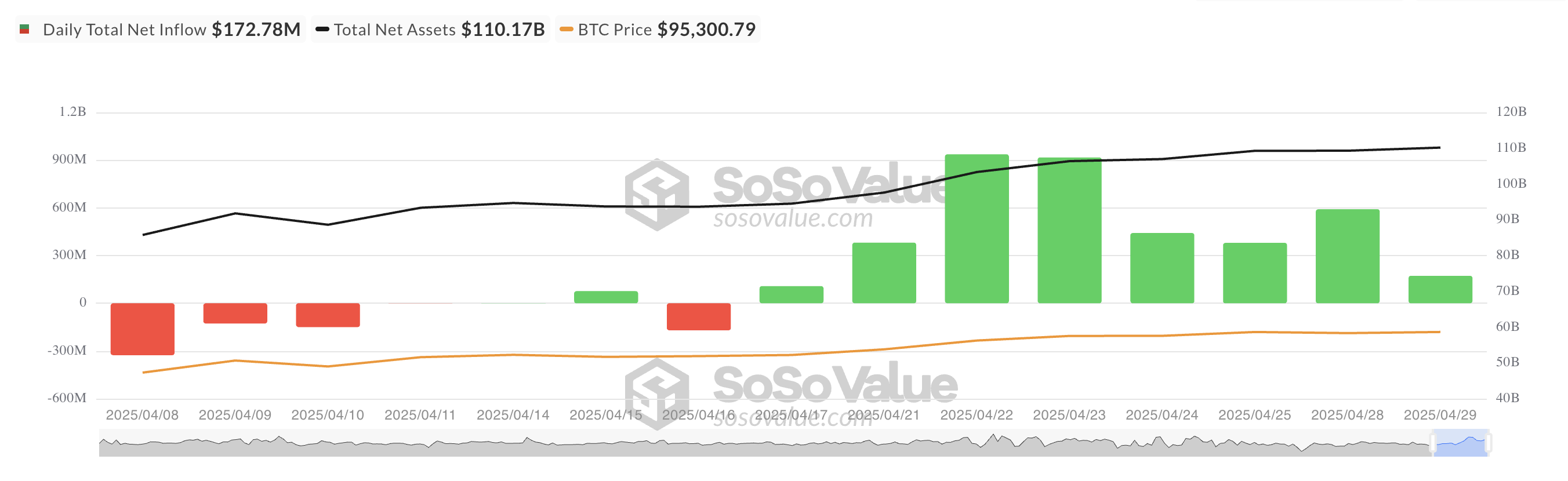
On Tuesday, institutional investors continued to pour capital into spot Bitcoin ETFs, marking the eighth consecutive day of inflows.
Total net inflows across all US-listed Bitcoin ETFs exceeded $170 million for the day, reinforcing the bullish sentiment that has gripped the market since last week.
Bitcoin ETFs Log 8th Straight Day of Inflows
Yesterday, BTC-backed funds posted another net inflow, totaling $172.78 million. This signaled sustained confidence in the asset class.
 Total Bitcoin Spot ETF Net Inflow. Source:
SosoValue
Total Bitcoin Spot ETF Net Inflow. Source:
SosoValue
BlackRock’s iShares Bitcoin Trust (IBIT) once again led the pack, recording the highest daily inflow among all issuers. On Tuesday, the fund recorded a daily net inflow of $216.73 million, bringing its total historical net inflow to $42.39 billion.
IBIT has consistently dominated in recent sessions, reflecting BlackRock’s influence in the crypto ETF space and sustained institutional trust in its offerings.
Meanwhile, Bitwise’s spot Bitcoin ETF (BITB) recorded the highest net outflow among all issuers on Tuesday, with $24.39 million exiting the fund. Nevertheless, BITB’s total historical net inflows remain strong at $2.05 billion.
Leverage Cools in the Bitcoin Market
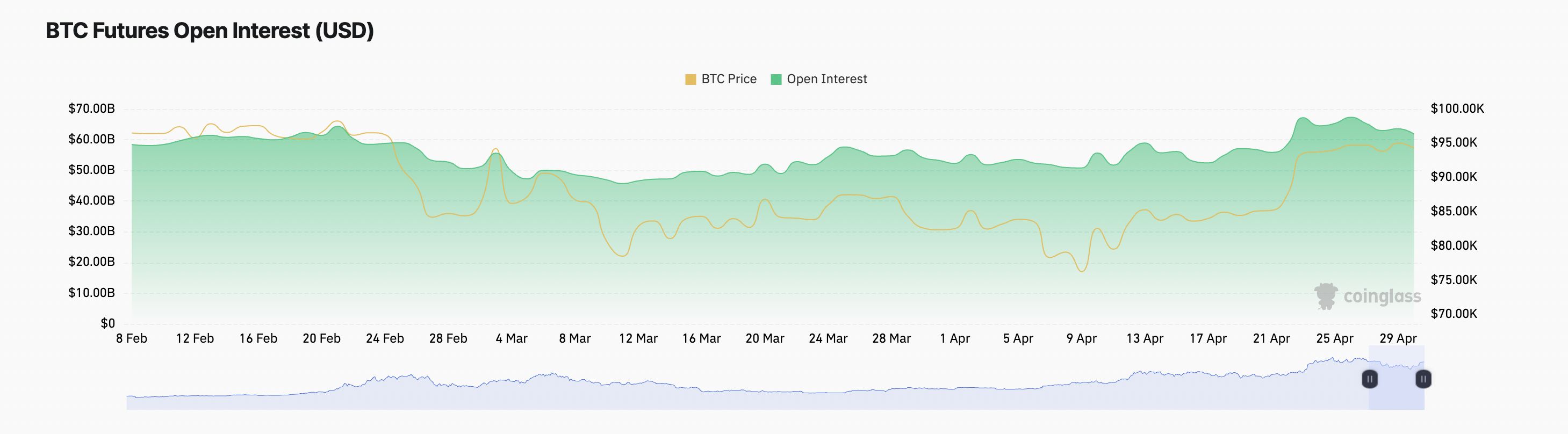
Open interest (OI) in the Bitcoin futures market has seen a modest decline today. This suggests a degree of cooling among leveraged positions, as some traders are closing out positions.
 BTC Futures Open Interest. Source:
Coinglass
BTC Futures Open Interest. Source:
Coinglass
It stands at $61.81 billion at press time, plunging by 3% over the past 24 hours. During that period, BTC’s price noted a 1% uptick.
When an asset’s price rises while open interest falls, traders take profits or de-risk, suggesting caution despite the uptick. This trend points to a lack of conviction in BTC’s rally, with fewer participants willing to take on new leveraged positions.
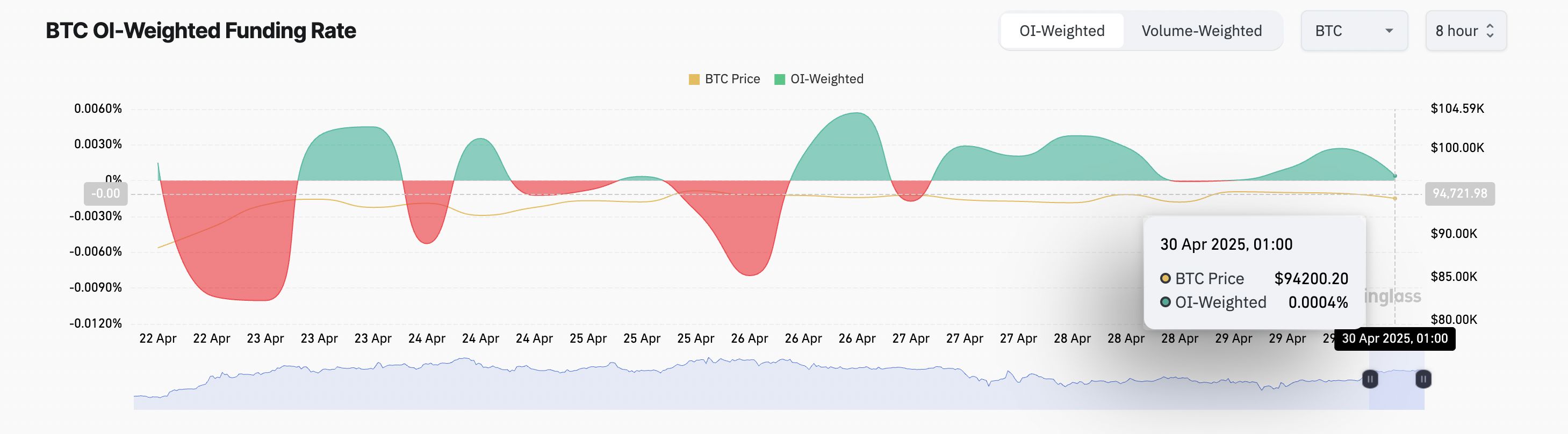
However, broader market sentiment remains optimistic. BTC’s funding rate is currently at 0.004%, indicating that long positions are still willing to pay to maintain leverage.
 BTC Funding Rate. Source:
Coinglass
BTC Funding Rate. Source:
Coinglass
The funding rate is a periodic payment between long and short traders in perpetual futures contracts, used to keep the contract price aligned with the spot market. When the funding rate is positive, longs are paying shorts, indicating that more traders are betting on the price going up, a sign of bullish market sentiment.
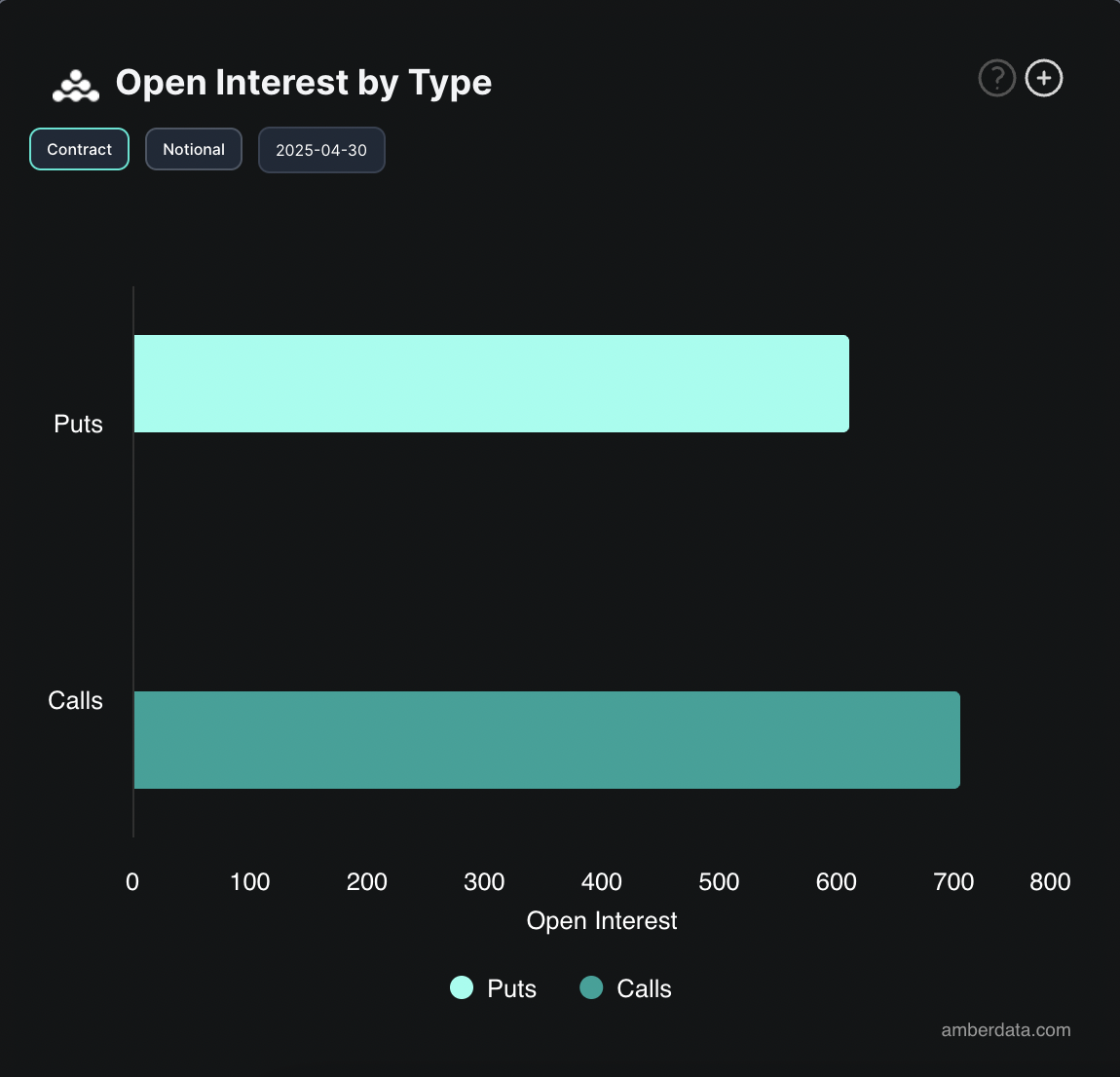
Moreover, the increase in call option volume suggests that traders are positioning for further upside in the coin’s price.
 Bitcoin Options Open Interest. Source:
Deribit
Bitcoin Options Open Interest. Source:
Deribit
While derivatives activity shows minor signs of uncertainty, the persistent inflows into spot Bitcoin ETFs point to a market still leaning bullish in the near term.
Disclaimer: The content of this article solely reflects the author's opinion and does not represent the platform in any capacity. This article is not intended to serve as a reference for making investment decisions.
You may also like
Zcash holders vote 99.9% in favor of 25-second block times, approve fast NU7 rollout
AI data center layout draws investor attention! Qualcomm (QCOM.US) stock price climbs to a two-month high
As investors increasingly favor Qualcomm's strategy of entering the artificial intelligence (AI) data center infrastructure sector, the chip manufacturer is receiving more attention.

HBAR trades below 20-day SMA as Hedera expands AI integration
The 5% Era of US Treasury Bonds Arrives: No Short-term "Explosions", but Pressure May Appear in 12 to 18 Months
The real impact of high interest rates lies in their duration. A large amount of debt issued at 2%-3% in 2020-2021 is now facing the pressure of being rolled over at a cost of 6%-8%, and this shock will concentrate and erupt in 12-18 months. The US housing market will bear the brunt, while commercial real estate, highly leveraged companies, and private equity-backed firms are also at serious risk. If high rates persist for more than half a year, the market’s tolerance will be completely exhausted.
Crypto prices
More


