
Cardano Whales Shed $69 Million ADA Ahead of This Week’s Token Unlock

Cardano whales offloaded $69M ADA ahead of December’s token unlock, causing volatility. Could ADA dip to $0.92, or rebound to $1.33?
Cardano (ADA) whales, who have been instrumental in driving the cryptocurrency’s price by 270% in the last 30 days, have now sold a bunch of tokens. This sell-off comes ahead of this week’s token unlock, which market participants expect will cause volatility.
As of this writing, ADA trades at $1.23. Will this sell-off draw the price down further?
Cardano Key Holders Offload Some Tokens
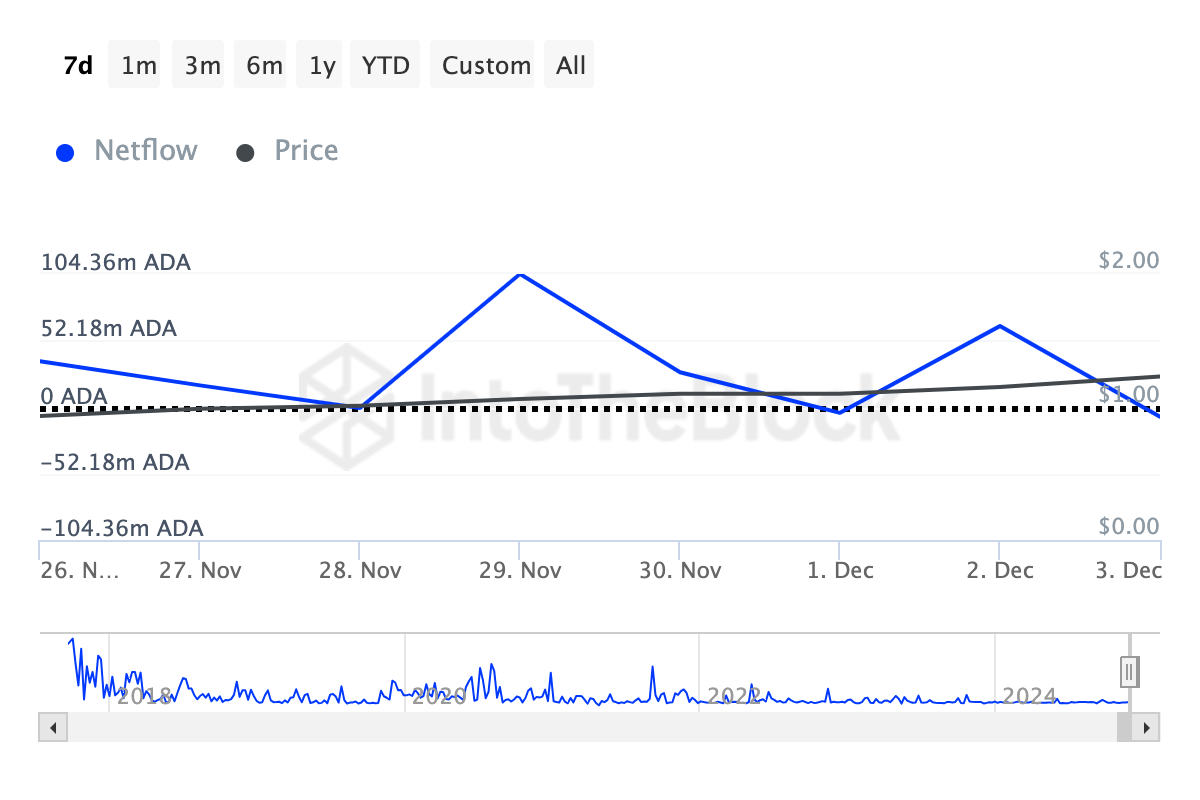
On Monday, December 2, Cardano’s large holders’ netflow reached 63.58 million ADA, reflecting a strong buying trend among whales. The netflow metric tracks the difference between tokens bought and sold by these key players. A rising netflow indicates accumulation, while a decline indicates selling pressure.
As of now, the netflow has plunged to 7.62 million ADA, according to IntoTheBlock, suggesting that whales offloaded 55.96 million ADA — either to take profits or rebalance their portfolios. At Cardano’s current price, this sell-off amounts to a staggering $69 million.
From BeInCrypto’s observation, the recent sell-off may be tied to the upcoming token unlock on December 6.
 Cardano Large Holders Netflow. Source:
IntoTheBlock
Cardano Large Holders Netflow. Source:
IntoTheBlock
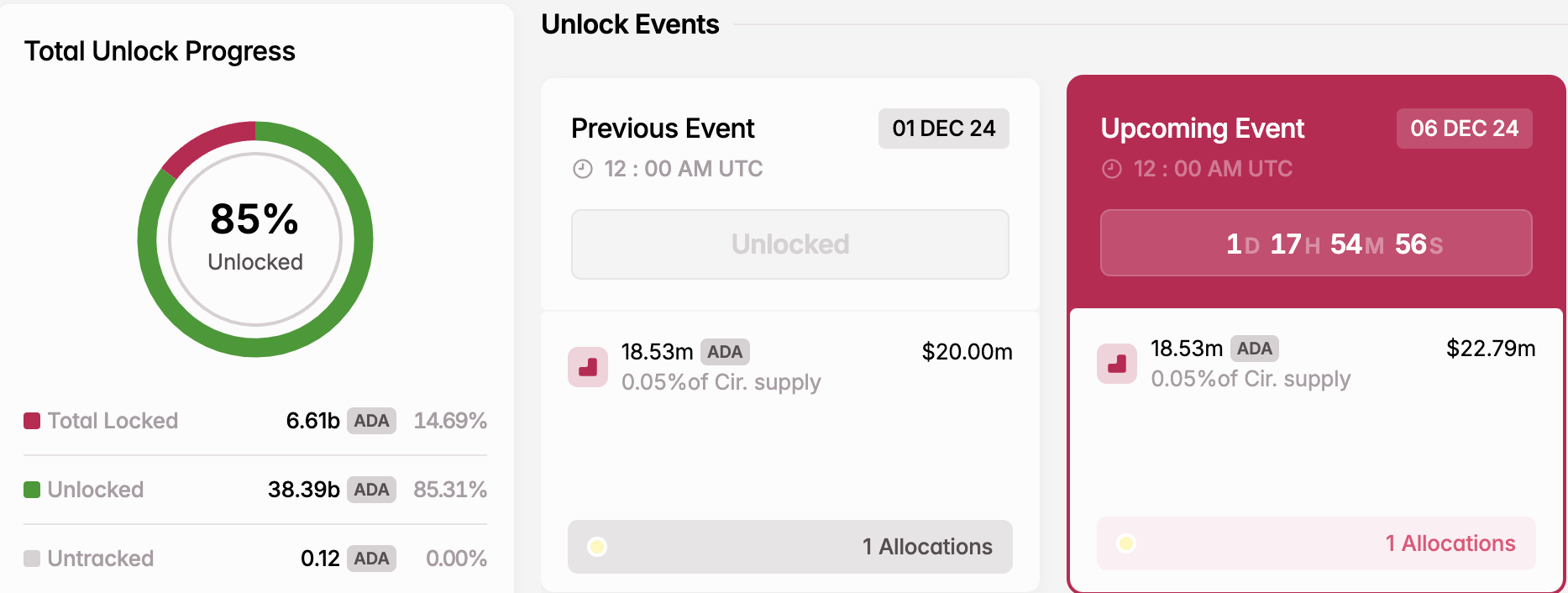
Token unlocks, which release previously restricted tokens into circulation, often drive significant price movements by altering supply and demand dynamics.
According to Tokenomist (formerly Token Unlocks), Cardano is set to release 18.53 million ADA on that date, valued at $22.79 million. This anticipated supply shock could introduce volatility, potentially hindering the altcoin’s ability to sustain an uptrend during this period.
 Cardano Token Unlock.Source:
Tokenomist
Cardano Token Unlock.Source:
Tokenomist
ADA Price Prediction: Overbought, Retracement Likely
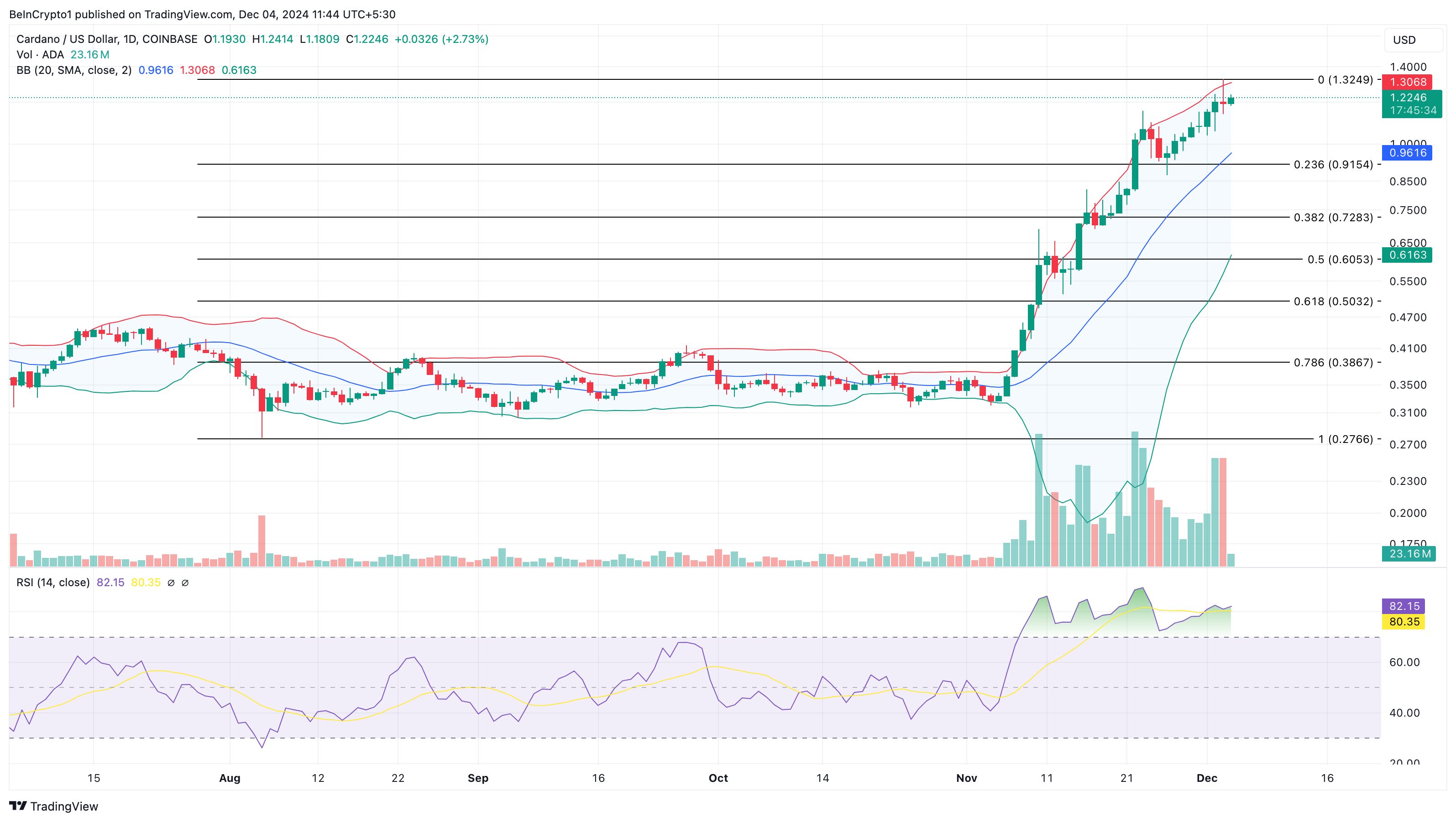
On the daily chart, Cardano’s Bollinger Bands (BB) have widened, indicating heightened volatility. The BB also highlights whether an asset is overbought or oversold.
When the price touches the upper band, it signals an overbought condition, while contact with the lower band indicates oversold territory. Therefore, the image below confirms the thesis that ADA is overbought.
The Relative Strength Index (RSI), which measures momentum, also aligns with the bias. When the RSI reading is above 70.00, it is overbought. On the other hand, when the reading is below 30.00, it is oversold.
 Cardano Daily Analysis. Source:
TradingView
Cardano Daily Analysis. Source:
TradingView
At press time, Cardano’s RSI stands at 82.15, firmly placing ADA in overbought territory. Given this condition, a price correction to $0.92 could be next. However, if Cardano whales resume accumulation, the trend could shift, potentially pushing the price above $1.33
Disclaimer: The content of this article solely reflects the author's opinion and does not represent the platform in any capacity. This article is not intended to serve as a reference for making investment decisions.
You may also like
NVIDIA ignites a new Wall Street expectation: $1 trillion revenue sprint for FY2028?
Nvidia's latest financial report has once again shocked the market, with management forecasting a revenue increase of over 70% for fiscal year 2028, far exceeding Wall Street's consensus estimate of 45%. Institutions such as JPMorgan, Goldman Sachs, and Bernstein are unanimously bullish, and some analysts boldly predict that reaching $1 trillion in revenue for fiscal year 2029 is "not impossible." With mass production of the next-generation chip platform Vera Rubin imminent, accelerating demand combined with supply constraints suggests that the current guidance may be a conservative figure.
Tron Inc. adds 147,969 TRX to treasury as TRX targets resistance at $0.3442
"Federal Reserve Communications News Agency": History Repeats Itself—In the Face of War, Bagehot Tests the "Boundaries Between the Federal Reserve and the Treasury"
Nick Timiraos from "Fed Communications Agency" believes that Bessent’s announcement to at least double the repurchase of long-term Treasury bonds aims to lower long-term yields, which have reached 19-year highs; this move comes at a time when the Federal Reserve may need to tighten financial conditions. If the intervention succeeds, it will prompt more FOMC officials to favor a rate hike. Coupled with Bessent's previous interventions in the Japanese yen, personnel and monetary policy at the Atlanta Fed, the historical boundaries between the Treasury Department and the Federal Reserve are being tested from multiple directions.
Suspicions arise over "AI Central Bank" or "Balance Sheet as a Service"? Nvidia halts "Revenue Sharing for Financing" model
Nvidia's "AI Computing Power Partnership Program" was halted less than two months after its launch, with antitrust concerns being one of the triggers. Meanwhile, Nvidia disclosed for the first time its massive off-balance-sheet commitments totaling $530.5 billion. Morgan Stanley warned that the "circular financing" model is introducing significant and opaque tail risks. CDS quotes soared to 83 basis points, doubling the historical average — Wall Street is voting with prices: Is Nvidia's balance sheet a moat or a liability?
Crypto prices
More


